

ICONLOOP Consortium and Gangwon Province Begin Pilot Operation of the Blockchain-Based Gangwon Chronic Disease Integrated Management Platform
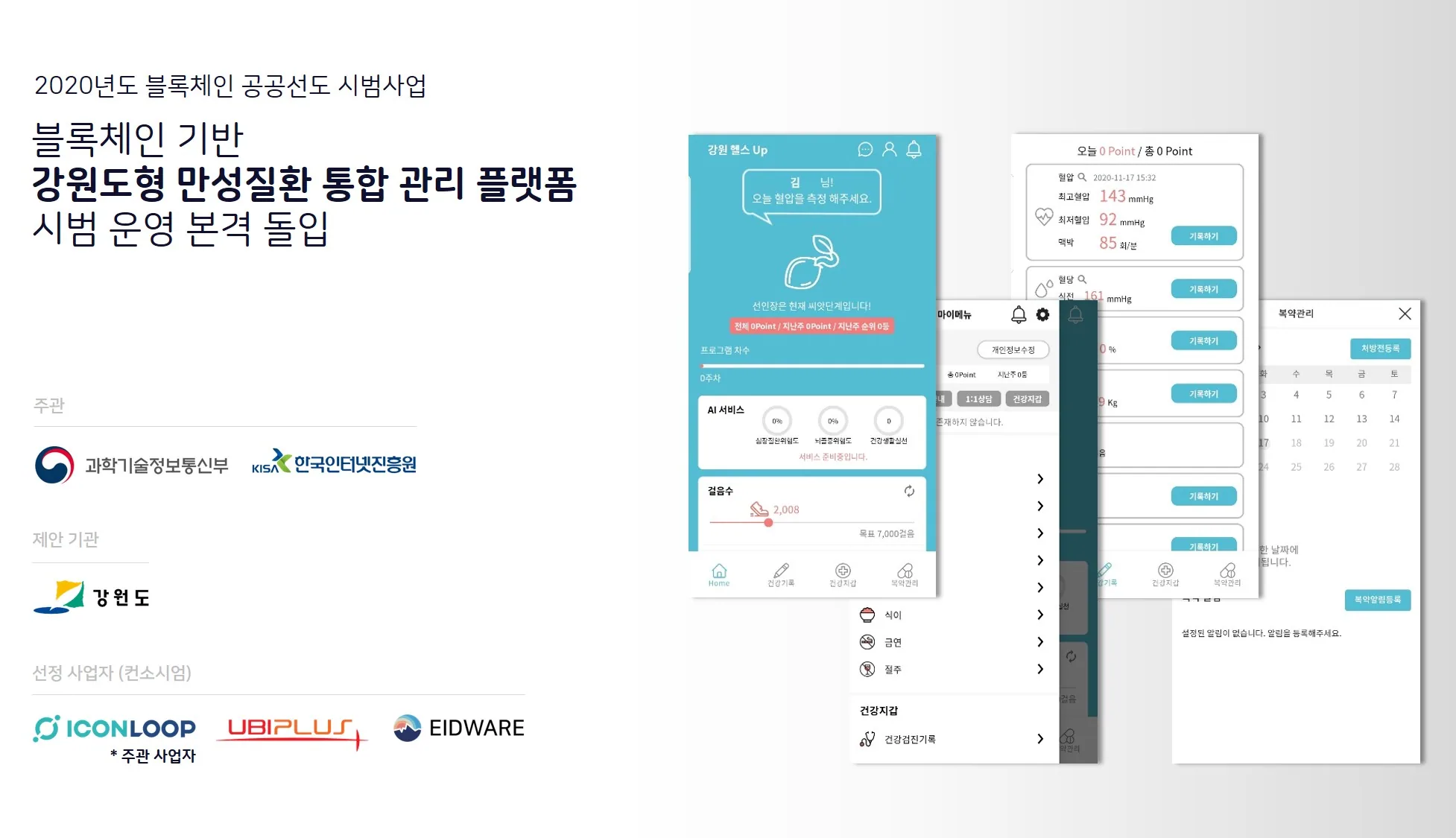
The platform project is the healthcare entry among the ten tasks selected for the 2020 Blockchain Public Sector Pilot Program, run by the Ministry of Science and ICT and the Korea Internet & Security Agency (KISA). As lead contractor, ICONLOOP formed a consortium with Ubiplus and Edware and has been developing the technology for the blockchain-based chronic disease integrated management platform.
The pilot operation runs for roughly four weeks, from November 9 to December 4, with 100 Gangwon residents living with chronic conditions who are registered at the Gaesu and Geomun primary health care posts in Pyeongchang. The 100 participants selected have been supplied with four types of IoMT (medical IoT) devices for measuring biometric data — a blood pressure monitor, a blood glucose meter, a scale, and a smart band (activity tracker) — and trained in how to use the app, and the pilot is now under way.
Based on AI analysis and prediction applied to the biometric data collected, participants receive personalized self-care services specialized in cardio-cerebrovascular conditions, including health and lifestyle information, institutional feedback, and coaching. Records of what is provided are managed more transparently and securely on the blockchain.
The Gangwon chronic disease integrated management platform is built on DID (Decentralized ID) technology for residents with chronic conditions in Gangwon Province, who face particular difficulty given the region's high proportion of elderly residents and the relatively low access to medical care imposed by its geography. It gives patients the right to self-determination over their personal information — direct management and control of ownership of their own data — and the right to data portability, allowing them to permit third parties to hold and manage their information. In doing so, it lays a foundation for MyData, a concept that has been drawing sustained attention.
To use the platform, users log in and verify their identity through Zzeung, ICONLOOP's DID-based identity verification service. A verifiable credential (VC) attesting that the holder is registered for chronic disease management is issued as a DID, so eligibility is verified when the management service is used and only the patient concerned can receive the appropriate services.
In addition, whereas submitting one's own data to a third-party institution used to be difficult because that data was tied to a particular institution, the platform lets users manage and control their data directly once they authenticate via DID. In other words, by consenting through the DID they have been issued to the provision of personal information to a third-party institution, users can submit their stored personal health data to that institution.
"Once the DID infrastructure is in place through this pilot operation, we can look forward to expansion into a range of areas beyond healthcare — into finance and other fields, for resident identity verification, credential verification, and more," said ICONLOOP CEO JH Kim. "ICONLOOP will continue to do its utmost, working with many institutions, so that sovereignty over data returns to the individual."
Zzeung, ICONLOOP's DID identity verification service providing a range of verifications including real-name, visit, and credential authentication, is broadening its reach: after becoming the first in Korea to apply DID to financial-sector real-name verification with Shinhan Bank, it now extends to the blockchain-based Gangwon chronic disease integrated management platform and Jeju Safe Code.
###