

SBI VC Trade in Japan has announced a lending service built on JPYSC, a yen-denominated stablecoin.
Applications open July 16, 2026, and lending itself begins July 23. The first round is offered at a 12-week term with a fee rate of roughly 3% per year.
At a glance, it reads like a simple headline: you can now earn a return on a yen stablecoin.
But from the perspective of digital finance infrastructure, the more important point sits elsewhere.
This case is a signal that stablecoins are starting to move beyond a pure payment instrument and into a financial operating structure — one that requires custody, lending, return, risk disclosure, audit, and control.

On July 13, 2026, SBI VC Trade announced it would launch a lending service for JPYSC, a trust-type yen stablecoin issued in Japan. The structure is straightforward: a user lends the JPYSC they hold to SBI VC Trade for a set period, and at maturity receives the same quantity of JPYSC back plus a fee.
The key terms confirmed in the official announcement are as follows.
- Applications open: July 16, 2026
- Lending begins: July 23, 2026
- First round terms: 12-week term, roughly 3% per year
- Expected ordinary terms: 12-week term, roughly 1–3% per year
- Return method: the lent JPYSC plus the fee, returned in JPYSC
- Early termination: not permitted in principle
What matters here is not the yield number. The part worth studying is the risk disclosure the official announcement carries alongside it.
The thing to watch is the structure, not the yield
SBI VC Trade states explicitly that this JPYSC lending is not a yen deposit and is not covered by deposit insurance.
Because the lent JPYSC is structured as a loan from the user to the exchange, disposals such as selling, transferring, or pledging as collateral are restricted for the duration of the loan.
The official PDF contains an even more consequential sentence.
JPYSC lent to SBI VC Trade is not subject to segregated management under the Payment Services Act, and if the company goes bankrupt there is a risk that some or all of it will not be returned.
In other words, this service is not simply a story about interest accruing on a stablecoin.
A set of questions follows for anyone participating.
Under what legal structure is the JPYSC I have handed over managed?
How are disposal rights restricted during the loan period?
How are situations like exchange insolvency, a liquidity shortfall, or a halt in subscriptions disclosed?
How can fee calculations and return records be verified?
How do user identification, suspicious transaction monitoring, and tax and accounting treatment connect to all of this?
These questions are precisely the operating layer a stablecoin needs once it enters real-world financial products.
From payments to financial products — the question about stablecoins is changing

Until now, the stablecoin conversation has largely stayed within three questions.
- First, who is allowed to issue.
- Second, how reserve assets are held.
- Third, whether it can be used for payments or remittance.
- SBI's JPYSC lending pushes the question one level deeper.
- Now it is: within what financial services can an issued stablecoin actually be operated?
- Once you reach this stage, issuance technology alone is not enough.
- Loan contracts, maturities, returns, fees, user disclosures, asset management, suspicious transaction detection, and auditable records all have to be there together.
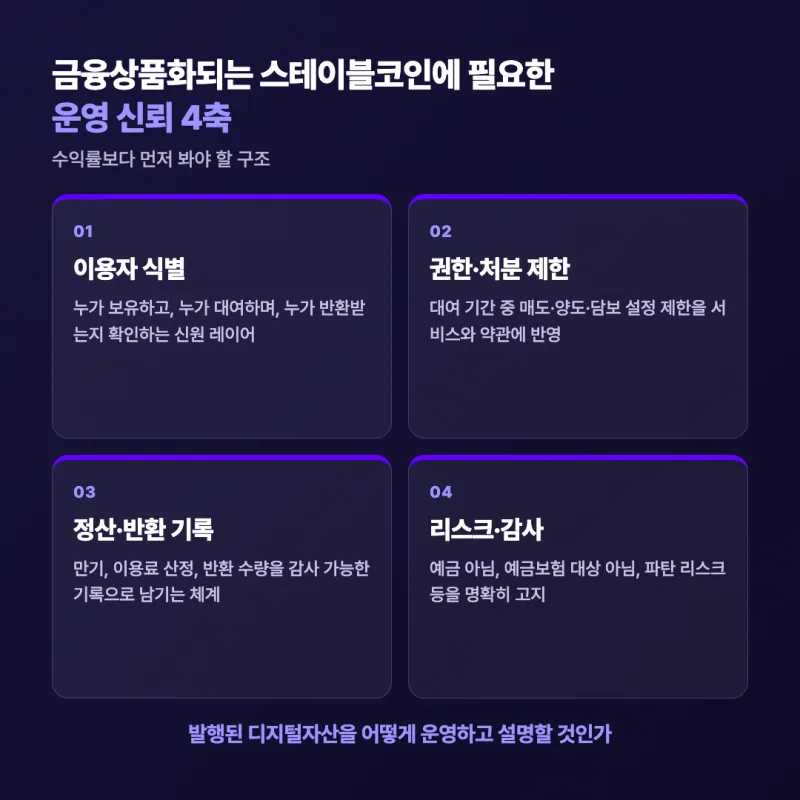
Especially when a digital payment instrument pegged 1:1 to fiat — like a yen stablecoin — starts being used like a financial product, the operating structure behind the screen matters more than the user experience in front of it. On screen it may look like a single "apply for lending" button, but underneath, permissions, settlement, accounting, risk, and audit all have to be attached.
What Korean financial institutions should take from this
In Korea too, the conversation around digital finance infrastructure — won-denominated stablecoins, deposit tokens, settlement tokens, security tokens — keeps moving forward.
Early in any regulatory build-out, attention goes to issuers and reserve assets. Given time, though, the question always shifts to operations.
There are three points institutions should be watching right now.
1. What comes after issuance
Stablecoins are unlikely to stay confined to payments.
The more they expand into custody, lending, collateral, settlement, and automated disbursement, the greater the operational complexity.
2. User protection and risk disclosure
Points that users easily misread — whether it is a deposit or not, whether it is covered by deposit insurance or not, whether it is subject to segregated management or not — have to be drawn clearly at the service design stage.
3. Auditable operating records
Maturity, return, fee calculation, early-termination restrictions, and responses to suspicious transactions all have to survive as records that can be explained later.
For financial institutions and companies in regulated industries, this is the crux of actual adoption.
SBI's JPYSC lending shows that a stablecoin is not an asset where issuance is the finish line.
The moment it is used for payments, wallets and settlement matter. The moment it enters a financial product structure like lending, permissions, risk disclosure, accounting, audit, and suspicious transaction detection become just as important.
PARAMETA sees in this trend the growing importance of digital asset operating infrastructure.
For stablecoins and tokenized assets, the fact that they can technically be issued is not sufficient.
In real financial institution and enterprise environments, who holds them, who can transfer them, under what conditions they are returned, and what records can explain all of it have to be designed together.
This is also why DID/VC-based identity verification, wallets, DLT, on-chain records, and settlement and audit systems have to come attached.
It is time to look at stablecoin operations
SBI's JPYSC lending may look like a small product launch in the Japanese stablecoin market.
Seen more broadly, though, it is an early scene of stablecoins moving beyond payments and into actual financial operations.
As the conversation around digital assets and stablecoins advances in Korea, similar questions are likely to come up again and again.
The question that now matters as much as "who issues it" is this.
How will an issued digital asset be operated, controlled, and explained safely?
PARAMETA will keep examining the operational trust structures that digital finance infrastructure needs in order to work in real markets.