

A weekly briefing that gathers up the news of the past seven days.
In digital asset infrastructure, this week was unusually crowded with stablecoin news.
Issuance, regulation, and real-world use all moved almost simultaneously, and once you lay the scattered items side by side, they point in a single direction
— past "who gets to issue" and toward "who solves what comes after issuance."

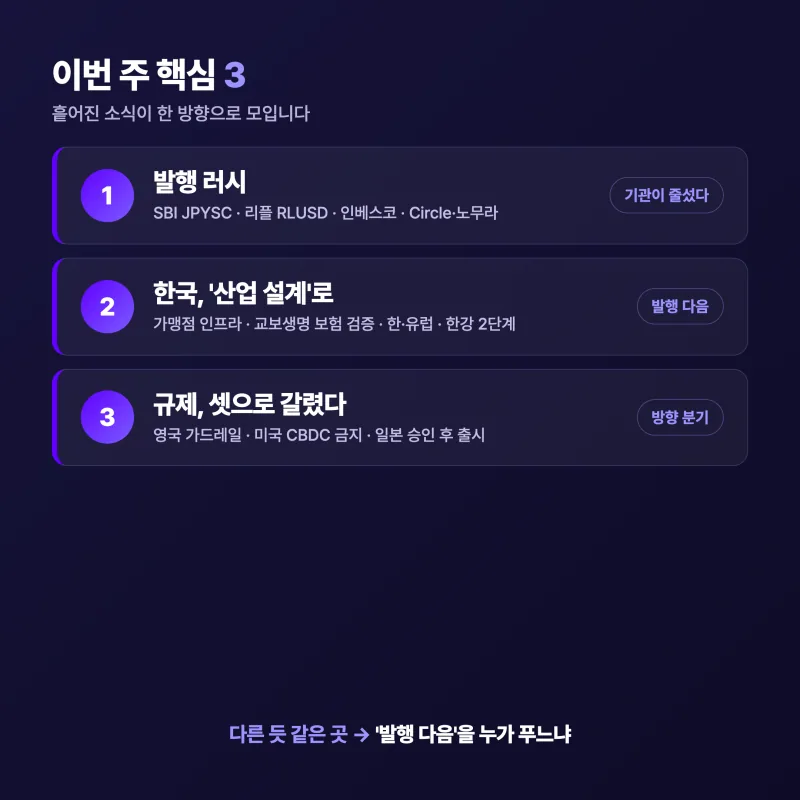
The top 3 this week
1. An issuance rush — institutions are lining up
This week alone brought a run of significant issuance and market-entry news.
Reports said SBI Group launched JPYSC, a stablecoin backed by a Japanese trust bank. (Nikkei and others, 6/24–25)
Ripple cleared regulatory approval and moved to launch RLUSD in Japan. (6/26)
Invesco, an asset manager running trillions of dollars, was reported to have filed with the SEC for a tokenized stablecoin reserve product (a money market fund). (The Block, 6/26)
Beyond those, there was news from Circle and Nomura (FX in Japan), SoFi (a bank-issued stablecoin), and a USD 25 billion credit union alliance joining the infrastructure.
Banks, trusts, asset managers, and securities firms are all coming in at once. Issuance is no longer a question of whether it can be done, but of who does it and on what trust structure.
2. Korea — from "issuance" to "industry design"
Korea has moved past debating whether issuance is possible and into designing where and how it will be used.
Domestic coverage noted that Korea's digital asset strategy is starting to shift into an "industry design" phase, and pointed to merchant infrastructure as the variable that will decide whether a won-denominated stablecoin business succeeds or fails. (6/24)
There was also news that Kyobo Life Insurance had become the first in the industry to run a technical proof of concept for collecting premiums and paying claims using a stablecoin. (6/25)
Korea–Europe stablecoin cooperation was raised as well. (Herald Business, 6/26)
And Phase 2 of the Bank of Korea's deposit token effort, Project Hangang — which we covered separately this week — entered live transaction testing.
The common thread is "after issuance." Merchants, insurance settlement, cross-border linkage — all of them are operational problems you have to solve once issuance is done.
3. Regulation — the direction split three ways
- United Kingdom: the Bank of England (BoE) released a draft framework for systemic stablecoins, shifting away from per-issuer holding caps toward system-level guardrails (around GBP 40 billion). (reported 6/22–23)
- United States: Congress was reported to have passed a bill banning the Federal Reserve from issuing a CBDC through 2030, sending it to signature. (6/25)
- Japan: as Ripple's RLUSD shows, the "approval first, then launch" path is taking hold.
Grow private stablecoins but put guardrails on them (the UK), block central bank digital currency (the US), and clear approval before going to market (Japan)
— the answers differ by country, but the question is the same. What rules will govern things after issuance?
Also this week
Items that did not make the top 3, but pointed the same way.
Chainlink launched a T+0 foreign exchange settlement project with a consortium of Korean and European banks. (6/26)
The market capitalization of tokenized real-world assets (RWA) passed USD 51 billion. (Bernstein, 6/23)
The Bank of Korea's financial stability report found digital asset futures trading at 5.2 times spot volume, and concluded that linkage with traditional financial markets has grown. (6/25)
Elsewhere, news kept arriving about the expansion into payment and settlement rails — Spark's stablecoin FX layer, mortgage loan tokenization (around USD 25 million), and more.
In sum — every item this week pointed at what comes after issuance
Put the scattered news in one place and the picture gets clear. The race to issue is already a given, and nearly every signal this week pointed to the stage after it.
- Institutional issuance rush → a race over who can operate it in a trustworthy way
- Korea's industry design → real-world operations like merchants, insurance, and settlement
- Divergent regulation → what rules will control and prove what happens after issuance
Three separate strands converging on the same place. It is also why PARAMETA has consistently focused on the operating, control, settlement, and audit layers that come after issuance in digital asset infrastructure. Issuance is only the entrance; the value comes from the structure that makes what follows controllably operable.
📌 What PARAMETA covered this week
Phase 2 of the Bank of Korea's deposit token effort, Project Hangang — from issuance to real use
Stablecoin regulation, from "issuance" to "operations" — signals from the US, EU, and Korea
Planning a digital asset service?
ParaSta, PARAMETA's enterprise digital asset infrastructure solution, supports the areas a digital asset service needs
— issuance, wallet, orchestration, and onchain KYC — so you can evaluate and adopt them in modular form.
If you are considering infrastructure for a digital asset service such as security tokens or stablecoins, book a 1:1 ParaSta consultation.