

Last year the Bank of Korea ran an experiment with seven banks that actually issued deposit tokens.
It was called Project Hangang. As Hangang moves into Phase 2 this year, the question it asks has become one notch more concrete.
If Phase 1 asked "can we create a deposit token," Phase 2 asks "can people actually use it?"

The Bank of Korea's CBDC experiment, Project Hangang, has entered Phase 2. This is the stage that tests whether deposit tokens can actually be used in practice.
The number of participating banks has grown from seven to nine. Joining the original seven (KB Kookmin, Shinhan, Woori, Hana, IBK, NongHyup, and Busan) are Kyongnam Bank and iM Bank.
Live transaction testing is scheduled for the second half of this year.
The biggest difference from Phase 1 is that this time they are building a real-world infrastructure that connects bank mobile banking, core banking systems, fraud detection (FDS), anti-money laundering (AML), and even the government subsidy administrative network.
The homework Phase 1 left behind — "there was nowhere to spend it"
The starting point for the Phase 2 design was the one-line verdict Phase 1 left behind: issuance worked, but there was hardly anywhere to spend it.
In the first pilot, the token amount converted from deposits was about KRW 1.64 billion, and of that, only about KRW 690 million actually turned into payments. (Blockmedia)
E-wallet sign-up rates were high, but the shortage of merchants that accepted it and the complexity of the authentication process were flagged as limits.
In other words, Phase 1 demonstrated "we can build it" but never proved "it runs in everyday life." Phase 2 aims squarely at that homework.
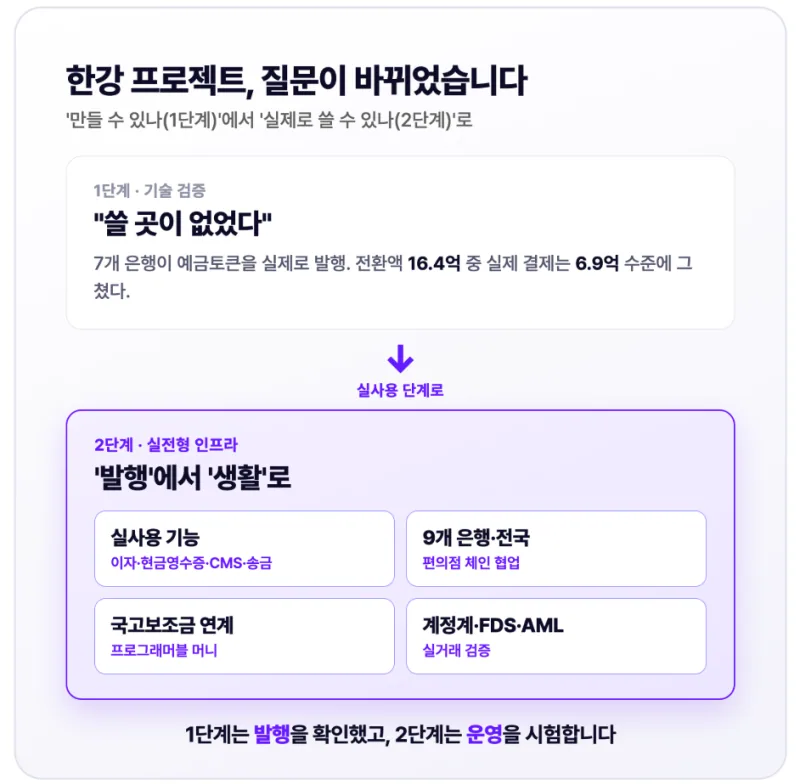
Phase 2's answer — from "issuance" to "everyday life"
Phase 2 extends the deposit token beyond a simple payment instrument and into the functions real financial life requires. (Electronic Times, 2026-05-21)
Interest payment, cash receipt issuance, and recurring automatic payment (CMS) are in.
"Interest payment" here does not mean interest accrues on the CBDC itself. It is closer to a function that manages interest inside the deposit token service that banks issue and operate.
Fingerprint biometric authentication, automatic conversion between deposits and deposit tokens, and peer-to-peer (P2P) transfers are newly added. These directly address the "complex authentication" criticized in Phase 1.
Acceptance was widened to what is effectively nationwide coverage through a partnership with convenience store chains.
Linkage with government subsidies and digital vouchers is central as well. Applying deposit tokens to programs such as EV charging infrastructure subsidies is under review. It is a "programmable money" experiment — one that blocks off-purpose spending and tracks disbursement in real time.
Do you see what this list has in common? All of it is functionality needed after issuance. Tax documentation, recurring payments, settlement, tracking — the operating functions money needs in order to actually circulate.
The thing to watch — Phase 2 is a proving ground for operating infrastructure
If Phase 1 was about confirming the technical feasibility of a deposit token,
Phase 2 is closer to building a real-world infrastructure that connects bank core systems, fraud detection (FDS), anti-money laundering (AML), and the government subsidy administrative network.
The financial industry views it as a live transaction validation stage that weighs whether deposit tokens can be commercialized.
The things Hangang Phase 2 newly layers on at the post-issuance stage sort into four axes.

Issuance and conversion — automatic conversion back and forth between deposits and deposit tokens. Issuance authority sits with the banks.
Holder identification and authentication — the layer, like fingerprint biometrics, that confirms who holds and moves a token.
Wallet and settlement — peer-to-peer transfers, convenience store payments, and the actual settlement of funds between banks.
Audit and control — FDS and AML, plus real-time tracking of whether government subsidies were spent as intended.
Issuance itself was already achieved in Phase 1. The real reason Phase 2 is hard is that operations, control, and audit all have to be stacked on top of it.
Limits that remain
Under the current structure, only banks may handle deposit tokens directly. Fintech and big tech companies can participate only as partners.
As one banking industry official put it, the Bank of Korea provides the underlying engine and structure, while the banks handle actual service implementation.
Deposit tokens are not stablecoins. The Bank of Korea drew a line under the idea, floated in some quarters, of using CBDC deposit tokens as reserve assets for a won-denominated stablecoin, calling it somewhat ahead of itself.
What PARAMETA sees here
Boil the message of Hangang Phase 2 down to one line: issuance ended in Phase 1, and the real game is operations.
What is interesting is that the cause of Phase 1's limit — "there was nowhere to spend it" — was not only the number of merchants. A complicated authentication process, meaning the operating-layer problem of how you confirm holders and control transactions, was tangled up in it too. That is why the first things Phase 2 reworked were biometric authentication, automatic conversion, and the audit and tracking structure.
The force that makes a deposit token actually usable comes not from issuance technology but from the identity verification, settlement, audit, and control layers attached above it. It is also why PARAMETA has consistently focused on the post-issuance operating and control layer in digital asset infrastructure.
What institutions should watch now
Hangang Phase 2 is testing not "can it be issued" but "does it run in everyday life." Success or failure rests on operating functions.
For banks and public institutions that will handle deposit tokens, designing how you will operate and prove identity verification, settlement, audit, and control — before worrying about issuance — puts you in a better position when live transactions and commercialization arrive.
PARAMETA will keep tracking this trend and explaining it in plain terms.
Do you need deposit token or digital asset operating infrastructure?
ParaSta, PARAMETA's enterprise digital asset infrastructure, supports issuance, wallet, orchestration, and onchain KYC in modular form.
We welcome inquiries about designing the identity verification, settlement, and audit operating layer.