

Over the past week, signals about stablecoin regulation came out of the US, Europe, and Korea almost simultaneously. And the direction the three of them pointed was curiously similar: not who is allowed to issue, but how users and transactions get controlled after issuance.
In particular, the US Federal Reserve was reported to have put forward a proposed rule requiring stablecoin issuers to maintain a customer identification program (CIP).

Three signals from around the world
Three signals overlapped last week.
- United States: the Fed was reported to have announced a proposed rule requiring stablecoin issuers to maintain a customer identification program (CIP). The direction is to make issuers verify and manage user identity at a level comparable to banks. (Cointelegraph and The Block, 6/18)
- Europe: reports said Tether (USDT), which has not met MiCA requirements, risks having its distribution restricted within the EU. The signal is that failing to meet issuer authorization, reserve, and operational transparency requirements pushes you out of the market. (TokenPost, 6/15)
- Korea: coverage described a debate over widening the digital asset anti-money laundering (AML) framework from the level of customer due diligence (CDD) to the level of wallets and transaction flows. (Herald Business, 6/18)
The three events are separate, but they point one way. The regulatory question is shifting from "issuance" to "operations."
The thing to watch — regulation's center of gravity is moving
Early discussion of stablecoins mostly concentrated on who could mint them and against what collateral. This week's signals show the next stage.
It is no longer simply about whether issuance is permitted.
Who controls and proves user identity, wallets, transaction flows, and reserves after issuance is becoming the center of regulation.
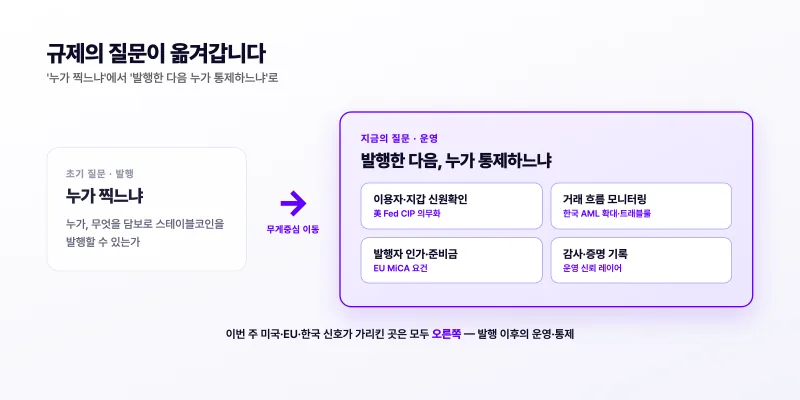
What regulation newly asks after issuance
What regulators have started to demand at the post-issuance stage sorts into four broad areas.

- Issuer identity and authorization — who is the issuing entity and under what qualification do they bear responsibility (the EU MiCA issuer authorization and reserve requirements)
- User and wallet identity verification — do you verify and manage who holds and moves the token (the US Fed's CIP mandate)
- Transaction flow monitoring — do you track beyond the single customer, all the way to wallets and transaction flows (Korea's AML expansion debate, the travel rule)
- Reserves and audit — what backs it, and how is that proven and recorded
- Issuance technology does not answer any of these four.
- These are problems the post-issuance operating and control layer has to solve.
Where things get stuck most often — identity verification
Of the four, the point where practitioners get stuck most often is identity verification.
The conventional approach focused on verifying one customer at sign-up (CDD). This trend widens that scope to wallets and transaction flows.
Once you move to the wallet level, the questions change.
Who is the beneficial owner of this wallet, where do the funds come from and where do they go, and can an identity verified once be re-proven for every transaction?
If issuers, operators, and wallet providers do not design this flow together from the start, bolting external tools on afterward makes it hard to close the gap.
How to solve this at the operating layer
- Issuance is only the beginning.
- Move the four things regulators pointed at into a post-issuance operating perspective and they sort out like this.
- User and wallet identity verification (Fed CIP) → issue and verify "who holds and moves it" with onchain KYC and DID/MyID
- Transaction flow monitoring (Korea AML) → track and record transactions with onchain audit logs
- Only the necessary information, without over-collection → selective disclosure and zero-knowledge proofs (ZKP)
- Issuer and reserve control → operations in one place, through issuance, wallet, and orchestration modules
- ParaSta, PARAMETA's enterprise digital asset infrastructure, handles these items in modular form.
- The point is not each individual function, but whether issuance, identity, and audit were bound into one layer from the start.
What Korean institutions should watch
In Korea too, the debate over formalizing stablecoin rules has continued since the Virtual Asset User Protection Act.
The US CIP and the EU MiCA requirements may well be cited as reference models for legislation.
From an institution's point of view, the question becomes clear.
Beyond whether issuance is possible, it is how you will operate and prove user identity, wallets, transaction flows, reserves, and audit.
Whoever designs that operating structure before the rules are finalized is better positioned when they take effect.
References
Reports on the US Fed's proposed rule mandating customer identification (CIP) for stablecoin issuers (2026-06)
Cointelegraph · The Block
Coverage of the debate over expanding the digital asset AML framework (Herald Business, 2026-06)
Coverage of EU MiCA and Tether USDT · TokenPost
Do you need stablecoin operating and identity verification infrastructure?
ParaSta, PARAMETA's enterprise digital asset infrastructure, supports issuance, wallet, orchestration, and onchain KYC in modular form.
We welcome inquiries about designing the identity verification, settlement, and audit operating layer.