

TokenPost recently published an interview with CK Ong, COO and acting head of SBI Digital Markets. Let's walk through it together.
Ong spent more than 15 years in traditional finance at Standard Chartered and UOB before moving into tokenization. He is also one of the few practitioners in Asia who has personally closed tokenization deals where real money actually moved.
What made this interview stand out was the direction of the message. He opened not with why tokenization is promising, but with why it still isn't working — and organized that diagnosis into a four-layer structure he calls the credibility stack.
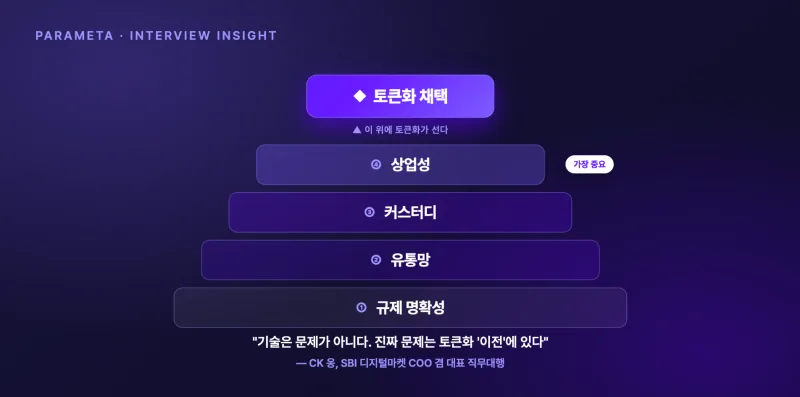
Ong's core argument fits in one sentence.
"Technology is not the problem. The real problem sits before tokenization."
He pointed to how slow adoption remains even in countries like Singapore, Hong Kong, and Japan, where regulation and trading track records already exist — sidestepping the usual assumption that regulation is the bottleneck.
Technology, he argued, is already ahead: deals execute through smart contracts, and audit and settlement complete. If commercially scalable models are still rare despite that, something else is going on.
The four layers of his credibility stack
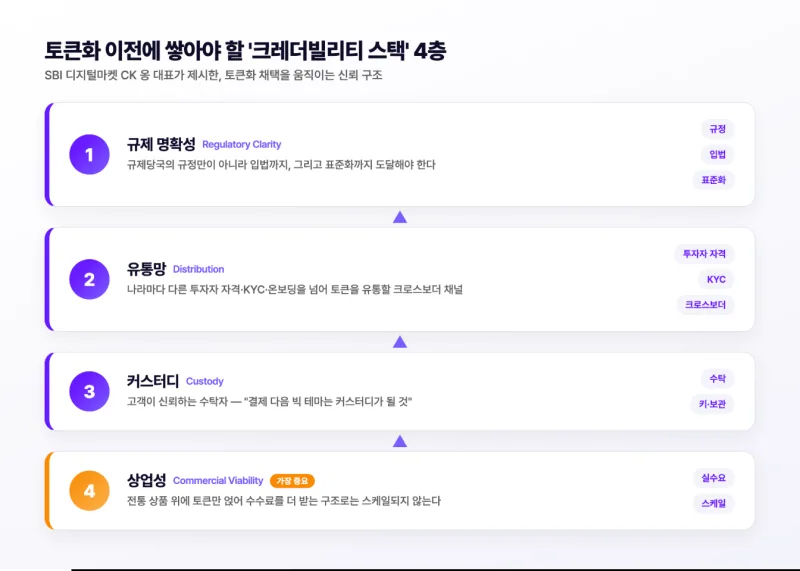
Regulatory Clarity — a concept that covers not just regulators' rules but legislation as well. Both have to be in place before you can get to standardization, and most countries in Asia, in his view, aren't there yet.
Distribution — investor classification, KYC requirements, and onboarding requirements differ from country to country. Until every platform's compliance demands are resolved, a token has a hard time crossing from one country to another.
Custody — because banks are the custodians customers have always trusted, he predicts that after payments (stablecoins), the next big theme is custody.
Commercial Viability — the layer he called the most important. If you build everything the traditional way and then bolt a token on top to charge an extra fee, there is no reason for an investor to buy the more expensive token.
Until those four layers are stacked up, his conclusion goes, no product and no country will meaningfully move tokenization adoption forward.
Applying it to Korea
The interesting part is that he named Korea as a country that has just fastened the first button on all four.
Regulatory clarity — amendments to the Electronic Securities Act and the Capital Markets Act that institutionalize security tokens (STOs) have passed the National Assembly. Enforcement, though, is provisionally set for one year after promulgation, and enforcement decrees and license issuance remain to be done.
Distribution — a securities firm consortium has built out infrastructure, but cross-border channels still have plenty of gaps.
Custody — the trust and account management institution framework is in the process of settling into place.
Commercial viability — Korean RWAs carry a structural homework problem: they skew toward assets whose valuation is subjective, like real estate and music rights, rather than standardized assets like government bonds and MMFs.
Korea, he said, is a market you absolutely have to watch over the next six months.
What he found distinctive was that regulators granted licenses to exchanges in consortium form, creating what amounts to a national-level initiative.
Where things get stuck most often, and what he says comes next
Of the four layers, the one that jams up most often in practice is the second: distribution. Investor eligibility and KYC differ by country and have to be verified all over again each time. The more networks you connect to, the more the same checks repeat.
That makes his read on the sequence telling. After payments comes custody, Ong predicts, and after custody comes identity — digital identity. Issuance, wallets, and payments are already done, he says; what is coming next is digital identity and automated on-chain compliance.
What PARAMETA is watching
In an earlier post we argued that a traditional financial firm buying a stake in an exchange is only an entry ticket, and that the operational trust structure underneath is what really matters. This interview reframes that view one level up, as a trust structure the whole market has to build together.
Ong's point that custody follows payments and digital identity follows custody lands squarely on territory PARAMETA has watched for a long time. In ParaSta, our digital asset infrastructure solution, on-chain KYC is handled as its own module alongside issuance, wallets, and orchestration.
Credentials based on DID and MyID — users hold identity and eligibility credentials issued in their own name
Selective Disclosure — submit only the attributes required, such as accredited investor status or country of residence
Zero-knowledge proof (ZKP) — prove that a condition is met without exposing the underlying data
On-chain audit logs — a record of which credentials allowed which transactions, in a form that can be audited after the fact
The direction here is less "collect more information" and more "verify only the eligibility you need, and leave it auditable." The repeated country-by-country KYC that Ong flagged at the distribution layer and the digital identity he named as the next step converge on a single question. Can you prove that this holder is eligible for this transaction without asking from scratch every single time?
Across digital finance and public trust infrastructure, PARAMETA is focused on DID/VC, wallets, and the digital asset operations layer.
What institutions and enterprises should take from this
If you are an institution evaluating a tokenization business, the first self-diagnosis may not be whether to tokenize but which layer of the credibility stack is empty for you. Ong himself described the frame as a stack for self-diagnosing whether to pursue tokenization at all.
Institutions and enterprises need to examine not just whether to adopt the technology, but authentication, permissions, audit, and the structure of operational accountability alongside it.
We will keep watching where this goes.
Reference
[Interview] Build four layers before you tokenize — SBI Digital Markets head CK Ong on the credibility stack (TokenPost, 2026-06-08)
tokenpost.kr/news/insights/367080
Preparing a digital asset service?
ParaSta, PARAMETA's enterprise digital asset infrastructure solution, covers what a digital asset service needs —
Issuance, Wallet, Orchestration, and Onchain KYC — as modules you can evaluate and adopt one at a time.
If you are considering digital asset service infrastructure for security tokens, stablecoins, or anything similar, book a one-on-one ParaSta consultation.