

Reports say the US SEC is weighing an 'Innovation Exemption' framework that would waive parts of existing securities regulation, but only for trading in tokenized stock.

The Defiant report
Cointelegraph report
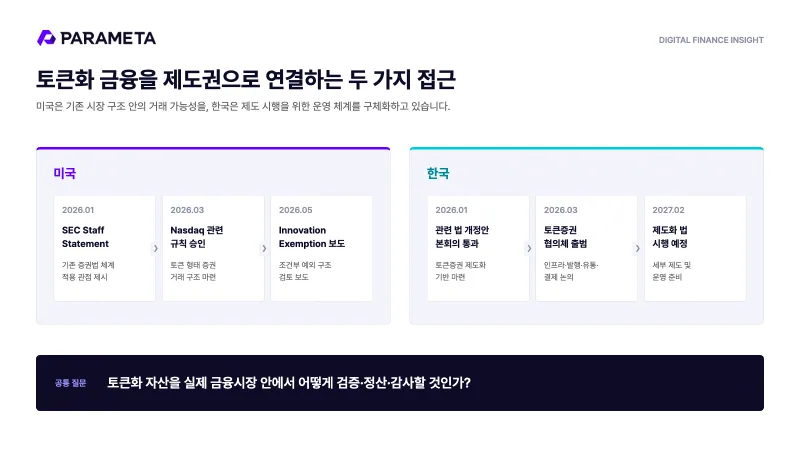
This is not just one line of American regulation changing. It matters because of the timing — Korea is about to put its own security token (STO) rules into force.
The story here is not simply that the US has moved a step closer to tokenized stock. It is that the US is getting there by exempting existing rules while Korea is getting there by enacting new ones.
The regulatory form is the exact opposite, yet both markets are crossing into the stage where tokenized assets are actually traded and settled.
What is the SEC's 'Innovation Exemption'?
According to The Defiant and Cointelegraph, the US SEC is considering an 'Innovation Exemption' provision that would waive parts of existing securities regulation for tokenized stock trading.
Two points capture the essence.
No new rulebook is written — parts of the existing rulebook are waived under set conditions.
The scope is narrowed to one specific type of instrument: 'tokenized stock'.
This is less about loosening regulation and more about carving out a path for tokenized stock to function inside the existing market.
Korea is meeting the same trend with 'rules'
Korea is taking a different road.
Its direction is to fold security tokens explicitly into a dedicated regime, and the related rules are reportedly scheduled to take effect within this year.
While the US waives parts of the existing rulebook, Korea is defining issuance, distribution, and settlement inside the rulebook.
On the surface these are opposite approaches, but both markets arrive at the same place.
A market opens where tokenized assets are genuinely traded and settled.
The central question becomes what accountability structure issuers, distributors, and custodians must carry.
Four pillars of operational trust financial institutions should check now
If you are a brokerage, bank, or custodian evaluating security token infrastructure, it is safer to work through the following four items regardless of which regulatory form applies to you.
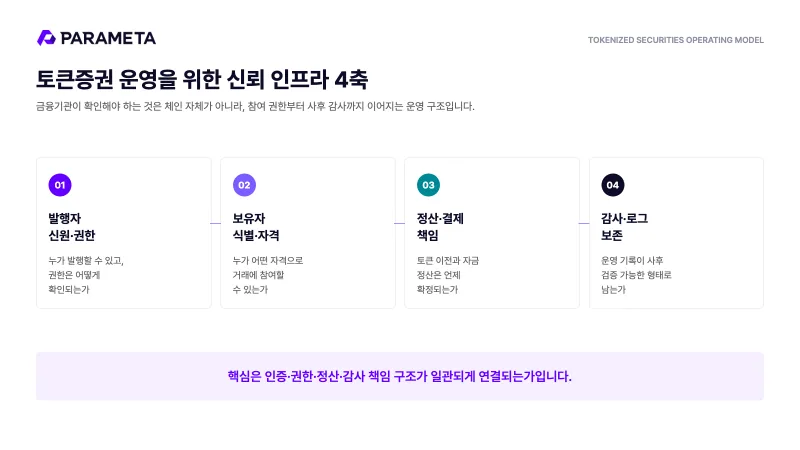
- 1. Issuer identity and authority — who is issuing, and under what authority model are they verified
- 2. Holder identification and onchain KYC linkage — what information must a token holder expose to have their eligibility verified
- 3. Settlement and payment accountability — who is responsible for token transfer and fund settlement, and at what point does it become final
- 4. Auditability and log retention — does a consistent operational record remain for later supervision and audit requests
- What matters is not which chain you put the token on, but whether authentication, authority, settlement, and audit accountability are designed consistently.
- Of those four, the second — holder identification and KYC — is also where security token operations get stuck most often.
- Lift traditional KYC over as-is and it cannot keep pace with token trading; build something new and it becomes disconnected from existing financial compliance.
- The bigger problem is that the same KYC repeats itself as the number of networks grows.
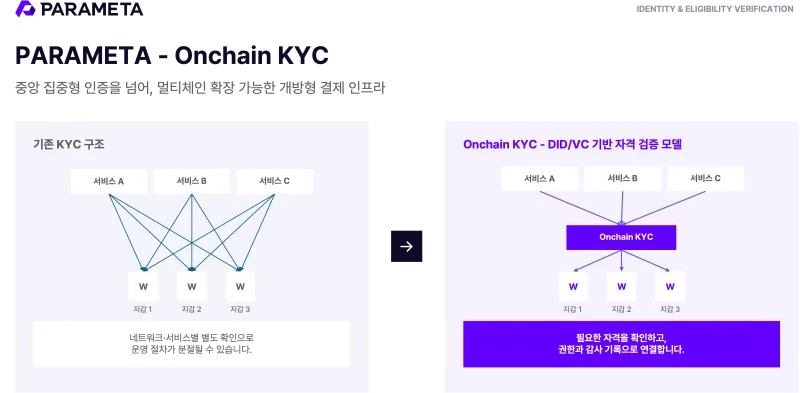
This is exactly where PARAMETA treats onchain KYC as its own module, alongside issuance, wallets, and orchestration.
- DID and MyID-based credentials — users hold identity and eligibility credentials issued in their own name
- Selective disclosure — submit only the attributes that are needed (accredited investor status, country of residence, and so on)
- Zero-knowledge proofs (ZKP) — prove that a condition is met without exposing the underlying data
- Onchain audit logs — record which credential permitted which transaction, in a form that can be audited after the fact
The thrust here is not "let's collect more user information" but "let's verify only the eligibility we need, and leave it auditable."
Whether the US arrives by exemption or Korea by regulation, security token exchanges, issuers, and custodians all end up having to answer the same thing on every single trade: is this holder eligible to make this trade?
Whether you can build that answer into a structure that holds up during live operation is what will decide how usable your system really is once the rules take effect.
Rules introduced, rules partially waived — the institutions actually running security tokens have to answer the same questions either way.
Who issued it, who holds the rights to it, and at what point and by what method it gets settled and audited.
That is less a question of which chain the token sits on than of whether you can design authentication, authority, settlement, and audit accountability consistently.
PARAMETA is focused on the importance of DID/VC, wallets, DLT, and the digital asset operations layer across digital finance and public trust infrastructure.
The key point: the day the rules take effect is when responsibility for running the system begins, not when it ends.
We will keep watching where security token infrastructure goes from here.
Preparing a digital asset service?
ParaSta, PARAMETA's enterprise digital asset infrastructure solution, covers what a digital asset service needs
across issuance, wallets, orchestration, and onchain KYC — each available as a module you can evaluate and adopt on its own.
If you are considering digital asset service infrastructure for security tokens, stablecoins, or anything similar, book a 1:1 ParaSta consultation.