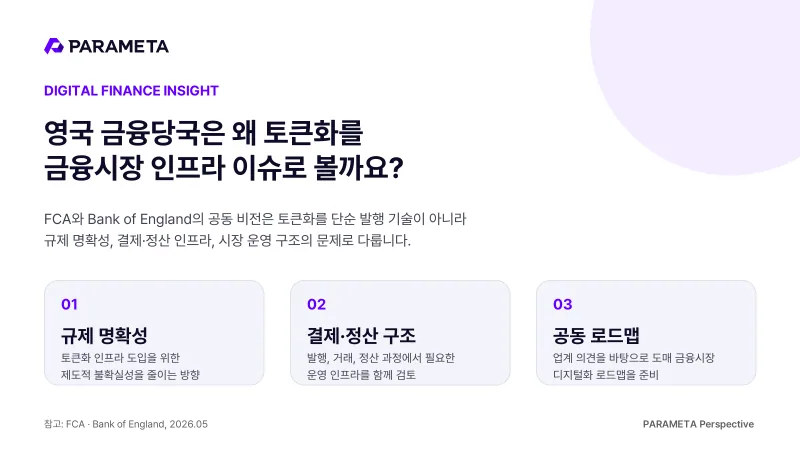
The FCA and the Bank of England have set out a joint vision for tokenization in the UK wholesale markets.
The Financial Conduct Authority (FCA) and the Bank of England recently published a joint vision for safely using tokenization and distributed ledger technology (DLT) in the UK wholesale financial markets.
Bank of England official announcement
FCA Call for Input
This is less the launch of a particular service or news of a single pilot,
and more a statement of policy direction on what conditions financial market infrastructure has to meet before it can absorb tokenization technology.
The FCA and the Bank of England are gathering industry input so that financial firms can adopt tokenization and DLT with more confidence.
The main topics on the table include regulatory clarity for tokenized assets, use as collateral, means of payment and settlement, and market infrastructure principles.
They also said they plan to present a joint cross-agency roadmap for digitizing the wholesale financial markets by the end of 2026.
What to take away from this announcement
Is there a structure in place for tokenized assets to actually be issued, traded, settled, and supervised inside real financial markets?
Tokenization does not end with turning an asset into a digital form.
For it to work inside real financial markets, payment rails, settlement structures, participant verification, risk management, auditability, and regulatory response all have to move together.
1. With tokenization, what comes after 'issuance' matters more
A tokenized asset does not become financial infrastructure just by being issued.
To be used inside a real financial service, you have to design alongside it who can take part in a trade, how the trade record is kept, on what basis settlement is processed, and how anomalous transactions and regulatory requirements are managed.
In other words, the heart of tokenization is not digitizing an asset but making that asset operate in a way financial institutions can accept.
2. Payment and settlement infrastructure is changing along with it
Traditional financial markets have run around fixed business days and settlement cycles.
But once tokenized assets and new digital payment instruments enter the market, financial infrastructure is asked for longer operating hours and faster settlement.
And speed is not the only thing that matters here.
The faster settlement gets, the more refined participant verification, permission management, transaction monitoring, and audit trails have to become.
Faster infrastructure demands stronger controls.
3. Financial institutions judge by a different standard
In digital asset markets, the arrival of a new technology or a new asset often draws attention all by itself.
Financial institutions see it differently.
When they consider adopting a new asset, the first thing they look at is whether it can be operated safely within their existing risk management framework.
Customer verification, asset management, settlement records, anomalous transaction response, and regulatory reporting all have to be examined together.
In the end, competitiveness in tokenized finance comes less from the technology itself than from the ability to connect that technology to a trustworthy operating structure.