

PARAMETA is gearing up for the EU Digital Product Passport with a Korean data space.
Gearing up for the EU Digital Product Passport (DPP) with a Korean data space
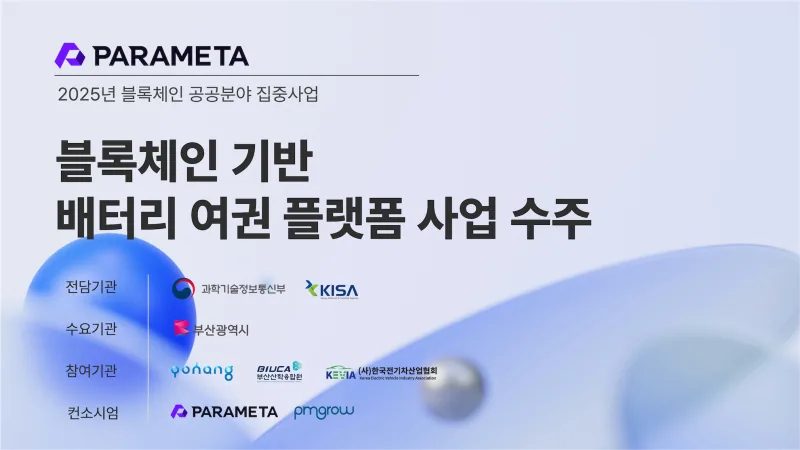
PARAMETA has been selected as a participating company for the Blockchain-Based Battery Passport Platform project, one of the core tasks of the 2025 Blockchain Public Sector Intensive Program run by the Ministry of Science and ICT (MSIT) and the Korea Internet & Security Agency (KISA).
The program is a public proof-of-concept project set up to get ahead of the EU Digital Product Passport (DPP) regime that takes effect in 2027. Through it, PARAMETA will carry out two tasks at once: applying MyID 2.0, the only blockchain service for public institutions built on the Korea Blockchain Trust Framework (K-BTF), and implementing a blockchain-based data space.
So what exactly is a digital product passport, or a battery passport?
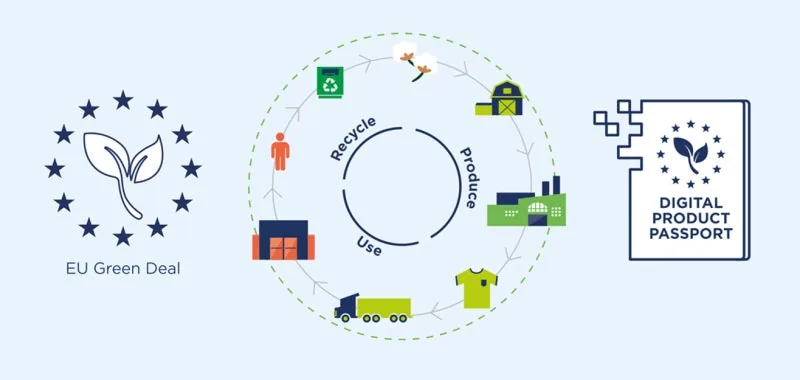
The Digital Product Passport (DPP) is a regime the EU will roll out in earnest from 2027. It is a system that digitizes, records, and shares information across a product's entire life cycle, from manufacturing through use, maintenance, and recycling.
The core goal is to secure the environmental performance and transparency of products within Europe, and to accelerate carbon neutrality and a circular economy.
The DPP regime starts with battery products and will later extend to every product in circulation, including electronics, clothing, and building materials. That makes putting a digital history management system in place ahead of time a requirement for any company that wants to export to the European market.
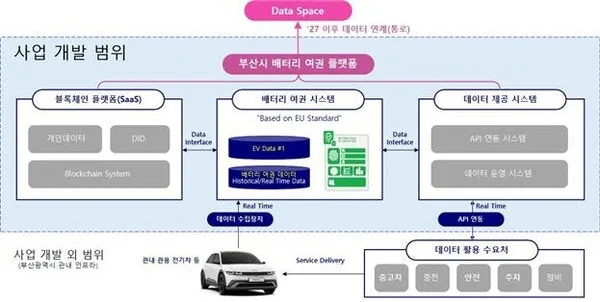
In line with this shift, PARAMETA is developing a blockchain-based platform that gives each electric vehicle battery its own digital passport.
The platform is designed to record and manage life cycle data for a battery, covering manufacturing, operation, charging, maintenance, reuse, and recycling, on the blockchain, and to store and distribute that data as digital certificates.
This goes beyond simple data collection. Designed so that the many players in the industry can share and use data on a foundation of mutual trust, the system will serve as both infrastructure and a proactive means for Korean companies to respond effectively to DPP regulation.
Data space: the next-generation data infrastructure the EU has its eye on
One of the key terms in this project is the data space.
A data space is a decentralized data ecosystem that enables trust-based data sharing among participants within a given industry, topic, or domain.
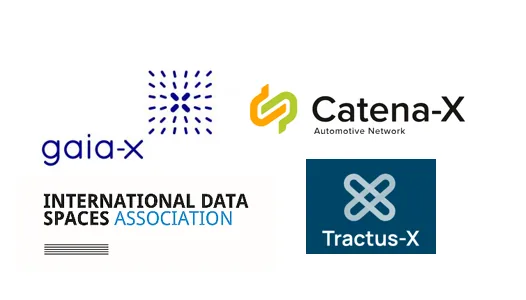
The EU is spreading this structure across industry through initiatives such as GAIA-X and Catena-X, and Korea needs proof-of-concept models of its own in response.
Through this project, PARAMETA will implement a Korean data space platform that combines decentralized identifiers (DID) with a personal data store (PDS), built on its own blockchain core technology.
DID verifies participants' identities securely, while PDS guarantees user sovereignty over sensitive data and still makes sharing possible.
A new standard for public blockchain: MyID 2.0
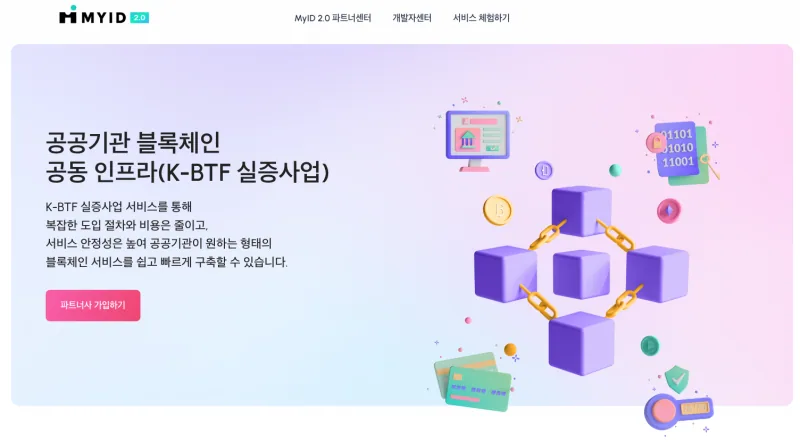
This project marks the first application of MyID 2.0, the public sector blockchain infrastructure developed by PARAMETA.
MyID 2.0 is the only blockchain infrastructure in Korea built exclusively for the public sector, developed through KISA's Public Institution Blockchain Common Infrastructure (K-BTF) program.
A SaaS structure means fast adoption with no separate system build (service can start within a week)
Built on CSAP (Cloud Security Assurance Program), so public institutions can use it with confidence
Up to 90 percent or more in cost savings compared with a conventional blockchain deployment
Continuous security updates, with no dedicated staff required
Those advantages have earned MyID 2.0 a reputation as the only blockchain infrastructure public institutions can realistically adopt, and this battery passport platform project will put its effectiveness to a full test.
Public-private collaboration to build export infrastructure for the EU
The project runs on a public-private collaboration structure, with Busan Metropolitan City as the demand agency, PMGROW as the lead company, and PARAMETA as the technology partner.
Busan, together with the Busan Institute for Industry-Academic Convergence, the City of Pohang, and the Korea Electric Vehicle Industry Association, will use 2,500 electric vehicles and battery-related companies as the proof-of-concept scope. It will build a collaboration network with demand sites and private companies including charging stations, parking lots, and municipal corporations, securing a practical basis for data collection and taking the lead on electric vehicle battery history management.
PARAMETA, drawing on the hands-on blockchain experience it gained from proof-of-concept projects such as WattEver, will provide the practical technology and infrastructure that private companies need to meet the DPP regime.
- This project will be practical infrastructure for Korean companies preparing to export to the EU.
- Through a blockchain-based data space, we will build a structure where the private and public sectors can thrive together.
- PARAMETA CEO JH Kim
Where responding to regulation once meant little more than preparing documents, from here on the deciding factor in export competitiveness will be how well you build trust-based data infrastructure.
PARAMETA will keep building platforms that deliver data trust, personal sovereignty, and public sector efficiency all at once, through blockchain technology.
Thanks for reading.