

PARAMETA is upgrading Gyeongsangbuk-do Province's public MyData platform, built on its own blockchain DID technology.
After the phase 1 build of Moiso Gyeongsangbuk-do, the public MyData platform for Gyeongsangbuk-do Province, PARAMETA has won the phase 2 project and is starting work on upgrading the platform.
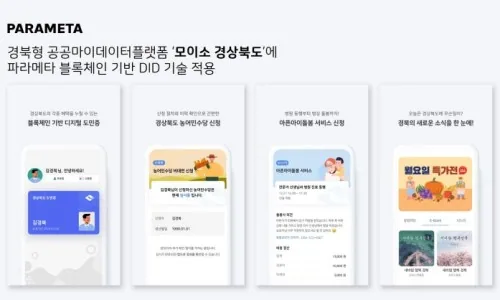
Moiso Gyeongsangbuk-do is a platform that puts data held by government agencies and local authorities to use with the consent of residents — the data subjects — so that administrative services can be accessed quickly and easily. PARAMETA, the sole contractor on the project, developed it and opened the service to the public earlier this year. In phase 1, PARAMETA applied its own blockchain DID technology to issue digital provincial resident cards and welfare cards, making identity verification dramatically safer and simpler.
Want to see what phase 1 covered? ▼
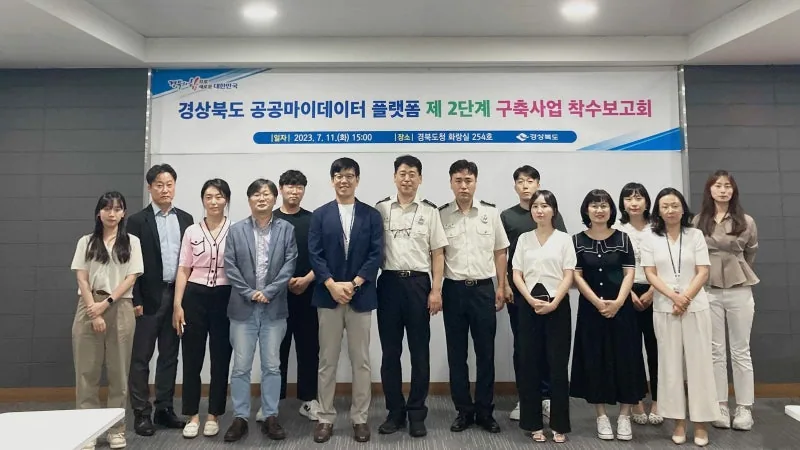
Phase 2, which PARAMETA will now carry out, aims to expand the administrative services that can be applied for safely and conveniently through the Moiso Gyeongsangbuk-do app using DID. To that end, PARAMETA joined some 20 people from the province, its cities and counties and other project stakeholders at the phase 2 kickoff briefing, where it presented the services slated for development and discussed the direction of the project.
Since the phase 1 launch, more than 26,000 people — 11.1% of the 235,000 total — have applied for farming and fishing allowances through the Moiso Gyeongsangbuk-do mobile app, safely and easily and without worrying about personal data leaks, while administrative efficiency in the responsible local government departments improved markedly. In short, the usefulness and stability of DID has been validated on multiple fronts. Phase 2 addresses the improvements identified while phase 1 was in service and, at the same time, brings new administrative services surfaced through collaboration between departments, cities and counties into the app — expanding DID-based services in earnest on a more advanced platform.
The new administrative services added in phase 2 include city and county school uniform subsidies, public job applications, forestry worker certification and the operation of the 119 Child Happiness Care Centers, all to be developed so residents can apply safely and easily through the Moiso Gyeongsangbuk-do app. The blockchain DID-based mobile resident card and QR code developed in phase 1 will also power linked services such as discount events for tourists visiting attractions in the province, and visitor data will be collected to develop data analysis and utilization models.
Beyond that, the plan is to keep upgrading Moiso Gyeongsangbuk-do by expanding provincial policy communications and linked services, gathering administrative information that used to be scattered in one place so that administrative services become easier to use.
This is how PARAMETA keeps validating the usefulness of blockchain by applying its DID technology across a range of fields — and DID happens to be a core technology of PARAMETA W, the company's flagship service for easy, powerful Web3 wallets.
PARAMETA W _ Wallet as a Service
PARAMETA W is a trusted custody-based key management service. Through DID (decentralized identifier) and PDS (personal data storage) technology it lets individuals manage their identity and data securely, and it delivers an easy, powerful Web3 wallet with convenient UX for industries such as finance and gaming and for both Web2 and Web3 businesses.
We are glad that PARAMETA's DID technology is playing a meaningful role in making administrative services more convenient for residents and administrative work more efficient for local government staff. PARAMETA will give this upgrade its best effort so that residents can use an even wider range of administrative services more easily and safely. We expect Moiso Gyeongsangbuk-do, which is creating real value with blockchain technology, to grow more active still, and we will keep building cases like it. :)
[Reference] Read the full PARAMETA press release ▼
[Reference] Go to the related articles ▼
Web3 Enabler, PARAMETA