

As blockchain services multiply and user counts climb, the industry is pushing hard on scalability so networks can respond faster and clear more transactions. The recent Ethereum 2.0 upgrade has also raised high expectations that scalability will improve from here. At the same time, there is a lingering concern that gaining scalability may come at the expense of decentralization and security, the other two corners of the blockchain trilemma.
In this post we look at how blockchains are trying to secure scalability without giving up security, and how ICON, which runs on PARAMETA's blockchain technology, and the blockchain framework PARAMETA are answering that question.
Blockchain Scalability
Early attempts at scalability leaned on building a separate mainnet using PBFT (Practical Byzantine Fault Tolerance) or PoA (Proof of Authority), with EOS and Tron as the best-known examples. But standing up a separate mainnet raised its own problems: decentralization concerns, instability caused by hard forks, and the fact that a single blockchain still ends up with the same bottleneck.
Ethereum
Ethereum is pursuing a different idea. Under the banner of Layer 2 (L2), it separates computation from the network so that execution can happen elsewhere while security is preserved. With the Ethereum 2.0 upgrade fueling expectations of greater scalability, Layer 2 projects such as Polygon, Arbitrum, Optimism, StarkEx and Metis have drawn attention, and total value locked (TVL) across Layer 2 has passed 3,600,000 ETH.
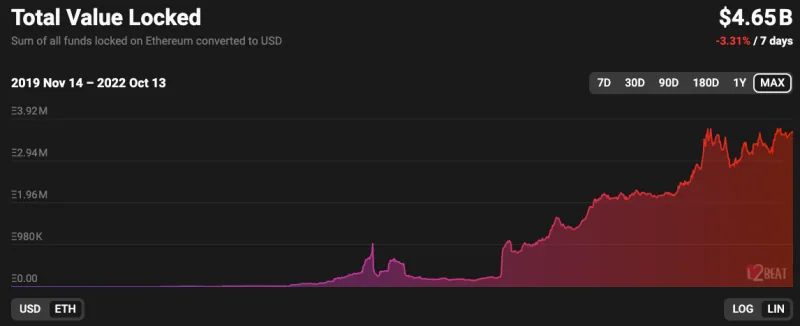
So how does Ethereum's Layer 2 actually deliver scalability? The main scaling solutions are Plasma and rollups (Optimistic and ZK).
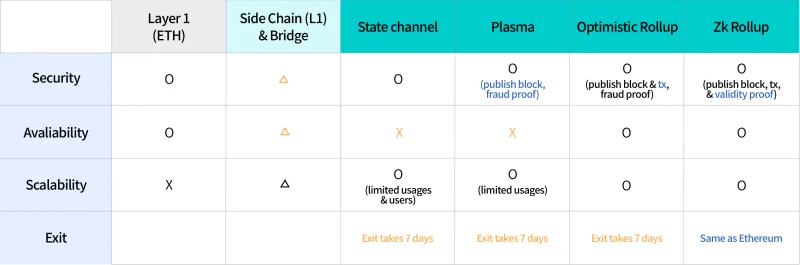
Plasma bundles the transactions processed on Layer 2 and passes only the result back to Ethereum for confirmation. That keeps Ethereum transactions to a minimum, easing the load on the network and lowering gas costs. Because only the result is passed along, however, without the detailed transaction record, there is a risk of a data availability (DA) problem: no way to confirm that the transactions that happened on Layer 2 were legitimate.
Rollups address exactly that DA gap by uploading the Layer 2 transaction data as well, so the data itself can be verified.
Optimistic rollups have one drawback: roughly seven days are needed after verification for the challenging period. To avoid that delay, ZK (Zero-Knowledge) rollups pass a proof of correct computation to Ethereum, and they are widely expected to become the definitive L2 solution — though plenty of hard technical problems remain unsolved.
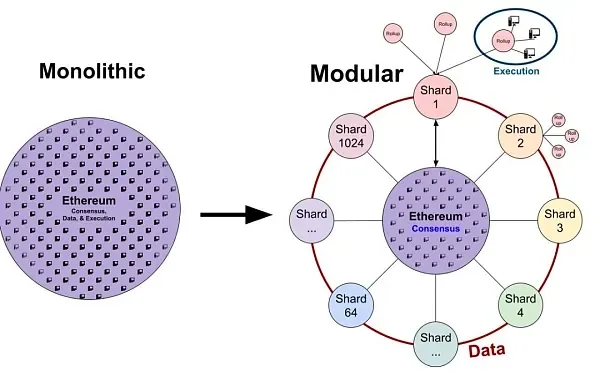
Ethereum also plans to introduce sharding through the Ethereum 2.0 upgrade. Sharding splits the main chain into multiple shards so that each shard handles a portion of the overall transaction load. If rollups take care of execution, shard chains take care of storage. Work that Ethereum once did alone gets divided up, and the research is aimed at keeping existing security intact while gaining scalability.
In short, Ethereum is dividing the labor that it previously handled on its own, with research pointed squarely at preserving security while securing scalability.
COSMOS
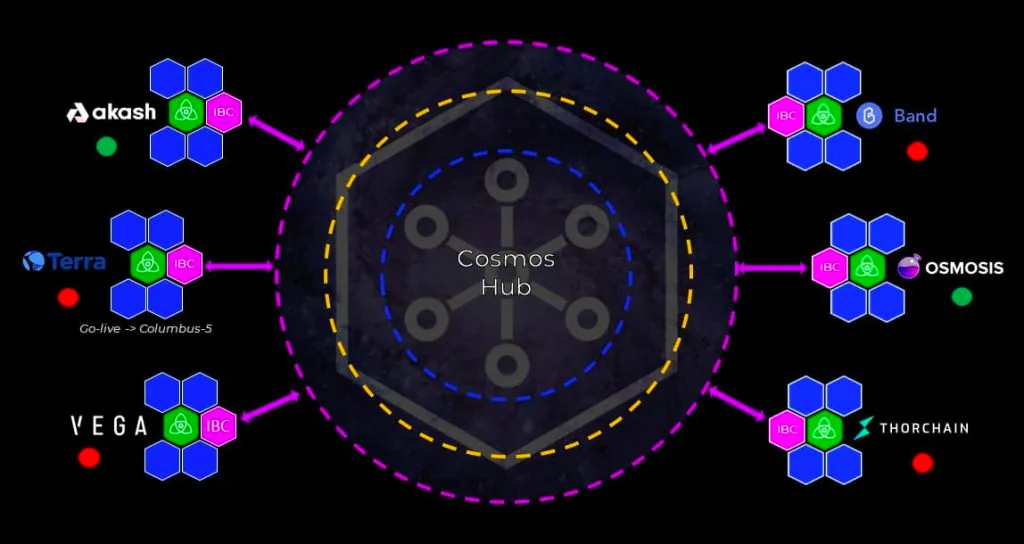
Cosmos champions the Application Specific Blockchain: one application per blockchain, with the validators of the Cosmos Hub guaranteeing security for mainnets built on the Cosmos SDK. In other words, Cosmos separates each application onto its own mainnet to prevent network overload and gain scalability, then connects those separated networks through the Cosmos Hub to secure them.
As these examples show, blockchains chasing both scalability and security are shifting away from the single monolithic model toward modular blockchains, dividing up execution, settlement, and consensus and data availability — functions that once all lived in one place.
ICON
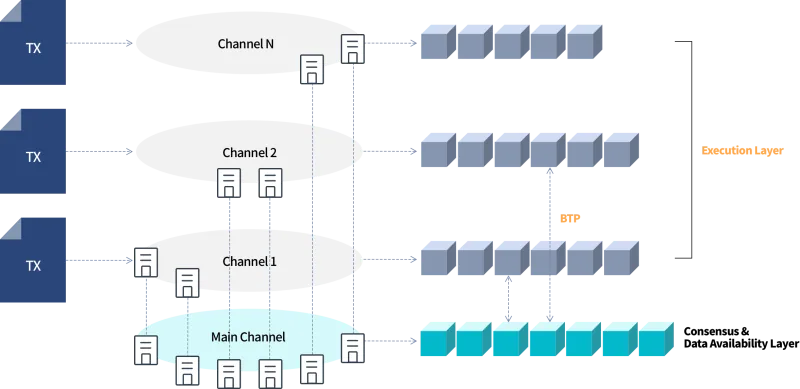
ICON, the global interchain project PARAMETA provides technical support for, was designed from the very beginning with scalability and security in mind, in a manner close to a modular blockchain. Using the multi-channel technology of PARAMETA's loopchain, ICON forms its consensus and data availability layer through its main validators (ICON's P-Reps), builds a settlement layer using the interchain technology BTP (Blockchain Transmission Protocol), and can dedicate a subset of validators to an execution layer. Because each blockchain function is handled separately, ICON achieves high scalability and reliability.
PARAMETA Framework
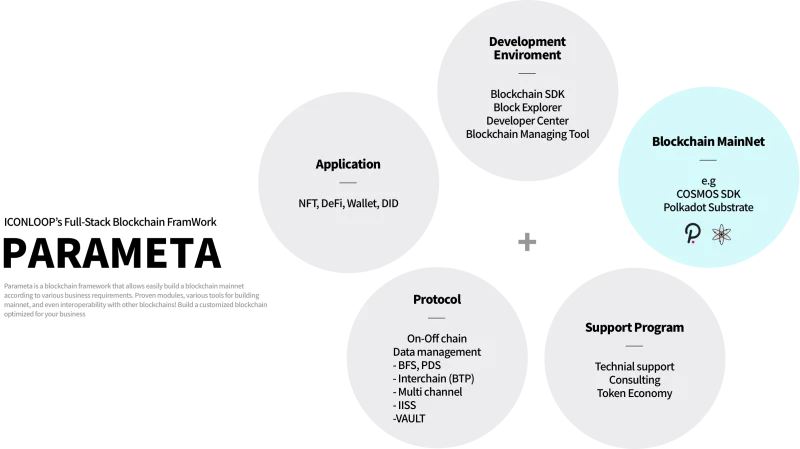
PARAMETA Framework, developed in house, is a full-stack blockchain framework that covers everything from the blockchain mainnet to protocols, applications, developer environments and support programs, so you can build a mainnet optimized for the business environment you want.
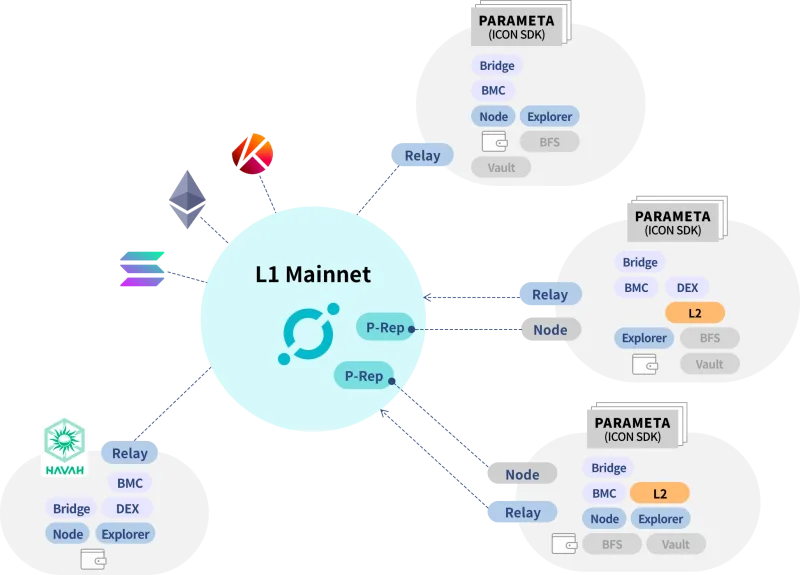
PARAMETA Framework supports building and developing Layer 1 (L1) mainnets like ICON, and it can equally well build a Layer 2 (L2) blockchain network connected to an L1 acting as a blockchain hub. When you build a mainnet in Layer 2 form, blocks are produced and verified using ICON's P-Reps, so security holds while your service runs on its own execution layer. That lets you lean on the Layer 1 mainnet for resources a mainnet normally requires — validators, wallet, explorer — which minimizes cost, and because the service runs independently on Layer 2, the Layer 1 mainnet is spared the overload.
In this post we looked at blockchain projects through the lens of modular blockchains, one of the efforts underway to serve both scalability and security by dividing up the functions of a mainnet.
Modular blockchains do draw criticism: distributing a mainnet's functions across separate networks arguably makes them less secure than monolithic designs. Still, given the scalability pressure that ever-growing usage puts on blockchains, this is a field that should keep growing, and it is well worth watching to see how far it can develop.
Web3 Enabler, PARAMETA