

Through PARAMETA Framework, its own blockchain framework, PARAMETA delivers every technology a Web3 business needs along with the full range of support required to run a blockchain efficiently. As the accumulated work of a first-generation blockchain company, PARAMETA Framework carries plenty of differentiated technology, and here we take a close look at one piece of it: a decentralized storage solution that strengthens decentralization and raises security substantially.
Why data storage needs to be decentralized
Before getting into PARAMETA's decentralized storage solution, it is worth asking why decentralization matters for data storage in the first place.
Ever since blockchain and virtual assets captured attention, decentralization has only grown in value. You cannot even discuss the paradigm shift now called Web3 without it. Put differently, we have arrived at an era where blockchain is essential to Web3 and to decentralization. Bitcoin decentralized assets and payments; Ethereum decentralized computation and data. The conditions for building decentralized storage on a blockchain are, in other words, already in place.
Reality diverges a little here, though. Even though blockchains can manage and compute all assets and data, the implementation of NFTs (Non-Fungible Tokens), the flagship of decentralized services, still contains centralized pieces. An NFT is a smart contract that records the owner of each unique token on the blockchain and allows that owner to change. Metadata is used to describe what makes each token distinct, and that metadata is stored outside the blockchain. Most NFT projects keep the artwork or the token itself in external, centralized storage. That approach cannot guarantee the availability of critical metadata, which makes it hard to call the result a fully decentralized service.
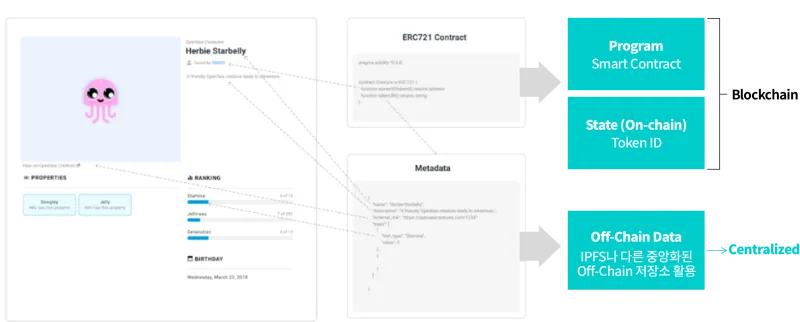
Ethereum is clearly a system capable of storing data, but high fees and privacy issues make it difficult to put important data on Ethereum — and that is exactly why. For true decentralization in a Web3 world, you need decentralized storage for large volumes of data and for personal information, and real services answering that need have started to appear.
Decentralized storage is not conventional centralized cloud storage but a distributed network made up of many storage providers — a "distributed" store where anyone can offer space and store data. It works like this: whoever provides storage space is rewarded for it, whoever stores data pays a fee based on usage, and together they build a sustainable ecosystem.
Before turning to the decentralized storage solution PARAMETA applied to PARAMETA Framework, let's look at a few of the existing decentralized storage projects.
Existing decentralized storage projects
Filecoin

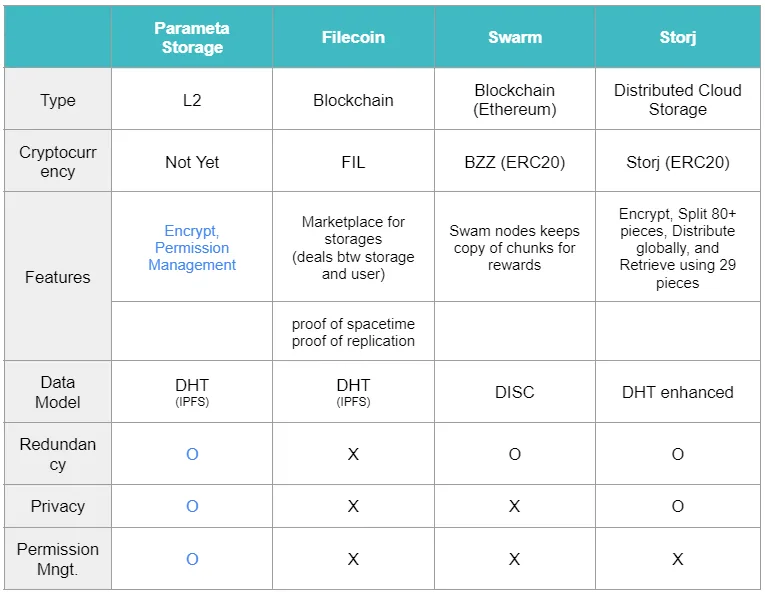
The largest project in decentralized storage is surely Filecoin. Built on IPFS (InterPlanetary File System), Filecoin provides a marketplace connecting those with spare storage space to those who need it. Once the party needing space and the storage provider strike a deal, the provider submits a Proof-of-Replication (PoRep) demonstrating that the data has been replicated and stored in its space, and receives FIL (Filecoin's coin) as a fee. It then periodically submits a Proof-of-Spacetime (PoSt) showing that it is still holding the data over the agreed term, and receives the remaining FIL. That proof system is what sets Filecoin apart, and its participants use these cryptographic proof techniques to run trustlessly and sustain decentralized storage.
Swarm
Swarm is decentralized storage offered by Ethereum and optimized for it, with the goal of providing data storage that Ethereum dApps can use. Its distinguishing feature is DISC (Distributed Immutable Store of Chunks), a data storage model that extends the DHT (Distributed Hash Table).
Storj

Storj is distributed cloud storage that encrypts data, splits it into more than 80 pieces, and stores those pieces on nodes distributed around the world. When the data is needed, 29 of those pieces are enough to reconstruct it. Encrypting and storing across mutually independent nodes is a highly effective defense against security threats such as server hacking, and because only a subset of the pieces is required for recovery, data availability holds up even when some nodes fail. Storj also offers developer convenience through an interface compatible with Amazon's S3 (Simple Storage Service), which many developers already use.
Beyond Filecoin, Swarm and Storj, countless other decentralized storage projects exist. It seems fair to say that nearly every public blockchain project feels the need to offer decentralized data storage of its own.
Privacy grows more important
"Ownership" is the single most important concept in Web3. To own something means being able to prove and control that it is yours, and NFTs can implement that to a reasonable degree. Because so much sensitive information cannot be made public, privacy support in decentralized storage matters enormously. Yet decentralized services so far have focused on decentralization rather than privacy.
Storing data in the cloud, and being able to reach it anytime from anywhere, has been a huge convenience in our lives. But data gathered in one place is an easy target for hackers, and breaches through hacking really do happen often. Even if you swap centralized cloud for decentralized storage, security stays weak wherever privacy has not been considered.
Decentralized storage therefore needs the following elements for privacy:
- Data must be encrypted with a private key so that even the storage operator cannot read it
- Only authorized people may access that data
- Access permissions must be controllable in real time
- A record of who accessed and used the data must remain, and that record must be trustworthy
PARAMETA's decentralized storage solution
The decentralized storage solution applied to PARAMETA Framework distributes and manages data in a fully decentralized way, and its privacy features make its security outstanding as well.
Encryption and access control
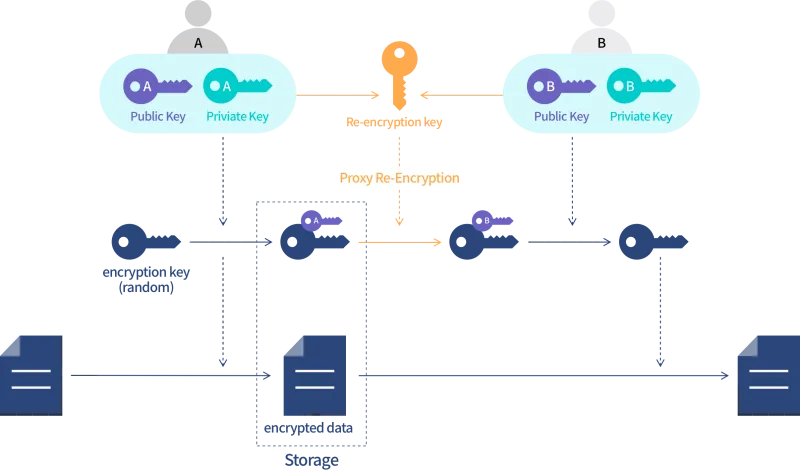
PARAMETA's decentralized storage solution has data encrypted with a private key before it is stored, so not even the storage itself can read it. That means that even if the storage is hacked, there is no meaningful data for an attacker to take.
Access is also limited to authorized people. Permission relies on asymmetric key cryptography, with a public key and a private key. Normally that means re-encrypting the data with the counterparty's public key before handing it over, and since a user cannot do that by hand every time, the data storage takes on the job instead. Which is precisely how the data storage ends up as a centralized party, bringing back all the issues of the centralized approach described above.
PARAMETA uses PRE (Proxy Re-Encryption) to achieve the same effect as encrypting with the counterparty's public key, without ever exposing the data owner's key. The data is encrypted with an arbitrary encryption key and stored, and that encryption key is then re-encrypted to match the counterparty (the public key) and delivered. This removes the need to re-encrypt stored data with the counterparty's public key before sending it, and only the designated person — the holder of the private key — can decrypt and view the data, giving you a powerful access control mechanism.
BFS (Blockchain File System)
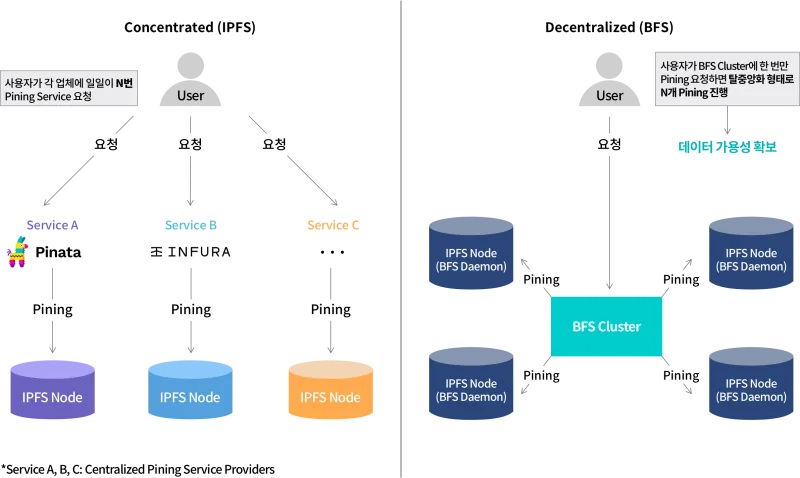
To distribute encrypted data across storage, PARAMETA's decentralized storage solution applies BFS (Blockchain File System). BFS is decentralized storage made available for use from smart contracts on the blockchain. It builds on the capabilities of IPFS nodes, a distributed storage system at heart, and offers pinning — the function that keeps data stored permanently — managed in a decentralized way.
Ordinarily, using IPFS to store data permanently means using pinning, which requires either relying on a provider that operates a pinning service or running an IPFS node yourself. That is the centralized approach mentioned earlier.
PARAMETA instead forms a cluster for the pinning service and has pinning carried out through the consensus of the nodes participating in that cluster. The cluster manages pinning so that data can be kept redundantly according to the requirements of the user who requested storage, and it keeps at least a set number of copies pinned at all times.
As blockchain and Web3 advance, interest in decentralized services keeps rising. A complete Web3 world requires decentralized data storage, and that storage has to provide improved security capable of protecting an individual's important data.
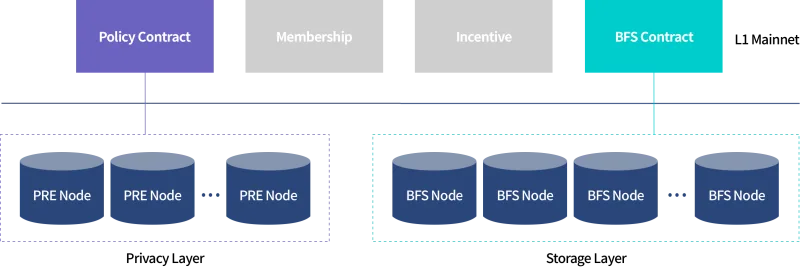
That is what PARAMETA offers with a decentralized storage solution built with significantly reinforced privacy features. It is structured as a Layer 2 and comes with its own incentive system, supporting the growth of a sustainable ecosystem.
[Reference] Go to the blog section of the official PARAMETA website ▼
PARAMETA's Decentralized Storage Solution
Through PARAMETA Framework, its own blockchain framework, ICONLOOP delivers every technology a Web3 business needs along with the full range of support required to run a blockchain efficiently. As the accumulated work of a first-generation blockchain company, PARAMETA Framework carries plenty of differentiated technology, and here we take a close look at one piece of it: a decentralized storage solution that strengthens decentralization and raises security substantially. Why data storage needs to be decentralized ICONLOOP's decentralized...
www.iconloop.com
Web3 Enabler, PARAMETA