

The interchain NFT playground built on PARAMETA, in the words of the person leading it
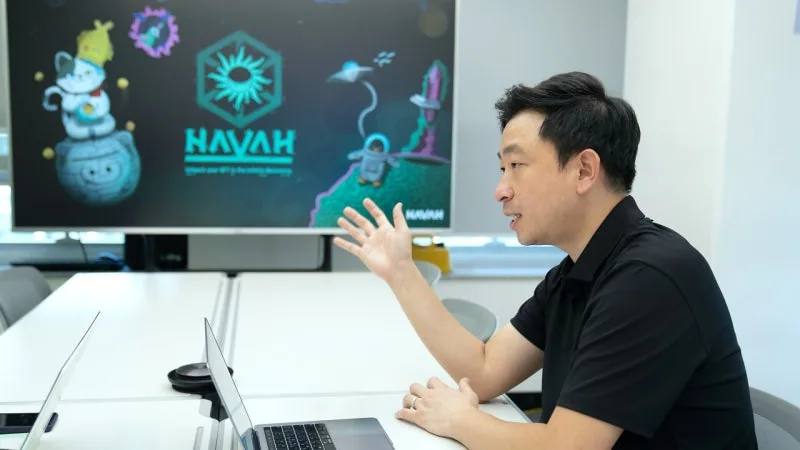
Here is an interview with Younggwang Lim, CEO of W3S (Web3 Solutions), who leads HAVAH — the Interchain NFT Playground built on ICONLOOP's blockchain framework, PARAMETA.
It covers where the project stands right now and what services are on the way, so give it a read.
HAVAH is an interchain NFT entertainment platform created to solve fragmentation, one of the defining limits of Web3. It is currently working through proof-of-concept (PoC) stages such as sending an NFT minted on Binance Smart Chain (BSC) over to Klaytn.
Seventy people across ICONLOOP, Twobyte and Web3 Solutions are currently working on HAVAH. The three companies each bring their own strengths and drive the project jointly. Web3 Solutions leads the project — designing the token economy, lining up partners — while ICONLOOP supplies the blockchain core technology and Twobyte handles marketing, games and content.
Meeting <CoinDesk Korea> on the 1st at the Twobyte office in Anyang, Gyeonggi Province, Younggwang Lim, CEO of Web3 Solutions and head of the HAVAH project, said: "We plan to launch the official service at the end of this year, and to support six chains in total — Ethereum, Klaytn, Solana, Polygon and ICON — before the first half of next year." He added, "If Ethereum's Merge upgrade wraps up before October as scheduled, we want to connect Ethereum first."
Even the name HAVAH carries the ambition of an interchain platform. The working name was originally Sphera, but an internal naming contest settled on hava, the Turkish word for sky. "Just as the sky has no end, we want to connect blockchains without end — that is why we went with HAVAH," Lim said, before sharing the story behind the spelling: "The Turkish word is actually HAVA, but we added an H at the end for the design."
Asked why they chose PARAMETA as their mainnet, Lim pointed to the absence of technical constraints. "PARAMETA is the only interchain that can connect networks built on different protocols," he said. "At a stage where we are trying to commercialize interchain, PARAMETA was the obvious choice precisely because there are no limits."
HAVAH is preparing Crypto Gears, a game that lets you use an NFT as an in-game item no matter which network it was minted on — Ethereum, Solana, anything. The plan is to finish closed beta testing and release it officially within the first half of next year.
There are two things on HAVAH I am most excited about. The first, Crypto Gears, is a new attempt at letting NFTs minted outside a game exert influence inside it.
That said, external NFTs are not brought over as-is. Crypto Gears is a game about robots battling on Mars, and you cannot exactly fight with a frog NFT. Instead, bringing an outside NFT in earns you benefits — claiming better land, gathering resources faster and so on. The NFT is not burned either, so users can send an NFT inside the game back to its original network whenever they want.
The second is multi-chain GameFi (Game-Fi, a service that grafts DeFi elements onto blockchain games). It will arrive around the same time as Crypto Gears. The structure lets you borrow or repay NFTs sitting on different networks and share the resulting yield. We want to show, intuitively, how much better the experience gets when NFTs from many networks are gathered on HAVAH.
HAVAH is also putting serious effort into fixing another of Web3's major limits: awkward user experience (UX).
Until now, users transferring assets through a bridge had to hold tokens on both connected blockchains, because fees are charged on each side. (Using a BSC-to-Klaytn bridge, for instance, means paying the BSC fee in BNB and the Klaytn fee in KLAY.)
By the end of the year we plan to launch HAVAH Meter, a service that clears away that hassle.
Lim also stressed that soulbound tokens (SBTs) can work effectively on the HAVAH network. An SBT — a concept introduced by Ethereum founder Vitalik Buterin this May — is a token that cannot be transferred or sold from the wallet that first received it, much like a medal or decoration you cannot hand off to someone else.
Say you want to give an SBT to users whose NFT trading volume tops KRW 10 million. Normally only users who generated that much volume on a single network would qualify. Users who traded KRW 2 million on each of five other networks would be left out. On HAVAH, though, you can aggregate those users' trading histories and award the SBT. That makes HAVAH a very natural home for SBTs.
Lim also described HAVAH as a multi-sidechain: it exists as a sidechain to several blockchains at once and can provide interoperability between them. HAVAH's ultimate goal is to let users freely use their NFTs anywhere, without ever needing to know where they were minted.
"The HAVAH project will give game players the experience of owning the items minted as NFTs themselves, rather than the game company owning them," he said confidently. "Beyond that, we will gather assets scattered across networks and let those assets move between them."
Source: CoinDesk Korea, reporter Jihyun Ham (September 10, 2022)
Any NFT You Like, Usable on HAVAH! — CoinDesk Korea
In a previous interview we briefly mentioned HAVAH as the first project built on PARAMETA, ICONLOOP's own blockchain framework. HAVAH is an interchain NFT entertainment platform created to solve fragmentation, one of the defining limits of Web3...
www.coindeskkorea.com
Life Meets Blockchain, ICONLOOP