

As digital technology advances, the use of personal data keeps growing and its economic value keeps rising, and MyData is drawing attention as a way to strengthen individual sovereignty over personal data while building an ecosystem for the data industry.
In this post we want to talk about MyData, and about PDS (Personal Data Storage) — the personal hub at the heart of it.
What is MyData?
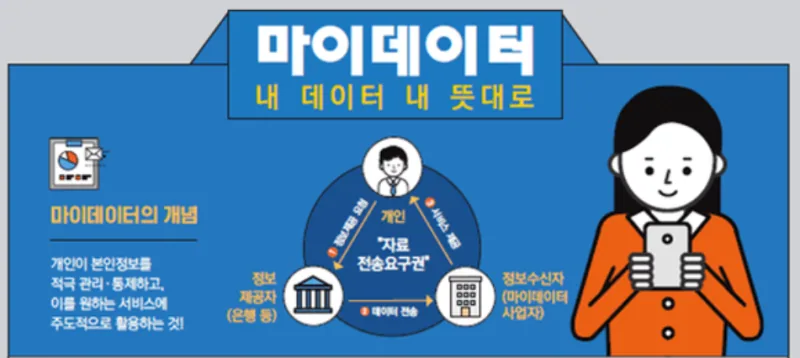
MyData is the process by which individuals, as the subjects of their own information, actively manage and control that information and put it to proactive use in their own lives — for credit management, asset management, and even health management.
Financial Services Commission
You could describe MyData as a system that shifts information sovereignty over customer data — financial asset information, credit information and the like — from financial institutions to the individual. In other words, MyData returns ownership of personal information to the person it belongs to, so that you can directly control how your data is managed and used. Its purpose is also to create new business: customer data that used to be scattered around or monopolized by particular companies can now be gathered broadly, at the customer's discretion.
Where does Korea's MyData business stand?
Korea has embraced MyData too, updating related rules such as the Three Data Acts and pushing forward financial services like MyData and MyPayment alongside a full opening of the payment infrastructure.
The expectation is that this will let you pull financial services scattered across many institutions into a single, optimized set of services built for you — and that personalization will go beyond finance, integrating health information and more so you receive health insights tailored to you.
The government-led MyData initiative is currently running along two tracks: MyData 1.0, where designated operators collect the data, and MyData 2.0, where a separate personal data store such as a PDS is built, data is entered there, and users log into the PDS and choose for themselves what to hand over.
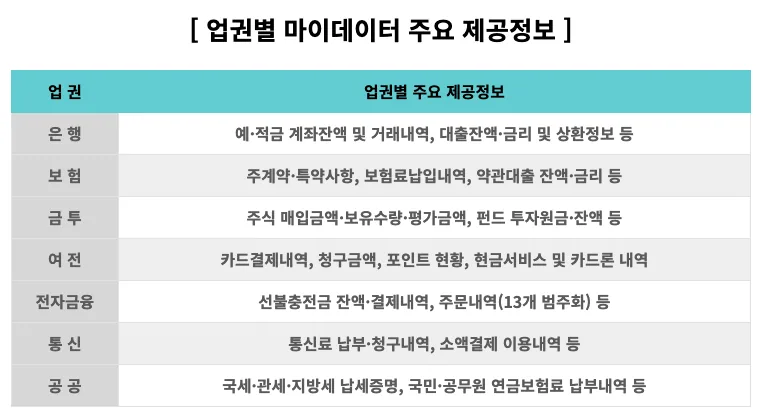
MyData 1.0
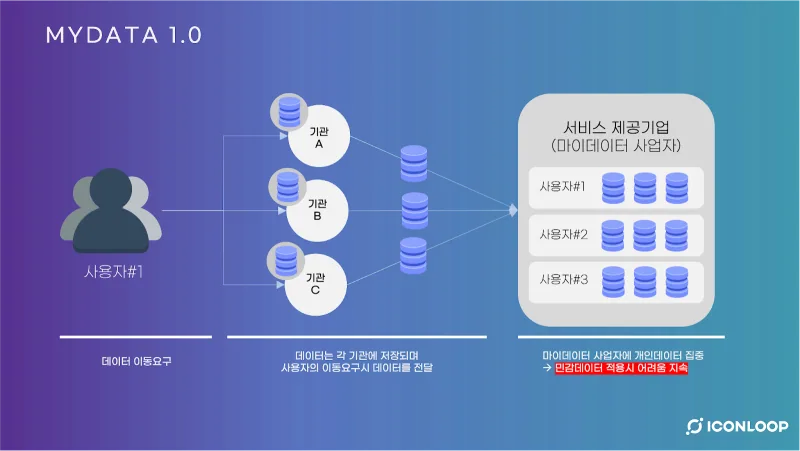
MyData 1.0 works by selecting MyData operators and granting them licenses. Once licensed, an operator can collect a customer's personal information from across multiple financial institutions with nothing more than the user's consent. Korea's major financial firms and big tech companies applied accordingly, and 59 institutions now hold licenses and are running businesses under them. ( See the list of approved personal credit information management businesses >> )
MyData run through licensed operators — the MyData 1.0 shape — has its limits: in practice the institutions holding the data are the same ones as before, so it is hard for users to exert real control. There are also concerns that personal information once scattered across many institutions ends up concentrated in the MyData operator, creating another Big Brother.
MyData 2.0
MyData 2.0 separates out a PDS (personal data store), enters the data into that store, and has the user log into the PDS and select for themselves which information to provide to a service provider. Because data is not concentrated in any one institution, the associated risks do not arise — and service providers carry a lighter burden too, since they no longer have to handle the security issues that come with storing personal information themselves.
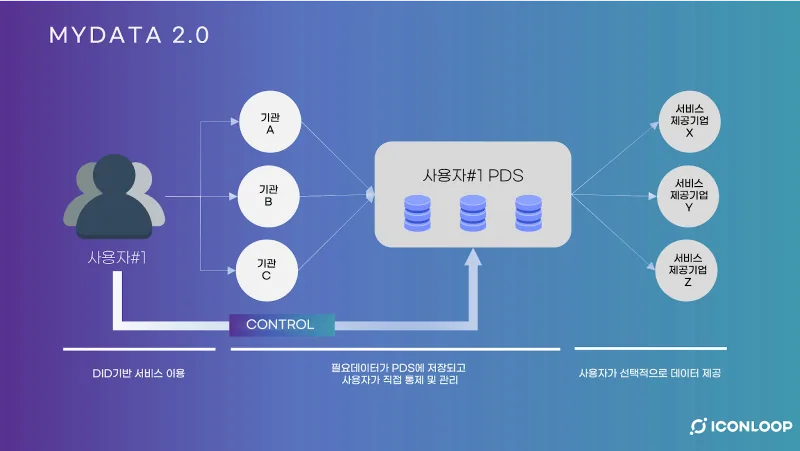
A PDS, as mentioned above, is a personal secure store that encrypts sensitive personal data so that only you can unlock it, keeps it separately, and lets you grant access to others as needed. The store itself cannot see your data, and only the people you authorize can access it, only for the period you authorize — which is why it is drawing attention as the core technology of MyData 2.0. Blockchain plays a crucial role in guaranteeing the reliability and integrity of the data held in a PDS, and PARAMETA has developed its PDS on its own proprietary technology and offers it in a variety of forms.
>> PARAMETA's blockchain framework, PARAMETA (learn more >>)
- Introducing PARAMETA 3 — Key Components (2)
- In the previous post we walked through PARAMETA's key components: the core engine, the governance...
- blog.naver.com
➡️ PDS is offered as a key component of PARAMETA, the blockchain framework for building mainnets optimized for Web3 business.
>> Gyeongsangbuk-do digital identity verification MyData platform (learn more>>)
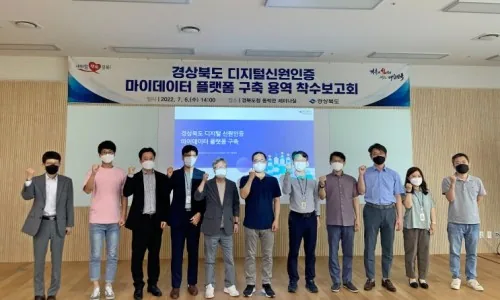
➡️ PARAMETA's PDS technology is applied so that sensitive personal information can be stored and used safely when the Ministry of the Interior and Safety's public MyData is used to verify the Gyeongbuk provincial resident ID. The store itself cannot see your data, and only the people you authorize can access it, only for the period you authorize…
>> MOU with first-generation MyData operator Gitple to pursue a blockchain-based MyData business (learn more>>)
- ICONLOOP and first-generation MyData operator Gitple lay the groundwork for a hyper-personalized MyData era built on PDS
- ICONLOOP has signed an agreement with first-generation MyData operator Gitple Inc. on PDS (Persona...
- blog.naver.com
➡️ The heart of this agreement is applying PARAMETA's PDS technology to Gitple's MyData platform so that it can handle not only financial data but also non-financial, everyday convenience information. To that end, the two companies plan to turn information from areas such as health, transport and telecommunications into data through PDS technology, combine it with the financial information already in scope, and complete a hyper-personalized MyData offering that puts far broader data use into practice…
MyData 2.0 is the approach that stays true to what MyData is really for — returning ownership of personal information to the individual — and the expectation is that the business will gradually expand and scale toward PDS-based MyData.
PARAMETA has focused on user-centered data distribution all along, with Zzeung, Korea's first DID service in the financial sector, and Jeju Safe Code, the Jeju tourism quarantine system. We will keep working through DID, PDS and other technologies to return data sovereignty to users and build a society you can trust.
Web3 Enabler, PARAMETA