

The recent Nomad Bridge hack caused more than KRW 250 billion in damage, and once again the calls are growing louder for real answers on blockchain bridge security.
This is far from the first time bridges — the cross-chain solutions that connect blockchains to one another — have been hacked.
Major bridge hacks of 2022
Feb 2022, Solana Wormhole Bridge - KRW 390 billion (USD 300 million)
Apr 2022, Axie Infinity Ronin Bridge - KRW 750 billion (USD 600 million)
Jun 2022, Harmony Horizon Bridge - KRW 130 billion (USD 100 million)
Aug 2022, Nomad Bridge - KRW 250 billion (USD 190 million)
...
According to Chainalysis, roughly 13 incidents have occurred so far in 2022, including the major cases above, with damages exceeding USD 2 billion (about KRW 2.6 trillion). Bridge hacks now account for close to 70% of all hacking losses.
So why are bridge solutions so vulnerable?
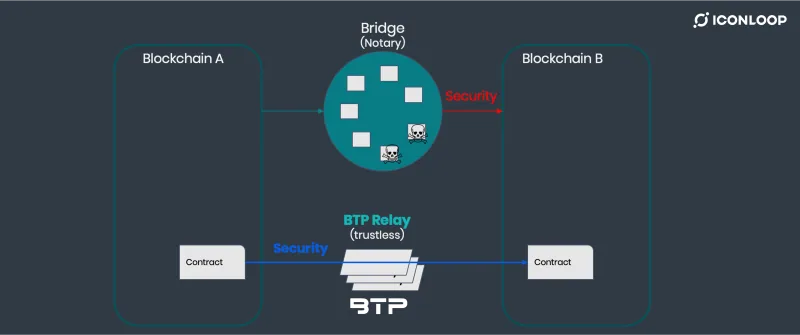
Here is how a bridge works. When an asset moves between blockchains, the token is locked up on the sending chain (the source blockchain) and reissued as a wrapped token on the receiving chain (the target blockchain). The fact that the token was locked is verified by a TTP (Trusted Third Party) in the middle — an intermediary validator — and that is where the trust comes from.
Today's blockchains achieve a high level of security through decentralization, but if the intermediary validators are not decentralized, or their security is weak, the bridge service inherits that weakness. If even some of those intermediary validators are compromised, an attacker can mint wrapped tokens on the receiving chain however they like.
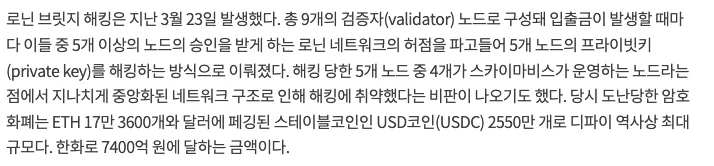
The Ronin Bridge hack last April was exactly that: weak security caused by centralized validators.
So can BTP (Blockchain Transmission Protocol) solve this problem?
The root cause with bridge solutions like the above is that no matter how trustworthy the source and target blockchains are, security collapses at the intermediary validator.
BTP works differently. Instead of a TTP or any intermediary validator, it verifies through smart contracts: the BTP Message generated on the sending blockchain and the Proof that attests to it are delivered as-is to the receiving blockchain. BTP therefore carries over the security of the sending blockchain, and short of the sending blockchain itself being hacked, there is almost no way to compromise it.
What does BTP (Blockchain Transmission Protocol) look like inside?
BTP consists of smart contracts and a Relay that delivers BTP messages.
On the smart contract side there are the BTP-related BMC (BTP Message Center) and BMV (BTP Message Verifier), plus the Lock, Mint, and Burn contracts tied to the bridge service.
Send the token you want to move to the target blockchain into the Locker and lock it, and a message stating that it has been locked is generated together with a proof. The Relay carries that to the target blockchain. There, the incoming BTP message is verified through the BMV, and if everything checks out, the Minter creates new wrapped tokens matching the locked amount.
No separate validator sits in the middle of this process. Verification uses the source blockchain's proof directly, so there is no security issue.
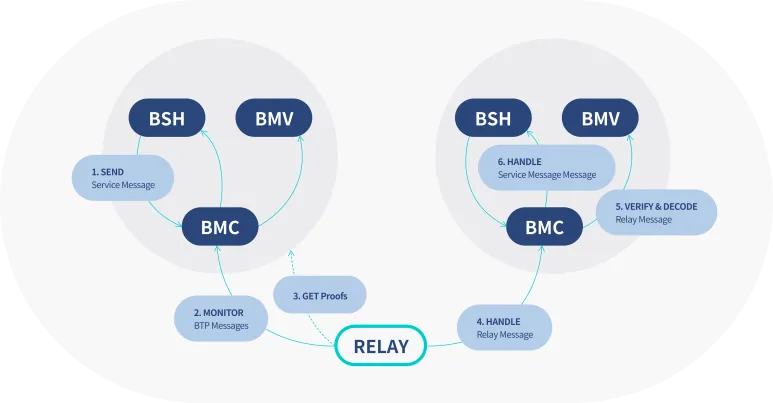
The heart of it is that the BMC generates the message to be delivered to the counterpart blockchain and the counterpart BMV verifies it — and because the whole process runs on smart contracts, it can be trusted.
With BTP you can call smart contracts that live on other blockchains. And since the whole thing is built out of smart contracts, any blockchain that supports smart contracts can, in principle, be connected — though details vary from chain to chain.
As new mainchains keep appearing to suit different business environments, a multichain ecosystem is taking shape. Connecting chains is steadily becoming a requirement rather than an option. With the Web3 market growing at extraordinary speed, enormous amounts of assets and value are expected to move across chain-to-chain connections in the years ahead.
Since its founding in 2016, PARAMETA has pursued the vision of Hyperconnect the World and researched blockchain interconnection without pause. BTP is the culmination of that vision, and we will use it to build safer, more trustworthy connections between blockchains.
* For an introduction video and materials on BTP, see the links below
Related video
Related Posts
- ICONLOOP's Interchain Technology, BTP (Blockchain Transmission Protocol)
- Blockchain projects are underway all over the world, and with so many dApps...
- blog.naver.com
Web3 Enabler, PARAMETA