

Economies online and off have been stuck in a downturn worldwide. A prolonged war has squeezed food supply and sent oil prices soaring, major economies including the US have held rates low, and the resulting acceleration in inflation has rattled the offline economy. Virtual assets, meanwhile, have slid across the board for reasons of their own — delivering a shock to the online economy at the same time.
If past contractions are any guide, a winter-like lull can just as easily become the moment that opens up opportunities on several fronts — and the broad current pulling things forward, built on Web3, is hard to argue with. Within that current, NFTs (non-fungible tokens) stand out as an asset class expected to gain value in the Web3 era, and the assessment of their potential keeps climbing. The steady stream of large companies in Korea and abroad adopting NFTs is proof enough.
So what exactly is an NFT, and where is it headed?
NFT
Non-fungible token
An NFT is a blockchain-based token that cannot be exchanged or duplicated, which gives each one its own uniqueness and scarcity. The name says it: non-fungible. The clearest way to pin down what "non-fungible" means is to compare it with its opposite, the FT (fungible token).
A fungible token is one whose units all carry the same value and the same function, so they can be swapped for one another. A KRW 100 coin in your pocket is worth exactly as much as someone else's KRW 100 coin, so the two can trade places freely. By the same logic, assets that substitute for one another — Bitcoin (BTC), Ethereum (ETH), ICON (ICX) — are all a kind of fungible token. (Strictly speaking, a coin used on its own blockchain network, or mainnet, is not the same thing as a token built on top of an existing blockchain.)
An NFT is different: every token carries unique information or traits, so its value differs from every other token's, and no two can be swapped. It uses blockchain technology just as an FT does, but unlike the virtual assets described above it attaches a separate, unique identifying value to a digital asset — which is exactly why they cannot be exchanged. In short, what separates "fungible" from "non-fungible" is whether each token holds information or characteristics of its own.
An NFT can also be described as a proof-of-originality technology that acts as a "digital certificate of authenticity" for a particular asset. Because it can confer scarcity and singularity on a virtual asset, its influence keeps spreading into digital art, game item trading, online sports, and plenty of other fields.
So how does the blockchain technology underneath an NFT actually work?
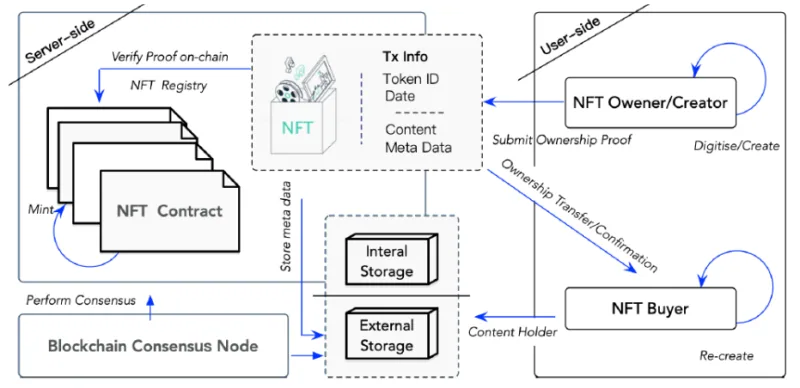
* Source: Non-Fungible Token (NFT): Overview, Evaluation, Opportunities and Challenges, 2021. 05
An NFT system runs on a blockchain, which can transmit and store data across a peer-to-peer (P2P) network. Because a blockchain is a distributed ledger, any participant can transparently check and verify the transaction history. A smart contract — program code that executes automatically once certain conditions are met — defines the token's behavior and issues it.
Participants in an NFT system fall into two groups: creators and buyers. A creator can take an analog or digital good and issue it as an NFT through the system, a process called minting. Every time an NFT is issued or sold, a smart contract runs and a new transaction is broadcast; once the blockchain confirms the transaction, the NFT's metadata and owner information are added to a new block.
When a buyer purchases an NFT, metadata such as the work's owner, purchase price, transfer of ownership, and acquisition price is stored on the blockchain. The buyer can hold ownership of the NFT work, but does not receive the creator's actual creation (the painting, the photograph) or the original file. The creator earns a payout every time the NFT sells and changes hands.
* Key NFT protocols
NFT Digitize
The NFT owner checks that the file, title, and description match exactly. The owner converts the raw data into digital information in a suitable format.
NFT Store
The NFT owner stores the raw data in a database outside the blockchain. The owner decides, through a gas-consuming instruction, to store the raw data on the blockchain itself.
NFT Sign
The NFT owner signs the transaction containing the NFT data and sends that transaction to the smart contract.
NFT Mint
The smart contract receives the transaction carrying the NFT data and mints the NFT. The token standard defines the NFT's internal functions.
NFT Confirm
The minting process completes once the transaction is confirmed. The NFT is linked to a unique blockchain address as permanent proof.
* Source: Non-Fungible Token (NFT): Overview, Evaluation, Opportunities and Challenges, 2021. 05
Now for the vocabulary you will run into around NFTs.
Minting
The term for "issuing" an NFT — creating an NFT of a digital asset such as an image or a video. Early raffles or first-come purchases of a new NFT are also called minting.
Whitelist
A list of people who get priority access to buy an NFT. Everyone on it can purchase ahead of the general public, and with less hassle. Projects typically pick out people who show interest early on and grant them minting rights, which encourages word of mouth and helps the project take off.
Drop
Uploading an NFT to an NFT marketplace for sale — in other words, the moment the NFT goes public.
PFP (profile picture)
A type of NFT that can be used as a profile picture across NFT communities and social platforms. Lately, expressing your identity through a PFP has become a culture of its own.
OpenSea
The world's largest NFT exchange, built on Ethereum, where NFTs can be issued and traded.
PARAMETA is building its own corner of the new Web3 era by layering applied technologies, NFTs among them, on top of the core technology of its blockchain platform. Here is the first project to use PARAMETA's NFT technology: HAVAH.
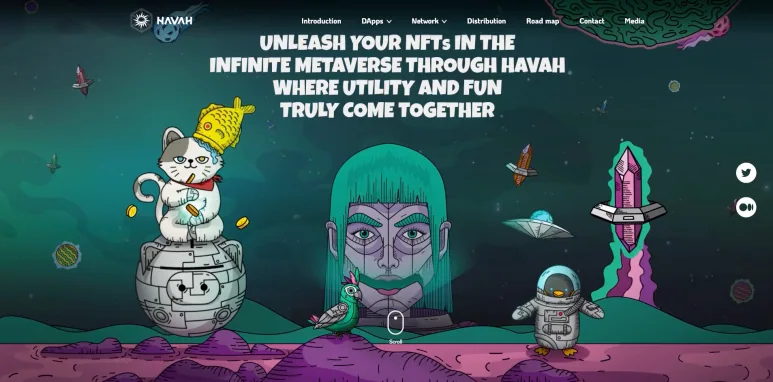
HAVAH is an interchain NFT entertainment platform that connects NFTs issued on chains across gaming, social, finance, and more. It is the first mainnet built with PARAMETA Framework, the in-house blockchain framework PARAMETA offers for Web3 businesses. The project draws on PARAMETA's blockchain technology across the board — the blockchain platform itself, interchain, a blockchain wallet, governance and token economy, NFTs, DEX — and is a collaboration between PARAMETA, the ICON Foundation, and Korean game studio 2bytes.
[Reference] Go to the official HAVAH project website ▼
- HAVAH
- Utilize your NFTs no matter the network, no matter which dapps.
- intro.havah.io
[Reference] Go to the blog section on the official PARAMETA website ▼
NFT (Non-Fungible Token)
Economies online and off have been stuck in a downturn worldwide. A prolonged war has squeezed food supply and sent oil prices soaring, major economies including the US have held rates low, and the resulting acceleration in inflation has rattled the offline economy. Virtual assets, meanwhile, have slid across the board for reasons of their own, delivering a shock to the online economy at the same time. If past contractions are any guide, a winter-like lull can just as easily become the moment that opens up opportunities on several fronts — and the broad current pulling things forward, built on Web3...
www.iconloop.com
We appreciate your interest.
Web3 Enabler, PARAMETA