

The previous post looked at PARAMETA's core components: the core engine, governance and token economics, and interchain. This post turns to the base services, developer support and management tools that let a blockchain platform host all kinds of businesses.
* Previous posts
PARAMETA Introduction 1 - What Is PARAMETA? ( Go > )
PARAMETA Introduction 2 - Key Components (1) ( Go > )
1. Decentralized exchange, DEX
Most mainnets these days run DeFi services, and the foundation underneath them is the DEX, the decentralized exchange.
Exactly as the name says, it is a service for swapping tokens in a decentralized form rather than on a centralized crypto exchange. Token swaps happen automatically according to a set of rules.
If you build a mainnet, all kinds of tokens can appear on it, and you need a platform for exchanging those tokens as a matter of course.
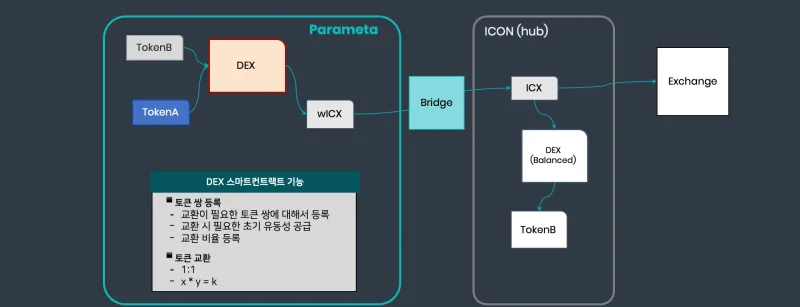
PARAMETA supports smart contracts with DEX functionality. With a little configuration and some liquidity you get automatic token swaps, and connecting that to the bridge lets you swap into listed tokens on other blockchains — an effect similar to being listed on an exchange.
2. Private key storage and management with Vault and Secret Sharing
One of the big differences between a blockchain and an ordinary service or program is the private key. Ownership and authority over every action are confirmed by a private key signature.
So you generate a private key, keep it locally, and use it for everything you do.
But if you lose that private key — a lost or stolen device, say — there is no recovering it. That is the nature of a private key, and the reason it is so secure.
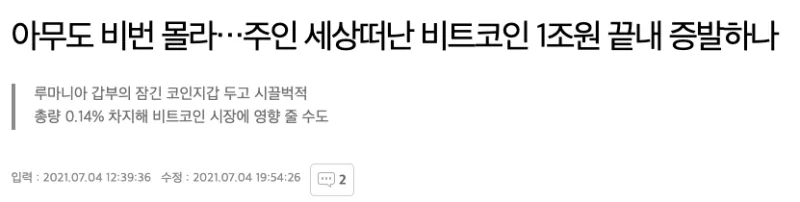
In the real world, though, private keys do get lost, and you have to be ready for it.
This is not a function of the blockchain core but something that has to be provided on top, so blockchains generally do not ship it and you have to build a separate solution.
PARAMETA provides a solution for private key backup and recovery as well. The Vault solution uses secret sharing technology.
Secret sharing splits a secret into several clues, backs them up across different server stores, and restores the original when needed by retrieving at least a threshold number of clues.
Unless clues meet that threshold the original cannot be restored, and partial clues reveal nothing about it, so short of the server stores colluding, the chance of a private key leaking is vanishingly small.
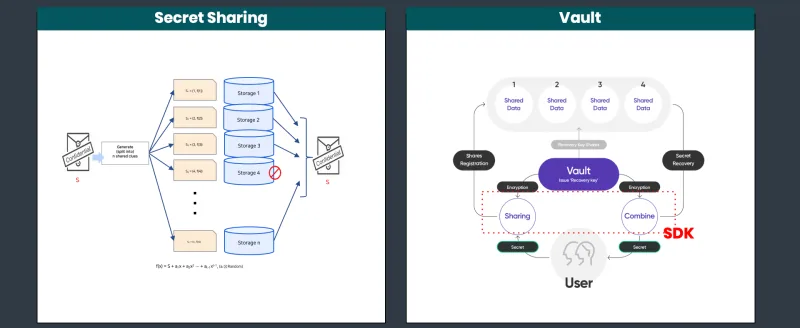
PARAMETA provides an SDK that uses secret sharing to split a secret into clues and restore it again, and you can apply it when implementing a wallet.
We also participate in operating the server stores so the split clues are kept safely.
3. Block Explorer & API
A blockchain stores transactions, their execution results and state data, but not in a form that is easy for people to view or query — so that data is usually reorganized and served under the name Block Explorer or Scanner.
It arranges block, transaction and smart contract information so it is easy to read and search, and adds supplementary data such as token details and token holder lists, along with statistics.
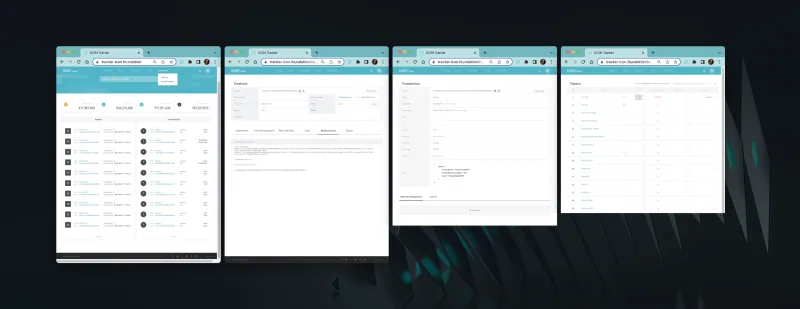
PARAMETA likewise provides an Explorer and a backend API server that serve this data quickly and easily.
4. Blockchain Wallet
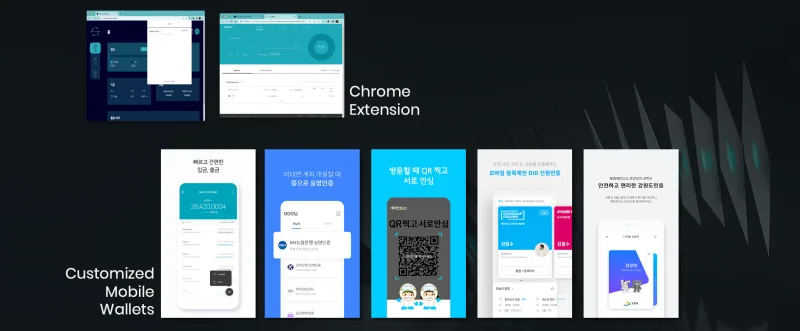
In blockchain, the wallet plays a critical role as the point of contact between users and services.
You could offer a single unified wallet for everything, but that makes for a badly inconvenient UX.
Implement a separate wallet per service, and you can shape a UX where users never even need to be aware that the service runs on a blockchain. That is why PARAMETA provides an SDK for building custom wallets.
5. Developer support tools
Once a mainnet exists, DApps get built and served on top of it — and to host a lot of DApps, building a DApp has to be easy and support has to be fast.
PARAMETA provides the development tools, guides, samples and SDKs needed to build DApps, plus tools for managing blockchain nodes and the chain itself. And if running blockchain nodes yourself is difficult, we can operate them on your behalf.
6. Support for multiple languages (Java, Python, (Solidity - planned))
In the early days of blockchain, Solidity was an unfamiliar language and many people found the VM too slow to work with. So mainnets that appeared after Ethereum adopted smart contracts supporting a variety of programming languages — Java, Python, Rust, C++ — rather than Solidity. Recently, though, as more and more work has been built in Solidity, demand to reuse that work as-is has grown, and with it demand for Solidity support.
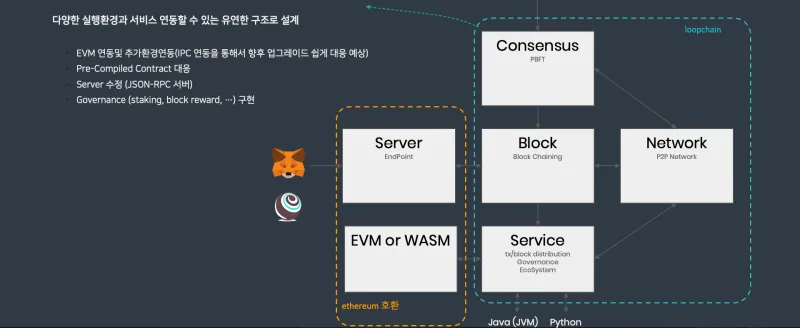
In response, PARAMETA plans additional development on loopchain to support EVM-compatible Solidity. loopchain was designed to support multiple programming languages such as Java and Python, so wiring in EVM support is relatively straightforward. And by adding an Ethereum-compatible API server, we expect Ethereum's development tooling to work as-is.
7. PDS/BFS, secure data storage usable from dApps
You cannot put bulk data or personal information on a blockchain. It is an open space and a permanent record, so secrets cannot go there, and bulk data runs up so much gas that uploads are limited. So the usual answer is an off-chain data store called IPFS. Plenty of NFTs are minted using IPFS these days.
But IPFS does not guarantee data availability. If an IPFS node fails or the service stops, that off-chain data becomes unreachable.
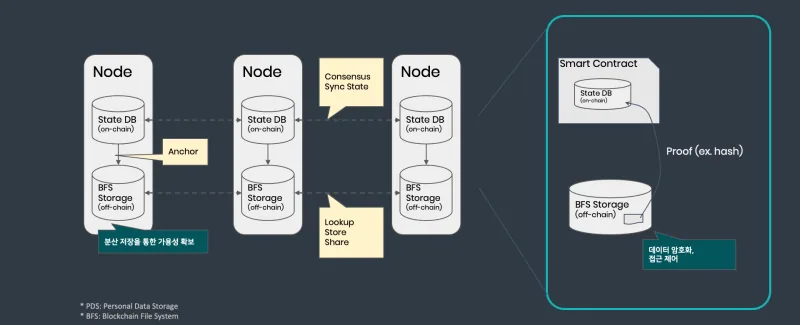
Various distributed storage systems and blockchains have appeared to give IPFS guaranteed availability, and we think PARAMETA needs this capability too — so distributed storage is on the roadmap.
That means you can run an off-chain data service with guaranteed availability using only blockchain nodes, with no separate IPFS nodes to stand up. It should also prove useful as MyData services for personal and medical information — likely a foundation of Web3 — take off.
USE-CASE
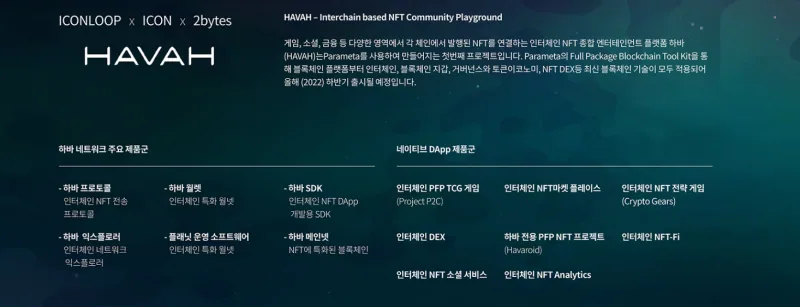
PARAMETA has built and operated the ICON public blockchain. We gathered all the technology and know-how accumulated over that time into PARAMETA, and we are using PARAMETA to build a mainnet called HAVAH.
HAVAH is an NFT Community Playground project — a mainnet platform that lets you bring NFTs issued on various mainnets over to HAVAH and put them to use in games and elsewhere.
Because NFTs have to be transferred in, interchain technology is essential, which is why it is being developed with PARAMETA.
HAVAH uses PARAMETA components including loopchain, the bridge, the wallet and the explorer.
PARAMETA VS.
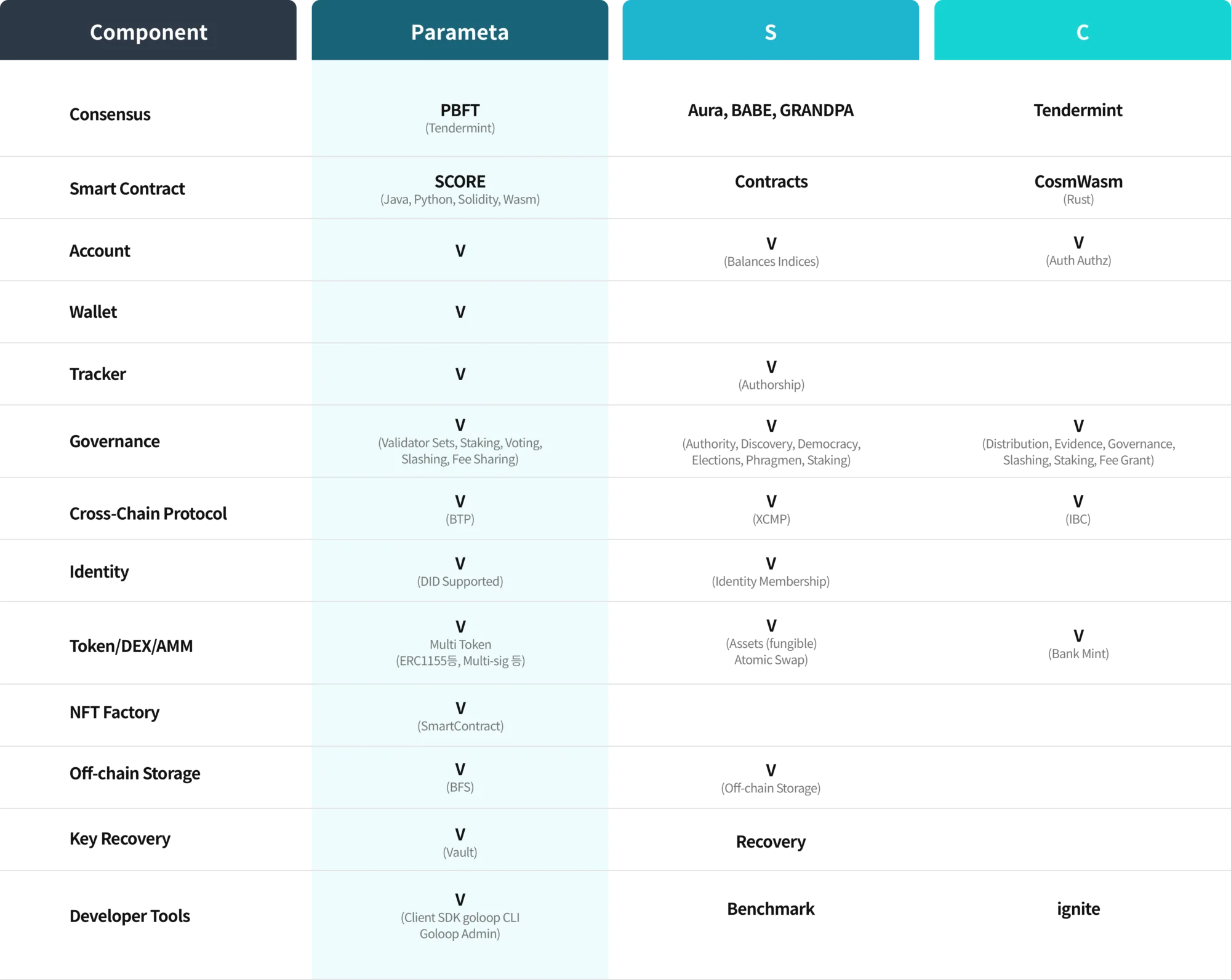
PARAMETA set up a blockchain R&D lab at the very start of the business in 2016 and, with the largest and most accomplished development team in Korea's blockchain industry, has researched and developed everything from the blockchain core to the technology behind blockchain services.
And by delivering private blockchains and services across a wide range of settings — public blockchains such as the ICON project, public institutions including the Seoul Metropolitan Government, financial bodies such as the Korea Financial Investment Association, and private companies such as the Korea Gold Exchange — we have been able to prove our technology and build up operational know-how.
Blockchain technology has not yet reached maturity and plenty of problems remain to be solved, but on the strength of that work we are clearing them one by one and moving forward. And it now looks certain that most services will eventually shift onto blockchain and Web3. In a transitional period like this one, development has to rest on solid foundational technology if you want to respond quickly and nimbly to whatever changes come.
PARAMETA wants to use the technology and experience it has built up, along with the full-stack products needed to launch a mainnet, to help many companies move to Web3 quickly. Not as a mere technology vendor but as a collaborating partner: we plan to build the ecosystem together, from consulting through to token economy. We hope you will keep an eye on PARAMETA and cheer us on.
Web3 Enabler, PARAMETA

Related posts
<Previous posts>
- PARAMETA Introduction 1 - What Is PARAMETA?
- This past June we unveiled a way to build your own optimized blockchain mainnet ...
- blog.naver.com
- PARAMETA Introduction 2 - Key Components (1)
- The previous post covered how PARAMETA came about and how it is put together as a whole ...
- blog.naver.com
Web3 Enabler, PARAMETA