

The previous post covered how PARAMETA came about and how it is put together as a whole. Picking up from there, this post goes into each of PARAMETA's components in more detail.
* Previous post
PARAMETA Introduction 1 - What Is PARAMETA? ( Go > )
The components of PARAMETA
1. Blockchain Core - loopchain
First up is the blockchain core, loopchain.
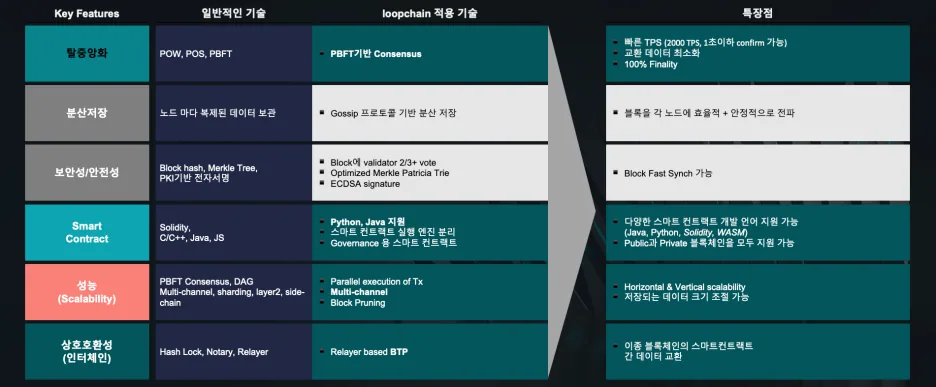
Developed in-house from the earliest days of the business rather than borrowed from open source, loopchain is a core engine that holds on to the fundamentals of blockchain — distributed storage, security and decentralization — while dramatically improving performance.
Its PBFT-based consensus algorithm delivers fast finality and high TPS, and we built our own hybrid p2p network that takes the best of gossip and structured networks.
For smart contracts it supports Python and Java, the languages with the largest developer bases, with Solidity and WASM to follow. Another distinguishing choice: governance is separated out of the core so it can be developed independently.
Beyond using PBFT consensus for performance, loopchain was designed to raise throughput by executing transactions in parallel (Parallel Execution of Tx) and to spread load by assigning different channels to different services through multi-channel technology.
It was also built from the ground up to support the interchain protocol BTP. Interchain has to be supported at the blockchain core for its security to match that of the chain itself. When it is not built into the core, you end up applying a separate validator set for security — which means either overhead or weaker security. With interchain in the core, the chain's own high security level is preserved, which is a clear advantage over interchain built on validator-based bridges.
2. Governance & Token economy
Building governance can be the single most important reason to stand up an independent mainnet.
A mainnet needs to carry the project's own business logic and apply governance and token economics optimized for it. The more complex that logic, the harder it becomes to implement on an existing mainnet, whether because of gas costs or smart contract limitations. That is why so many teams want a mainnet of their own.
As governance and token economics grow more complex, they need thorough verification to be stable. PARAMETA's strength here is that it has not only developed technology against a wide range of requirements — the governance voting system and token economics on ICON, block rewards, incentive structures for participants, funding the reward pool on the HAVAH mainnet — but has also operated them in production, which makes for more optimized and more stable design and implementation.
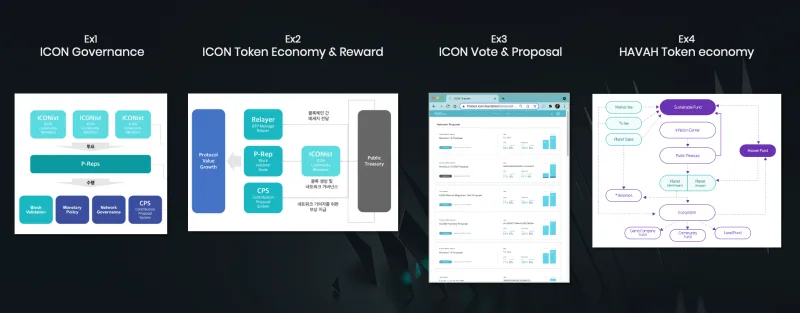
We aim to generalize these pieces into modules and libraries for convenience, but every project has its own business direction, variables and environment, and going it alone without consulting is genuinely difficult. Drawing on this body of experience, know-how and existing work makes even fairly complex business logic straightforward to implement.
This kind of business logic is also closely tied to the core's consensus algorithm, which means modifying the core. Forking an existing blockchain and patching it can send development difficulty through the roof and reduce stability, so it matters that you either build the mainnet yourself or get support from a company that owns the core technology.
3. Connecting blockchains - BTP
PARAMETA's biggest point of differentiation is its interchain technology.
From the start of our blockchain business we expected a wide range of mainnets to take off, and we committed to interchain development. The result is our own interchain protocol, BTP, which we commercialized and which currently runs as version 1.1 on the ICON mainnet.
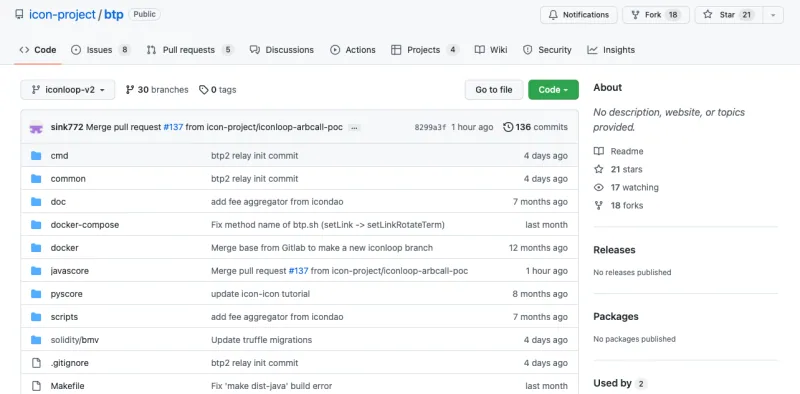
BTP is an interchain protocol designed to exchange data and messages between different kinds of blockchains.
When people hear "interchain" they usually picture a bridge that moves asset tokens. On a blockchain, moving an asset means locking a token on one chain and minting an equivalent new token on another.
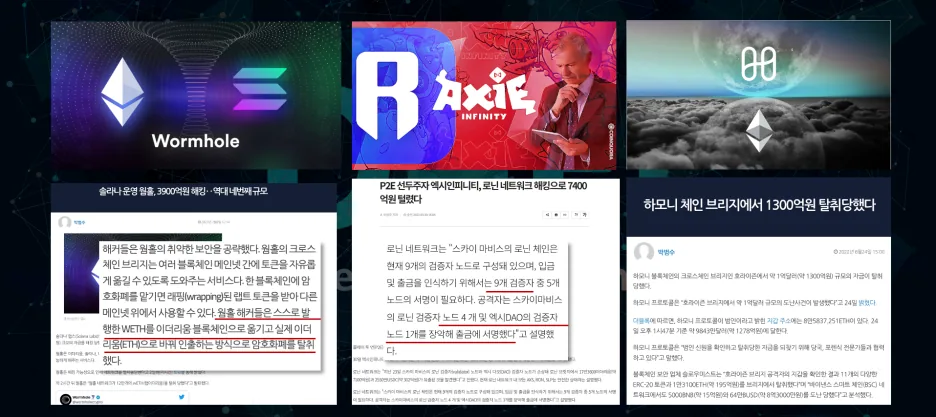
Today's bridges typically have a TTP (Trusted 3rd Party) in the middle verify that the token was locked on the source chain. Some try to decentralize that TTP by turning it into a separate blockchain. But a TTP ends up acting as a security weak point, and breaches keep happening. Axie Infinity's Ronin Bridge and Harmony's Horizon Bridge are recent examples of security incidents on exactly this kind of intermediary-verifier bridge.
BTP is interchain technology that moves assets without that intermediary TTP, preserving the security of the source blockchain as it goes. It is built entirely from smart contracts, and its distinguishing feature is BMV, a lite-client-style verifier that can verify the counterpart chain. Keeping each chain's security intact with no TTP in between (trustless) strengthens security considerably.
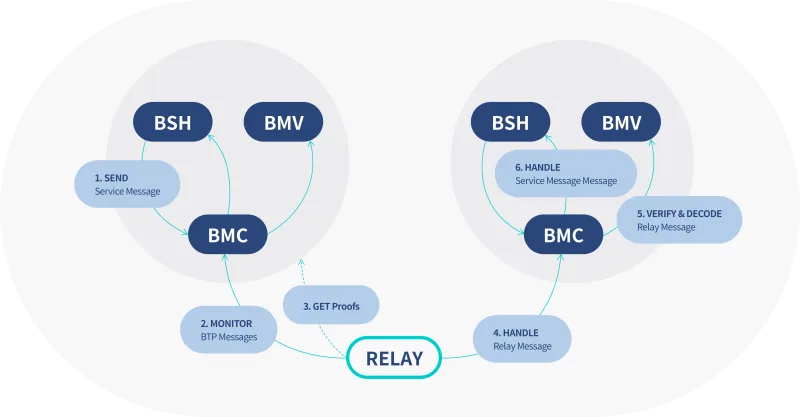
The heart of it is that BMC (BTP Message Center) creates the message to deliver to the counterpart blockchain and the counterpart BMV (BTP Message Verifier) verifies it — and because this whole process happens in smart contracts, it can be trusted.
With BTP you can call smart contracts on other blockchains. And since it is built out of smart contracts, you can essentially connect any blockchain that supports smart contracts, allowing for differences from chain to chain.
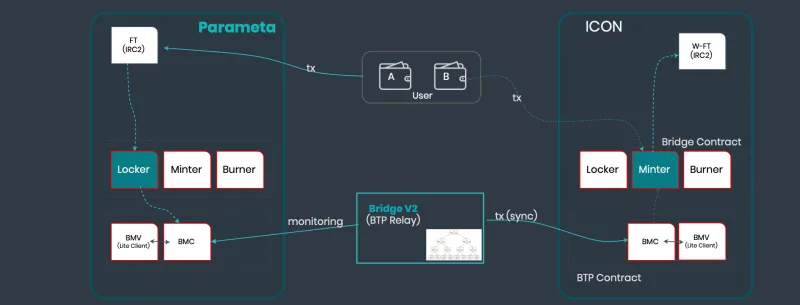
The bridge PARAMETA provides is built on BTP, and its advantage is a large improvement in security when assets move.
It consists of the relevant smart contracts plus a Relay that carries BTP messages.
On the smart contract side there are BMC and BMV for BTP, and Lock, Mint and Burn contracts for the bridge service.
Send the token you want to move to the target blockchain into the Locker and lock it, and a message saying it has been locked is generated along with a proof. The Relay carries that to the target blockchain. There, BMV verifies the incoming BTP message, and if everything checks out the Minter creates a new wrapped token matching the locked amount.
No separate verifier sits in the middle of this process — verification uses the source chain's proof directly — so there is no security issue.
We described two ways of implementing a bridge service above, so let us sort out the difference before moving on.
In the notary approach, where verifiers sit in the middle, those verifiers validate a transaction on the source chain (blockchain A) and pass the result along, and the target chain (blockchain B) executes on trust in the notaries' signatures. No matter how secure the source blockchain is, if the intermediary verifiers are not decentralized or their security level is low, the security of the entire bridge service drops to theirs.
If some of those intermediary verifiers get hacked, the attacker can mint tokens on the target blockchain at will. That is exactly how incidents like Axie Infinity's Ronin Bridge and Harmony's Horizon Bridge happened.
The BTP approach — sometimes called the relay approach — has no intermediary verifier such as a TTP. The component labeled Relay simply carries the BTP message generated on the source chain, along with the proof that attests to it, over to the target. If the Relay tampers with the message, the forgery is detected immediately on the target side.
So the BTP approach carries the source blockchain's security straight across, and short of the source chain itself being hacked, the odds of a hack are close to nil.
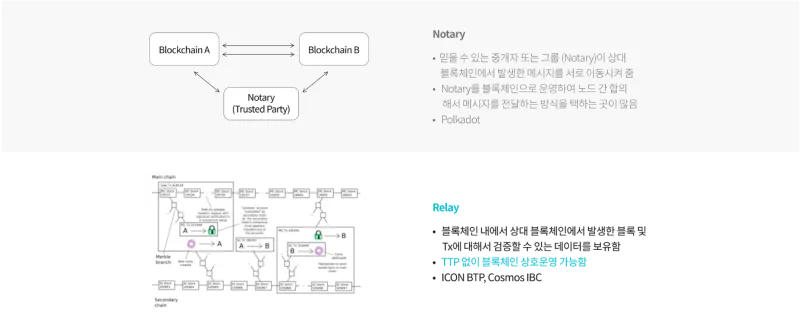
The relay approach is technically demanding, and because verification happens in smart contracts it consumes a lot of gas, which made it expensive and kept it out of production use. BTP solves the gas cost problem, so we expect it to be applied widely in bridge services going forward.
That covers the core engine, governance and token economics, and interchain — PARAMETA's most distinctive components and the ones that matter most when building a blockchain platform (mainnet).
In the next post we will take a closer look at the base services, development tools and management tools that let you run all kinds of businesses on the platform.

Related posts
<Previous post>
- PARAMETA Introduction 1 - What Is PARAMETA?
- This past June we unveiled a way to build your own optimized blockchain mainnet ...
- blog.naver.com
<Next post>
- PARAMETA Introduction 3 - Key Components (2)
- In the previous post we looked at PARAMETA's core components: the core engine, governance ...
- blog.naver.com
Web3 Enabler, PARAMETA