

We are living through a world where the shift to a digital economy — digital transformation — is accelerating fast. In a digital economy, economic actors interact socially and economically in far more ways, and the kinds of credentials that prove who they are are far more varied than in the traditional economy, which makes a much higher level of mutual trust essential.
For a long time, platform companies gathered users by offering convenient services, built ecosystems around them, and turned that into growth. But the sheer scale those platforms reached has produced no shortage of problems. A service pushed out of an app marketplace for adopting its own payment system instead of in-app billing. A delivery app that set off a firestorm by reworking its commission structure. Massive personal data breaches. Case after case. The fundamental flaw of centralized platforms — users losing control over their own data and having their privacy seriously compromised — has only become clearer with time.
It is against that backdrop that DID (Decentralized Identifier) drew attention early on as the technology underpinning sovereignty over personal data, and it amounts to a new paradigm born to reshape a centralized, provider-driven authentication market around the user. In the Web 3.0 era, as a user-centered data economy expands, DID will be indispensable: it lets users become the subject of information exchange and manage their own personal data instead of being locked into a particular platform or service.
So let us take a look at what DID actually is, and how PARAMETA has been applying it.
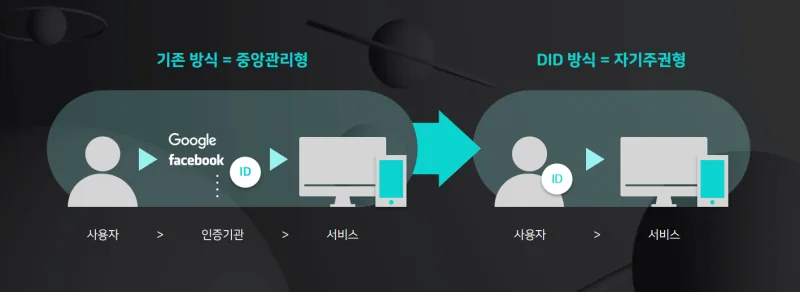
Under conventional identity verification, a third-party institution or service provider controlled personal information in a centrally managed way. DID is different: it is not controlled by a central system, and by giving individuals complete control over their own information it makes Self-Sovereign Identity possible. In a centralized ID system, IDs, passwords and personal data sit on the servers of a centralized ID provider or service provider. In a decentralized ID system built on DID, they are stored only on a mobile device under the individual's control.
So what are DID's defining characteristics?
- Persistent
- Cannot be altered or manipulated
- Resolvable
- Can be looked up through metadata
- * Metadata: structured data about data — data that describes other data
- Cryptographically verifiable
- Ownership can be proven cryptographically
- Decentralized
- No centralized authority required
You could also describe a DID as a globally unique decentralized identifier that is registered on a distributed ledger or network and therefore needs no centralized registration authority. W3C (World Wide Web Consortium), one of the international web standards bodies, is currently leading the discussion on blockchain-based ID authentication structures and has defined and open-sourced the DID Document Syntax.
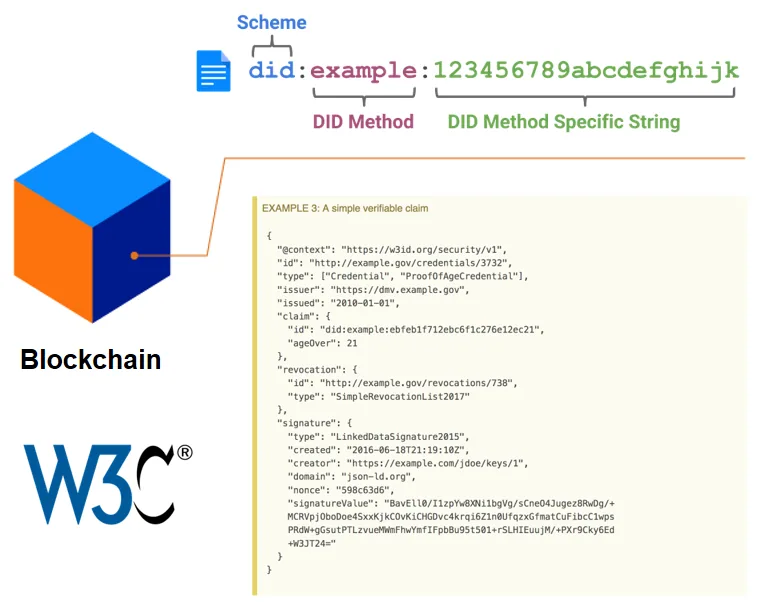
* Source: https://www.w3.org/TR/did-core
Per the DID format standardized by W3C, a DID can be expressed as a string made up of three parts: DID Scheme / DID Method / DID Method-Specific Identifier. The DID Scheme acts as the prefix indicating that the string is a DID, and it is always "did". The DID Method defines how DIDs and DID documents are created and updated, and the name of the DID Method in use (always lowercase) must be defined within the DID string. The DID Method-Specific Identifier is the identifier used within that DID Method.
DID has been a concept since the 2000s, but it was hard to realize because it required a ledger that could not be forged. Blockchain's resistance to tampering solved the forgery problem, and that is what made commercial services possible.
Ready to look at DID services? A DID service is built on four core elements.
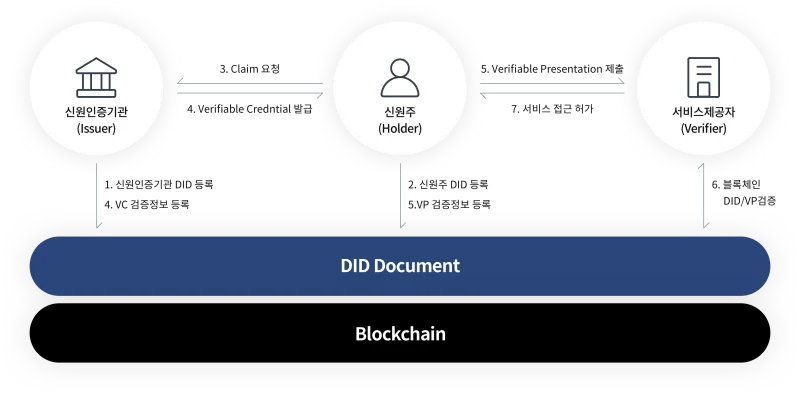
- Issuer: a government body, an authentication technology company or similar — the party that verifies an identity and issues a credential at the owner's request
- Owner: the actual owner of the personal information, such as a resident registration number or passport number
- Verifier: a shopping mall, bank, payment gateway or similar — the party that needs personal information in order to provide a service
- Blockchain: the distributed ledger technology or network that manages DIDs, the decentralized identifiers, and records verification history
A DID service separates issuance from use, splitting the roles between issuer and verifier, and lets the owner of the identity manage a variety of identity data directly through a wallet. You store an identity verified by an issuing body only on your own device, then selectively hand over only the information you need to at the moment you need to — when signing up for a service, for example. It works exactly like the offline routine of getting an ID card from a community service center, carrying it around, and showing it where it is needed to prove who you are.
As we said above, mutual trust has to reach a higher and higher standard. Digital identity verification services built on DID technology can solve problems such as the data breaches that follow from personal IDs being monopolized by third parties, and return sovereignty over online identity and data to the individual.
PARAMETA has focused on researching, developing, commercializing and raising awareness of this technology since the early days when few people knew what DID was, and has applied its own DID technology across many industries in many forms.
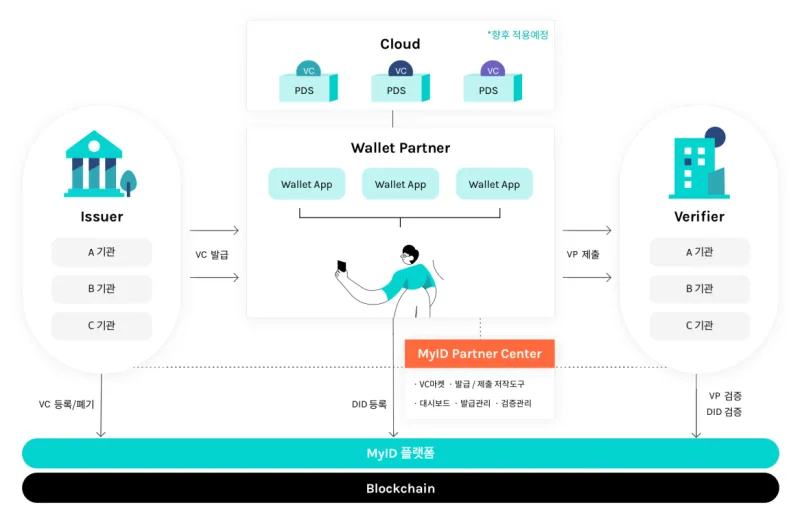
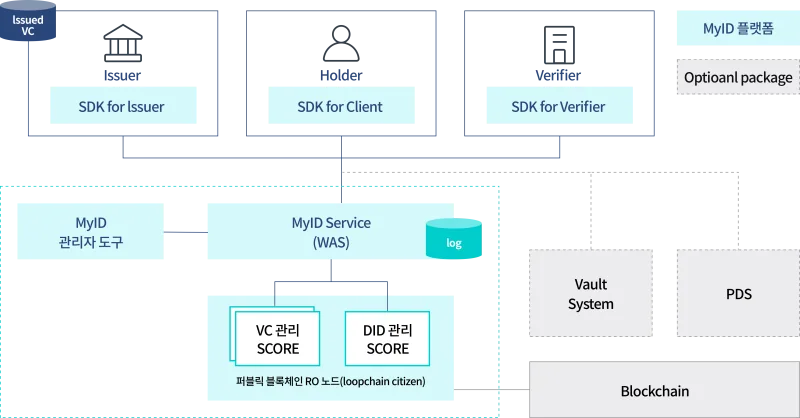
PARAMETA packed the full breadth of its DID technology into MyID, its own DID identity verification platform. The MyID platform consists of smart contracts for creating and managing DIDs and VCs, an API that makes them easy to use, a server that stores the related data, and a server for managing all of it — so you can wire DID into an existing service conveniently. It also provides SDKs for issuers and verifiers, plus an SDK for building a DID wallet, which makes for faster service development.
On top of that, we provide a Vault system for managing private keys and PDS for managing personal data such as VCs in a cloud-style setup, so you can build a more complete service.
Blockchain identity verification services built on the MyID platform (DID)
Zzeung, the blockchain identity verification service built on MyID, encrypts identity information that has been verified once through a trusted institution, stores it on the user's phone, and lets the user choose exactly which personal data to submit when submission is required.
Designated an Innovative Financial Service by the Financial Services Commission, Zzeung supports real-name verification for non-face-to-face account opening and banking, QR check-in, credential management and more — a range of verification methods kept in one place and ready to use.
Integrating online and offline identity verification by applying MyID (DID) technology to the Nayana and Gangwon Health Up platforms
PARAMETA's DID identity verification technology has been applied to Nayana, an integrated service platform built under the vision of "a digital transformation of all Gangwon residents, the entire economy and all provincial administration" to support non-face-to-face economic activity, including the convenience that comes from consolidating digital services. Blockchain technology simplified the previously complex application processes and required paperwork, and by integrating online and offline identity verification it has been applied across resident identity verification, credential verification, finance and more.
The DID technology in this service uses the data a user provides at DID issuance along with the user's own settings to surface the administrative services that fit them at a glance, and it is expanding the range of services users can reach through existing DID services such as Gangwon Health Up.
Building an integrated authentication system by applying MyID (DID) technology at CHANGe UP GROUND
PARAMETA's DID technology has been applied at CHANGe UP GROUND, the startup space POSCO operates to nurture venture companies, so that resident companies and various credential-issuing bodies including POSCO and POSTECH can issue credentials as needed. Access control, visitor verification, parking management, meeting room booking — the functions CHANGe UP GROUND needs are held inside a DID, so every kind of authentication is handled easily from a single phone, giving the space a convenient and trustworthy authentication system.
A history of PARAMETA's DID work
- ■ 2018.11: First in Korea to register a DID Method with the W3C Method Registry
- ■ 2019.06: MyID designated an Innovative Financial Service by the Financial Services Commission (FSC), granting a financial regulatory sandbox exemption
- ■ 2019.07: Launch of DPASS, a blockchain identity verification (DID) service
- ■ 2019.11: Lead organization of the MyID Alliance, Korea's largest DID consortium with roughly 86 partner companies
- ■ 2020.04: MyID passes the Financial Security Institute's security review
- ■ 2020.04: Participation in drafting the Decentralized ID standard led by the Financial Security Institute
- ■ 2020.06: Participation in the Financial Services Commission's Financial Authentication Task Force
- ■ 2020.06: Participation in the 2020 Blockchain Technology and Industry Policy Forum hosted by the Ministry of Science and ICT (MSIT)
- ■ 2020.07: Participation in the public-private DID council organized by the Korea Internet & Security Agency (KISA)
- ■ 2020.08: Launch of Zzeung, a DID identity verification service built on MyID
- ■ 2020.08: First DID issuance in Korea's financial sector, with Shinhan Bank
- ■ 2020.11: DID applied via Zzeung to Gangwon Province's blockchain-based integrated chronic disease management platform
- ■ 2020.11: Blockchain DID technology applied to SK Telecom's IoT smart home service NUGU Smart Home
- ■ 2020.12: DID issuance for Jeju Safe Code, Jeju's tourism quarantine system
- ■ 2020.12 : MyID's Innovative Financial Service designation extended by two years
- ■ 2020.12: Zzeung Mobile Driver's License Service granted temporary approval under the ICT regulatory sandbox
- ■ 2021.01: Blockchain-based Seoul citizen reporter ID issued and linked to Zzeung
- ■ 2021.03: MyID platform-based access control system deployed at Orange Life headquarters
- ■ 2021.05: DID technology applied to Nayana, Gangwon Province's integrated digital service platform
PARAMETA will keep working to deliver real value through DID technology and to build a world where individuals fully own their data.
[Reference] Go to the blog section of PARAMETA's official website ▼
DID (Decentralized Identifier): The Identity Technology of a Digital Economy Built on Self-Sovereign Identity
We are living through a world where the shift to a digital economy — digital transformation — is accelerating fast. In a digital economy, economic actors interact socially and economically in far more ways, and the kinds of credentials that prove who they are are far more varied than in the traditional economy, which makes a much higher level of mutual trust essential. For a long time, platform companies gathered users by offering convenient services, built ecosystems around them, and turned that into growth. But the sheer scale those platforms reached...
www.iconloop.com
Web3 Enabler, PARAMETA