

PARAMETA offers full-stack blockchain technology and consulting for building platforms, from mainnet design and construction all the way to token economies. Underneath all of it sits PARAMETA's own solid core blockchain technology. On top of the highly stable distributed database that any blockchain depends on, we implement a wide range of components through our own proprietary technology so that the advantages of blockchain actually come through.
So let's take a closer look at loopchain, the in-house engine that packs in all of PARAMETA's core blockchain technology.
loopchain, the blockchain core engine PARAMETA developed on its own, is built on a structure faithful to blockchain fundamentals, with features optimized for real-world business.
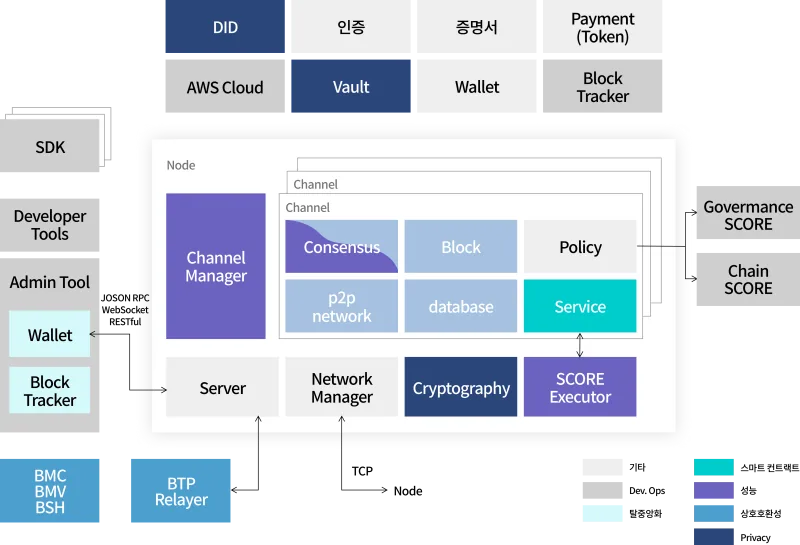
A blockchain is made up of a great many components, and loopchain focuses on implementing each of them so that the strengths of blockchain can be pushed as far as possible. To that end it provides not only nodes but also developer tooling, a software development kit (SDK), operations tools and more, and the combination of all these components makes it possible to build a wide variety of foundational services that take full advantage of blockchain.
So what exactly sets loopchain apart?
- High-performance consensus algorithm: PBFT
- Hybrid P2P network: works for both public and private
- Smart contract support: SCORE (Smart Contract on Reliable Environment)
- Multi-channel support: greater performance and scalability
- Interchain implementation: BTP (Blockchain Transmission Protocol)
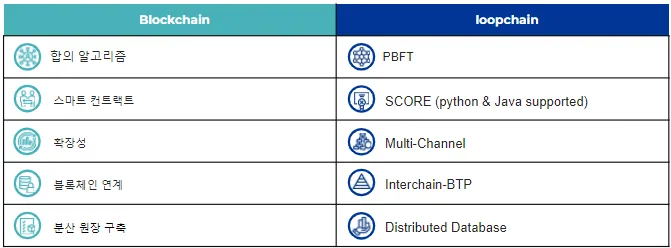
loopchain's characteristics can be introduced in five parts. loopchain uses a high-performance consensus algorithm that makes up for the weaknesses of earlier algorithms and improves both speed and security, and it runs on a hybrid P2P network that can be applied to public and private environments alike. It provides a smart contract execution environment based on widely used, developer-friendly languages (Python, Java), raises performance and scalability with multi-channel technology, and supports interoperability on the back of interchain BTP technology.
High-performance consensus algorithm: PBFT (Tendermint or LFT)
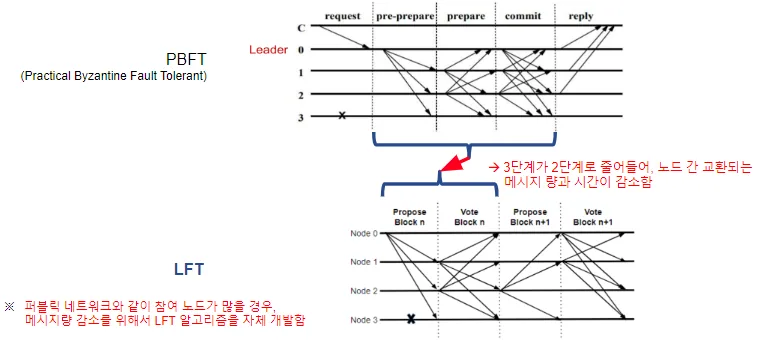
loopchain ships with the PBFT (Practical Byzantine Fault Tolerance) consensus algorithm applied by default, and because the algorithm is implemented as a plug-in, other consensus algorithms can be used alongside it as needed.
The consensus algorithm determines how fast blocks are produced and underwrites the stability of the chain — it is the engine, and throughput and fees are the problems it always has to solve. With the earlier PoW (Proof of Work) approach, a lot of time goes into the computation required to prove work, so block creation is slow; today, BFT-family consensus algorithms are widely used for performance, thanks to fast consensus and finality. BFT-family algorithms reach consensus by voting based on the number of machines or on stake, which wastes little energy and allows immediate agreement.
The PBFT applied to loopchain by default belongs to the BFT family. Grounded in BFT theory for reaching consensus in a distributed network, it focuses on safely deriving consensus even when malicious nodes are present on the network. PBFT works by having a block verified and applied to the chain once a certain proportion of representative nodes agree, and it is regarded as advantageous in speed while raising security. Notably, loopchain's PBFT applies the Tendermint consensus algorithm, whose safety and liveness have already been verified.
PARAMETA also guarantees high scalability and network bandwidth by applying the LFT (Loop Fault Tolerance) consensus algorithm, a lighter, performance-improved take on PBFT. With PBFT, the more nodes participate in the blockchain, the more the number of message exchanges needed to reach consensus grows exponentially, dragging down speed and efficiency. LFT was developed in-house precisely to cut down message volume on public networks with many participating nodes. Its defining feature is that it merges the commit of a block and the broadcast of the next block into a single phase, simplifying the data exchange between nodes. Applying LFT reduces message volume, but block finalization time may increase somewhat, so the algorithm should be chosen selectively depending on the environment.
* PARAMETA completed verification of LFT's safety and liveness with Professor Yongdae Kim of KAIST. (https://arxiv.org/pdf/2004.04294.pdf)
Hybrid P2P network: works for both public and private
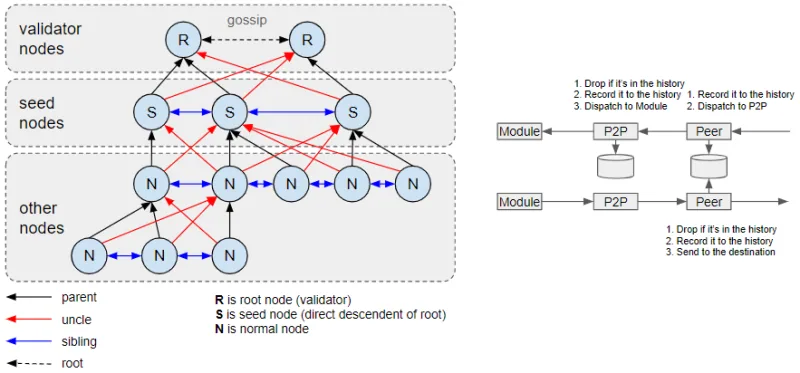
loopchain uses Gossip and a structured network to run a hybrid P2P (peer-to-peer) network that can be applied to both public and private environments. Organizing nodes hierarchically distributes load and blocks direct access to validator nodes, a structure that improves both performance and security. It also minimizes message traffic: duplicate messages that the node has recently received or sent are ignored, and when retransmitting, messages go to only f+1 nodes in an environment of N(3f+1) validators.
Smart contract support: SCORE (Smart Contract on Reliable Environment)
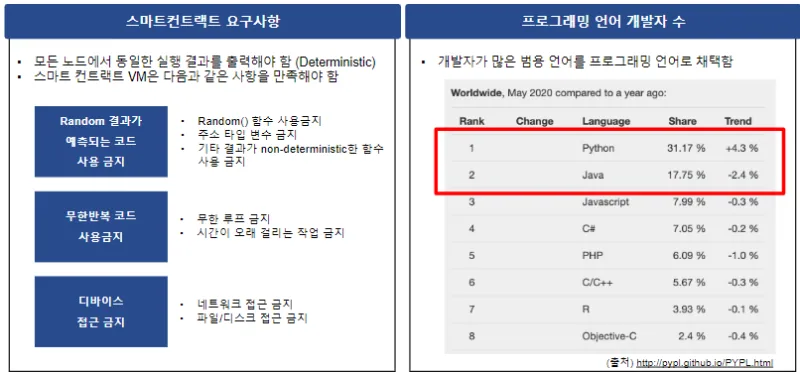
* Source: https://pypl.github.io/PYPL.html
SCORE (Smart Contract on Reliable Environment) is loopchain's smart contract execution environment.
The biggest feature of loopchain SCORE is that you can freely compose your development environment using developer-friendly languages. On some other blockchain platforms, smart contracts can only be written in languages usable on a special virtual machine, and data access and storage are only possible through variables inside that virtual machine — which leaves little freedom. loopchain SCORE supports Python and Java, the general-purpose languages with the largest developer bases, which makes it far easier to attract dApp developers. Java in particular can achieve native-level performance through JIT (Just In Time) technology.
loopchain SCORE also applies an architecture that separates out the smart contract execution engine, making it easy to add support for more smart contract languages later.
* Solidity and WebAssembly (WASM) support planned
Multi-channel support: greater performance and scalability
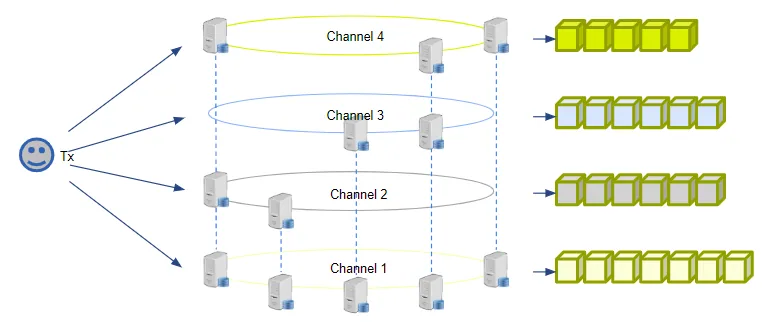
Multi-channel support is another important feature of loopchain. Multi-channel lets you compose virtual networks called channels by line of business within a single independent blockchain network, so that transaction requests, consensus and smart contracts can be carried out per channel. In other words, nodes are divided into related groups and each group is assigned its own channel, so blocks can be created and verified channel by channel. Only the parties to a given line of business connect to a node, channels can be formed in many different ways per business area, and because blocks are created in parallel per channel, each channel keeps its independence — which means integrity and consensus can be guaranteed per channel.
Among loopchain's real deployments there are projects that used multi-channel to carry out work effectively channel by channel: service-level channel allocation across departments of the Seoul Metropolitan Government (voting, used-car transactions, qualification verification, mileage, authentication and so on), and the CHAIN ID and FDS (Fraud Detection System) channels of the Korea Financial Investment Association.
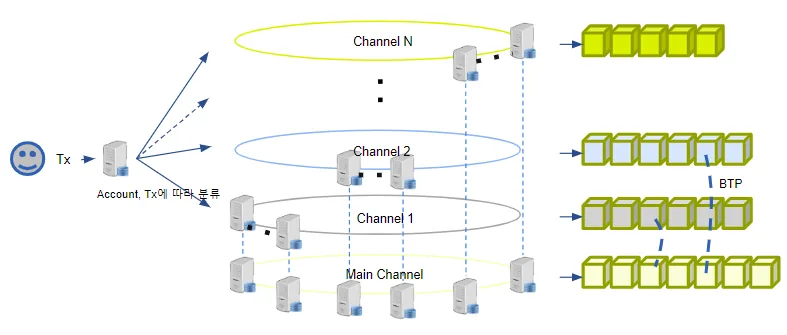
Multi-channel support naturally improves overall performance as well. Classify transactions by account or by transaction (TX) type and distribute them across channels, and blocks are created per channel while key data and data that needs to be exchanged between channels is registered on the main channel. It is a structure where TPS (transactions per second, i.e. processing speed) improves as the number of channels grows. (TPS per channel x number of channels)
Interchain implementation: BTP (Blockchain Transmission Protocol)
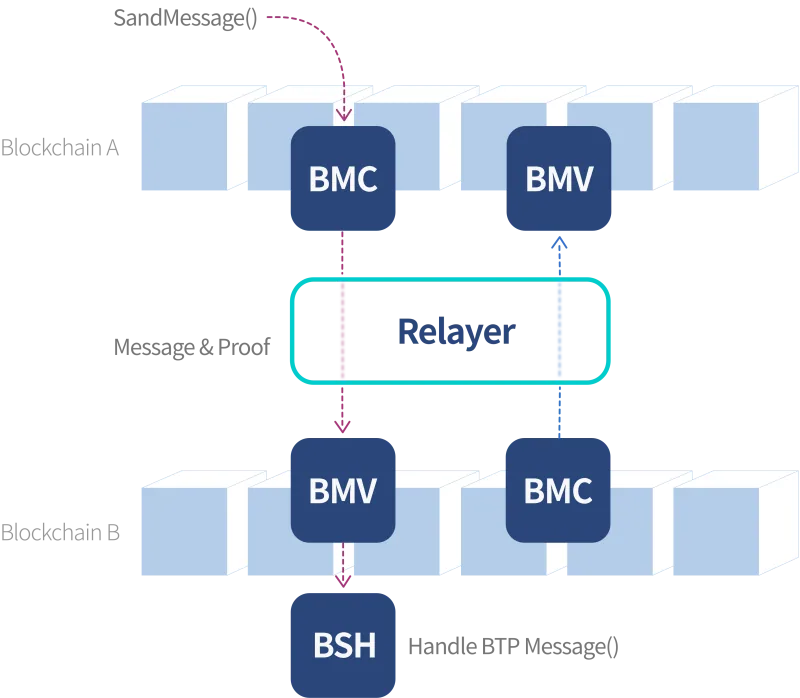
BTP (Blockchain Transmission Protocol), built for interoperability, is one of the most essential technologies applied to loopchain. BTP is a protocol that enables trusted data exchange between smart contracts running on heterogeneous blockchains, and it can be used not only for moving assets and exchanging messages across different chains but also as a scalability technology for growing an interchain ecosystem.
You can find a much more detailed look at BTP in a separate piece.
[Reference] Read the related BTP content ▼
- ICONLOOP's Interchain Technology, BTP (Blockchain Transmission Protocol)
- Countless blockchain projects are underway around the world and many dApps run independently on platforms with different technical characteristics...
- blog.naver.com
That was a look at loopchain, the in-house engine in which PARAMETA's core blockchain technology comes together. loopchain is currently used across public blockchains, enterprise blockchains, government blockchains and more, and PARAMETA will keep working to bring the value of blockchain technology to ever more industries and to everyday life.
[Reference] Go to the blog section of the official PARAMETA website ▼
ICONLOOP's Core Blockchain Technology, loopchain
ICONLOOP offers full-stack blockchain technology and consulting for building platforms, from mainnet design and construction all the way to token economies. Underneath all of it sits ICONLOOP's own solid core blockchain technology. On top of the highly stable distributed database that any blockchain depends on, we implement a wide range of components through our own proprietary technology so that the advantages of blockchain actually come through. So let's take a closer look at loopchain, the in-house engine that packs in all of ICONLOOP's core blockchain technology(...
www.iconloop.com
Thanks for reading.
Web3 Enabler, PARAMETA