

The HAVAH team is building an interchain NFT playground.
This is our very first Medium post, and we could not be happier to meet you here.
For our opening topic we want to talk with you about the NFT market today and the limits it is running into. In the next post we will tell you the story of how HAVAH was born out of those limits.
An NFT market growing at breakneck speed
After Satoshi Nakamoto introduced Bitcoin, it sent shockwaves through global society, and main chains built around decentralization began to appear alongside it. Bitcoin showed what was possible as a form of currency, and Ethereum, through smart contracts and dApps, created the foundation on which all sorts of blockchain services could actually run.
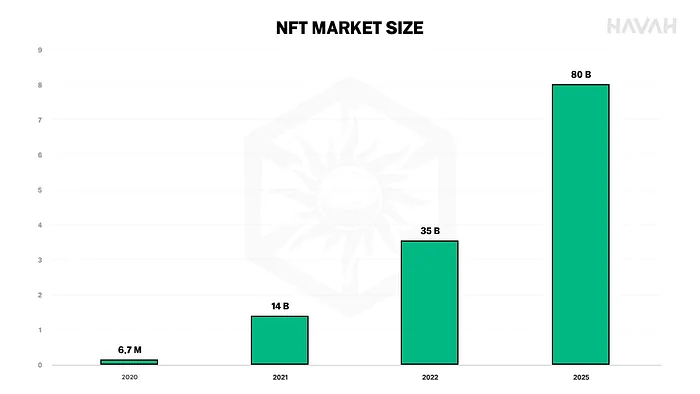
Among those services, the integration of NFTs into the metaverse was the first to set off change in virtual worlds, and it is now reaching into the real one as well. People who watched that change began piling into NFT investment, and on the back of that investment fever the NFT market approached KRW 18 trillion in 2021, with projections running as high as KRW 110 trillion by 2025.
NFT users are running into a wall
But NFT buyers and users quickly hit limits on the network and usability side. For most NFTs today, there is simply not much for a holder to do with them between purchase and the next trade — few places to actually use them. There can be many reasons for this, but the one the HAVAH team focused on was this: NFTs are only usable on their own individual chains, so they run into a ceiling on expandability.
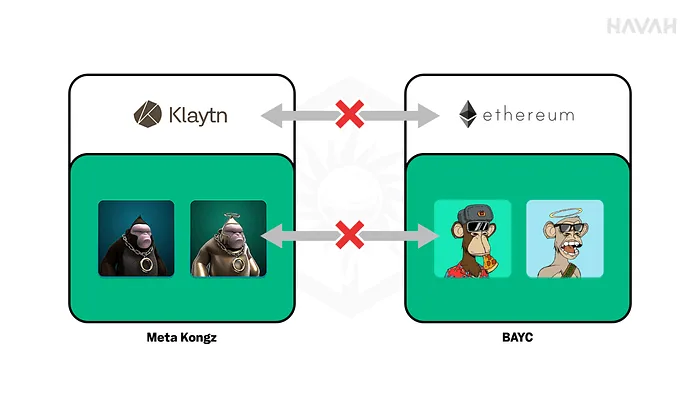
Yuga Labs' BAYC, for example, can only be issued and used on the Ethereum chain, and Metakongz by Metakongz Inc. only on the Klaytn chain.
Just like in the picture below.
Why does this happen?
Because in a typical blockchain ecosystem, a user's individual data and assets are confined to each chain and do not interact with one another.
As a countermeasure, new approaches such as combining NFT projects have recently been put forward.
1. SANDBOX applied BAYC NFTs to in-game avatars, with the two teams cooperating at the project level, and
2. Gala Games placed VOX, a PFP NFT, in Townstar Game so players could collect more digital rewards —
both efforts to expand the usefulness of their services and their NFTs.
But even combinations between NFT projects
are not a sustainable form, resting as they do on a one-off agreement between the two NFT projects, and
are combinations of NFT projects within a single chain, which makes combining with another chain difficult.
Unable to escape those limits, they ultimately fail to solve the usability and expandability problem at its root.
So what should be done to get past those limits?
In the next post we will introduce the HAVAH project, which lets you use NFTs in all sorts of ways without network constraints, and together with you we will look for an answer to the question: how do we use NFTs more broadly?
Source: HAVAH Medium, 'NFT Users Are Running Into a Wall', June 21, 2022
- HAVAH
- Utilize your NFTs no matter the network, no matter which dapps.
- intro.havah.io