

Countless blockchain projects are underway around the world, and many dApps run independently on platforms that each have their own technical characteristics — which makes the question of integration impossible to ignore. If a dApp can only ever be used on the platform its service is built on, convenience and versatility are bound to shrink over the long run.
That is why PARAMETA has, since its earliest days, developed a range of core and applied technologies with one ultimate goal: building an interchain environment where blockchains can communicate and interact. We have been working toward an era in which interchain becomes real, services spread to the mainstream through connections between different blockchains, and the strengths of both public and private blockchains can be used together.
So let's take a closer look at BTP, the interchain technology PARAMETA developed.
BTP (Blockchain Transmission Protocol) is a chain-agnostic, scalable cross-chain interoperability solution. BTP is a general-purpose interoperability solution, and it is also offered as the standard protocol of ICON, the global interchain project built on loopchain, PARAMETA's own blockchain core engine.
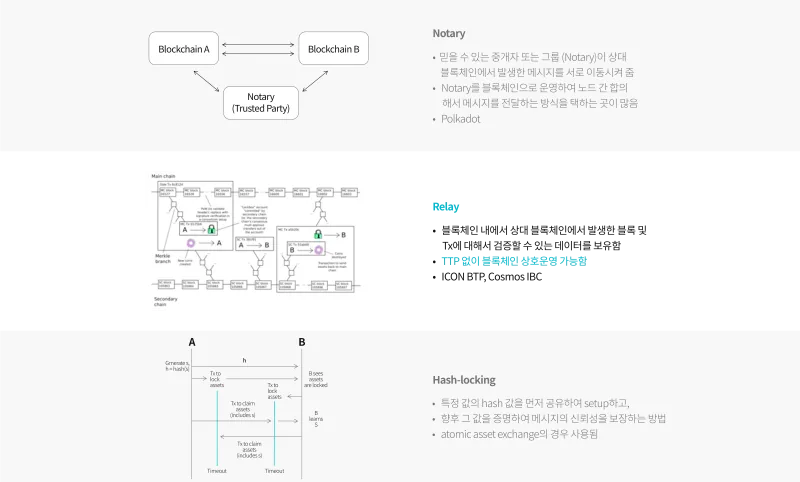
* Reference: Vitalik Buterin, 'Chain Interoperability', Sep 9, 2016
BTP can interconnect and integrate any blockchain that supports smart contracts, and users can easily send tokens, NFTs, messages and other information between connected blockchains. And unlike existing bridging solutions, which rely on a selected set of validators to pass messages and custody funds between blockchains, BTP is a safer model built on fully decentralized incentivized relayers (nodes) and on-chain verification of messages.
BTP can be seen as a standard that makes heterogeneous blockchains interoperable, including chains built on completely different consensus models and algorithms. In most industries, interoperability means that replacing system A with system B causes no constraints or problems; in blockchain, it is defined as the capability that makes value transfer, service calls and data exchange easy.
Blockchains operating on the usual silo basis — a silo meaning a store of data and assets that only one group of users can access, the way most blockchains have evolved — can, in this way, act as a trustless settlement layer where safe transactions are possible through a universal standard.
From an application-level perspective, token transfer between heterogeneous blockchains is probably the best example. At the protocol level, BTP makes it easy to transfer tokens directly from one blockchain to another through smart contracts, without using a centralized trading platform.
Another case of chain-to-chain communication enabled by BTP is MyID, PARAMETA's DID-based identity verification platform. An individual's DID (decentralized identifier) data registered on the MyID platform can be verified on the ICON public network, so the owner can exchange messages across public or private networks interconnected through BTP without resubmitting a DID document or public key to each blockchain.
So what are the core elements that make up BTP?
- BMR (BTP Message Relay): the relay
- BMC (BTP Message Center): the message center contract
- BMV (BTP Message Verifier): the verifier contract
- BSH (BTP Service Handler): the service contract
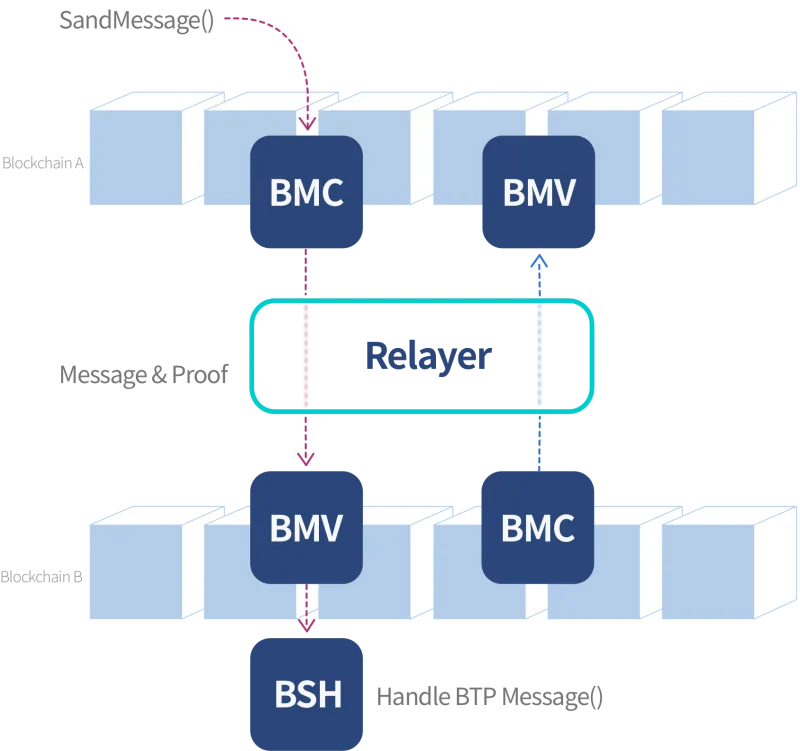
To put BTP fully to work — transmitting data reliably while maintaining integrity and validity — a blockchain has to implement the following components through smart contracts.
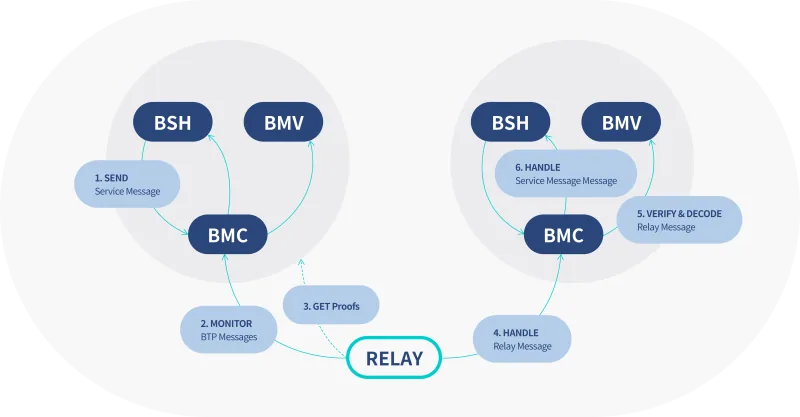
First, the BMR (BTP Message Relay) is responsible for passing messages between message centers. The relay's job is to monitor the BMC (BTP Message Center) and deliver the cross-chain transactions the BMC generates to the destination blockchain. It also delivers the verification information the destination blockchain needs to verify that cross-chain transaction. The relay cannot distort the cross-chain transaction or the verification information, and if it did, the destination blockchain would spot it immediately — so the relay does not have to be trusted. That is what makes BTP a safe and trustworthy technology.
The BMC (BTP Message Center) aggregates all BTP messages on a designated network, composing BTP messages and passing them to the relay. The BMV (BTP Message Verifier) checks and decodes the messages received from the relay as BTP messages. This is a mechanism that allows cross-chain transactions to be verified through smart contract technology rather than through trusted validators — arguably the most innovative part of BTP. The BSH (Service Handler) holds the application-specific logic and passes BTP messages along to service smart contracts. (For example: token transfer between networks vs. NFT transfer between networks.)
Now let's look at the representative use cases for BTP.
Cross-chain token transfers
The most common interoperability use case is sending tokens from one blockchain to another. Cross-chain bridge contracts generally work by burning tokens on the source chain and minting an equivalent amount on the destination chain; with BTP, users can transfer tokens across connected chains without a bridge for each individual chain.
Cross-chain arbitrage
Unlike most existing bridging solutions, which only support cross-chain token swaps, BTP will also support more general messaging capabilities such as cross-chain smart contract calls in the future. Put simply, that means a smart contract running on ICON can interact with smart contracts running on other blockchains such as Binance Smart Chain or Moonbeam. In other words, BTP is an essential solution for building a decentralized cross-chain arbitrage platform.
Cross-chain NFT-as-identity
The metaverse is the next big issue in the crypto industry, and 'NFT-as-identity' is expected to play a pivotal role in metaverse spaces over the coming years. Take a well-known NFT project like BAYC (Bored Ape Yacht Club). A Bored Ape NFT is more than a collectible artwork — it also works as a membership card granting access to members-only benefits in the real world. It is a leading example of on-chain NFTs being used as a tool of identity.
NFTs will serve as IDs in metaverse worlds too, and as the field expands, many different kinds of metaverse may spring up. If they end up relying on different blockchains, BTP can be used to verify the identity and ownership of tokenized items across a multi-chain metaverse. Because BTP supports communication well beyond basic token swaps, it is expected to play a major role as a technology capable of handling complex work such as cross-chain verification of NFT ownership in the metaverse.
So far we have looked at BTP's components, how it works and its representative use cases. So what is the standout strength BTP alone has, compared with the other interchain technologies and interoperability solutions on the market today?
At this stage, the interoperability offered by solutions other than BTP is in most cases confined to their own ecosystem. BTP, by contrast, is far more focused on connecting different ecosystems that each have their own architecture. As described above, BTP is chain-agnostic and can interconnect any blockchain that supports smart contracts. Unlike other solutions, BTP can also be described as being closer to a product — an out-of-the-box solution that is relatively easy to implement on an existing blockchain. Chain-agnostic means there are no strict requirements a blockchain must satisfy in order to implement BTP: you simply build the three smart contracts described above (message center / verifier / service contract) on a given chain, then add support for that chain to the existing relay network. It is, in essence, a solution that is easy to use.
Hacking incidents have been coming one after another in the blockchain industry lately — P2E games, NFT projects, DeFi services — and calls for stronger security are growing louder. Among them, attacks exploiting vulnerabilities in cross-chain bridges connecting multiple blockchains are widely attributed to insufficient decentralization as a primary cause. Unlike large blockchain networks maintained by thousands of nodes, where hacking is all but impossible, networks that use a small number of verification nodes on the basis of a cross-chain bridge are somewhat less secure and can easily be exposed to the risk of hacking. On that point, Ethereum co-founder Vitalik Buterin has said there are fundamental limits to the security of bridges spanning multiple 'sovereign zones' (blockchain networks).
Unlike existing cross-chain bridging solutions that depend on a small set of selected verification nodes, BTP provides strong security through fully decentralized nodes and on-chain verification of messages.
While continuing to develop and research BTP, PARAMETA also supports the ICON project's blockchain platform and blockchain technology overall. Blockchains set to connect with ICON through BTP include Binance Smart Chain (BSC), Polkadot, NEAR Protocol and Harmony, and major DeFi projects include Balanced DAO, Omm Finance, Optimus Protocol and Equality Exchange.
Until the day interchain connects the world's blockchains, PARAMETA will give its best to technology development and research.
[Reference] Go to the blog section of the official PARAMETA website ▼
ICONLOOP's Interchain Technology, BTP (Blockchain Transmission Protocol)
Countless blockchain projects are underway around the world, and many dApps run independently on platforms that each have their own technical characteristics — which makes the question of integration impossible to ignore. If a dApp can only ever be used on the platform its service is built on, convenience and versatility are bound to shrink over the long run. That is why ICONLOOP has, since its earliest days, developed a range of core and applied technologies with one ultimate goal: building an interchain environment where blockchains can communicate and interact...
www.iconloop.com
Thanks for reading.
Web3 Enabler, PARAMETA