

The metaverse and NFTs have set the market on fire — and Web 3.0 keeps coming up right alongside them.
The metaverse and NFTs (Non-Fungible Tokens) have surged into the mainstream and are keeping the market on fire. And the keyword Web 3.0 keeps coming up right alongside them. Much like the blockchain frenzy that arrived a few years ago with cryptocurrency, or the way DeFi grabbed everyone's attention starting last year. At ICONLOOP, we read all of this as a signal that a new era of the internet is arriving.
So what exactly does a new era of the internet mean? And what role will DID (Decentralized Identifier) play in getting there?
Web 1.0: The birth of the WWW - Read
To talk about a new internet, it helps to look back at how the internet began. It started in 1969, when a US Department of Defense project aimed at exchanging information between distributed servers produced a result called ARPAnet. As private companies and universities joined in, it was eventually opened up entirely to the public.
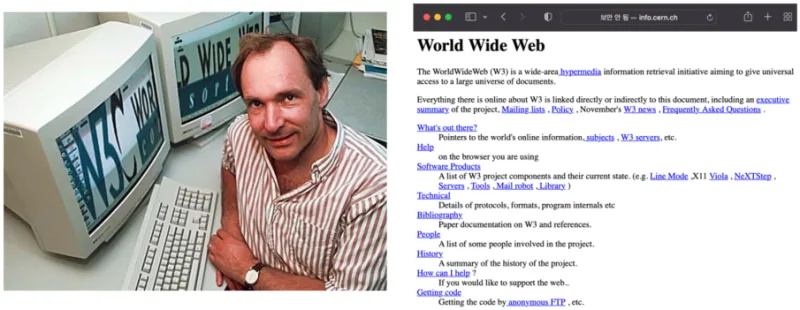
Meanwhile, Timothy John Berners Lee, a British scientist working at CERN (the European Organization for Nuclear Research), was wrestling with a question: was there an easier way to read data sitting on a distant computer? His answer was the hypertext-based World Wide Web (WWW). The world's first website went live in 1991, and with it came the moment when the internet — until then the province of a handful of specialists typing commands — finally reached the general public. Berners Lee went on to spread the internet further when the National Center for Supercomputing Applications (NCSA) in the United States released Mosaic, the first web browser, free of charge.
Web = something anyone can use
Timothy John Berners Lee, creator of the World Wide Web
The web of that era was mainly a way to read static data, but Berners Lee insisted that the internet had to be "something anyone can use." That principle still carries through as the founding philosophy of the web today.
Web 2.0: Openness, participation, sharing - Read/Write
Then in 2003, O'Reilly used the keyword Web 2.0 for the first time. If the web of the Web 1.0 era — the era of "connecting" — was a read-centric collection of websites, Web 2.0 was expected to become a platform delivering web applications, one that would replace desktop applications outright. Anyone could produce data and share it over the internet, which meant the arrival of an era of "writing," where users handled data themselves rather than only reading it. The roughly 250,000 sites of the Web 1.0 era grew to 80 million a decade later in the Web 2.0 era, users passed the one billion mark, and web services expanded explosively.
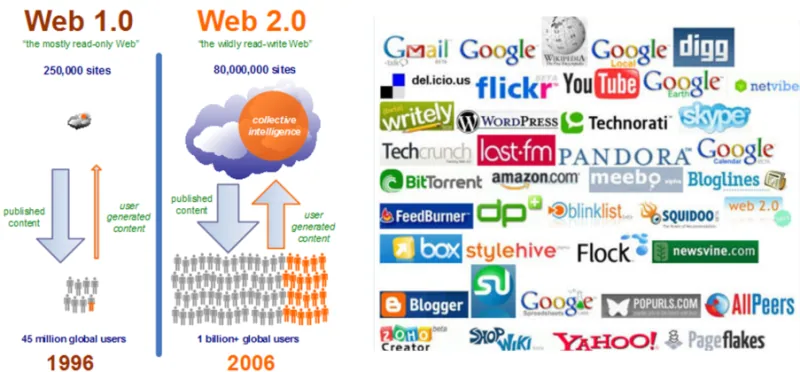
Around 2006, the keyword Web 3.0 had already appeared. People were starting to define the web's next form in all sorts of ways, and the most prominent of those definitions was the Semantic Web — a next-generation intelligent web in which computers would understand the content of a web page, reason logically about it, and serve up personalized information. In practice, it never materialized.
The web as I envisioned it, we have not yet seen.
Timothy John Berners Lee, creator of the World Wide Web
As most web applications settled into a business model of offering services for free, collecting data, and then monetizing it through advertising and the like, monopoly platforms emerged. From a platform's point of view, the data it had gathered was the competitive edge of its service, so it neither published nor shared it — and the result evolved into a form of platform capitalism.
Berners Lee warned that as a small number of giant IT companies monopolized the spaces where ideas and information gather, diversity was steadily disappearing. His critique: in the pursuit of platform monopoly, individuals had lost control of their own data, fake news was spreading indiscriminately, and opaque political advertising was flooding in.
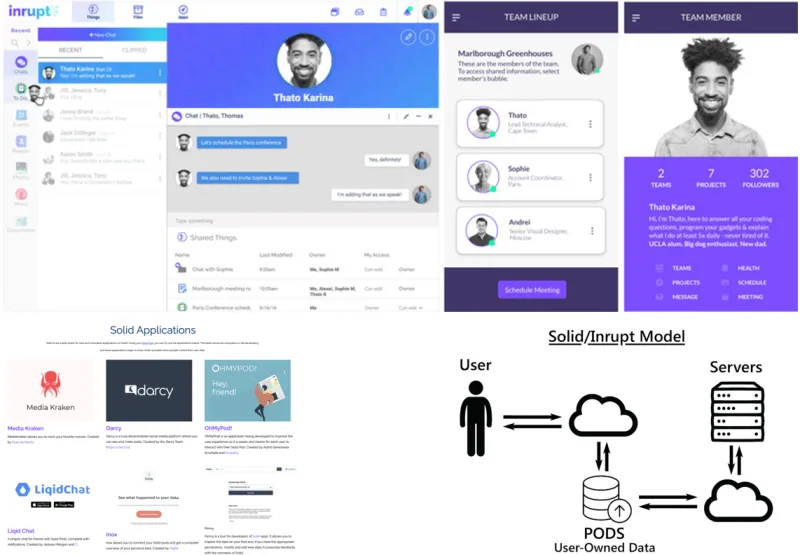
* https://www.iowacomputergurus.com/insights/article/inrupt-on-the-solid-web-platform-is-a-new-paradigm-of-privacy-and-data-ownership
Having searched relentlessly for a solution, Berners Lee founded a company called Inrupt in 2018 and launched the Solid Project. The model he is pursuing separates personal data from platforms, and the Solid Project proposed a personal data store called a POD. Users manage and control their own personal data inside their POD, and applications access it — with the user's permission — to deliver a service. Over three years the project set a number of standards, and a good many web applications now follow the Solid protocol.
What the Solid Project was after, in short, was to make the individual the party in control of their own data: data ownership.
Web 3.0: A person-centered data economy - Read/Write/Own
NFTs, the hot topic of the moment, are likewise a technology whose defining characteristic is data ownership — clearly guaranteeing who owns a piece of data. P2E (Play to Earn), the talk of the gaming industry, belongs in the same conversation. Most game companies used to prohibit cash trading of in-game goods through their terms of service, and ownership of items rested with the company. Now that studios are announcing or considering NFTs, you can see a shift toward handing item ownership back to users.
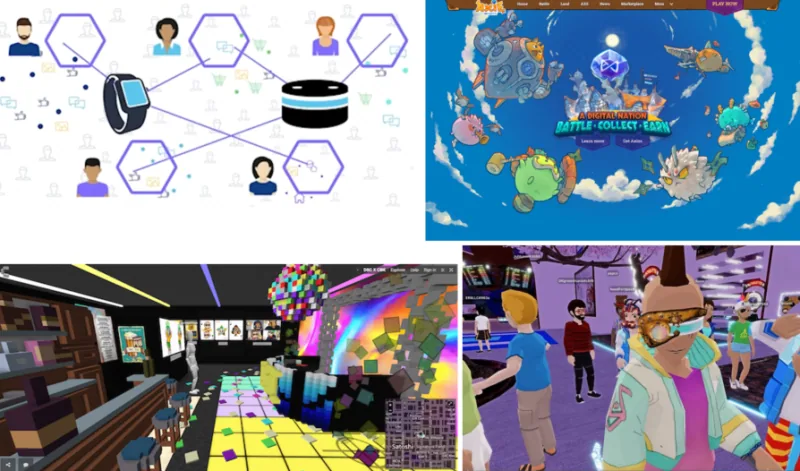
If Web 2.0 was a company-centered platform economy, the web's next form — Web 3.0 — will be a person-centered data economy where you can go beyond reading and writing to "own."
Alongside the web's evolution, the conversation about digital identity on the web has never stopped, and lately its importance has only grown sharper.
Identity = what I say about me + what others say about me
Identity 1.0, which appeared together with the web itself, is a model where you create an identity by signing up at each individual website — identity organized around the site. That produced no shortage of problems: identities created per site were hard to move, privacy was at risk, and how they were used was anything but transparent.
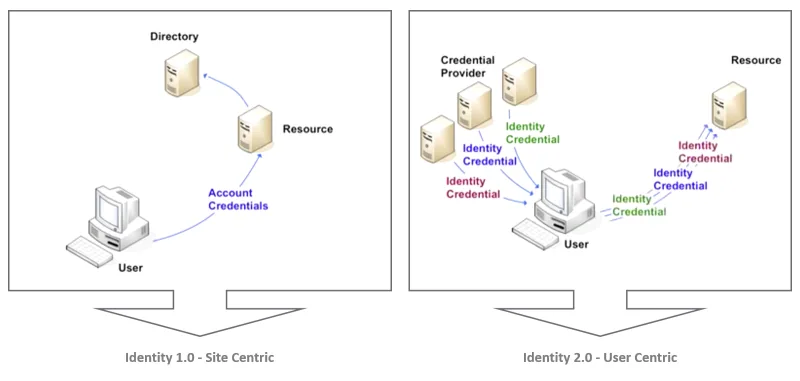
So in the early-to-mid 2000s, while Web 2.0 was being debated, the concept of Identity 2.0 emerged. The idea was to gather a user's identity in one place and build a user-centered identity system the user could draw on as needed.
But Identity 2.0 never came to pass. In the age of platform capitalism, identity is the single most valuable asset for building a data silo — so platforms have only tightened their lock-in, under the name of Social Login.
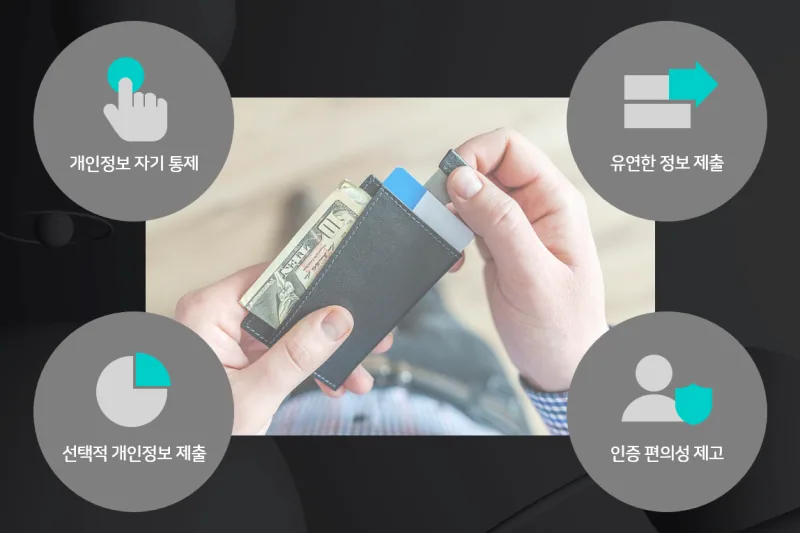
The coming Web 3.0 era needs an identity model suited to it. What would an identity system look like if it let individuals own and control their data? We already know the answer, as it happens. The ideal model for Identity 3.0 is the wallet in your pocket. A wallet holds payment methods — credit cards, debit cards, cash — but also ID cards, access passes, membership cards, family photos: personal assets and private identity data, kept together, and handed over piece by piece at the owner's discretion. Move exactly that into the digital world and you have an identity model fit for Web 3.0.
The role of DID in the Web 3.0 era
As the Web 3.0 era arrives and the concept of ownership spreads rapidly from virtual assets into NFTs and beyond, blockchain as infrastructure and the wallet as the user's point of contact have emerged as the most important elements of Web 3.0.
Which makes DID — the real-world wallet moved into digital form — the technology best suited to Identity 3.0. DID's components include the issuer, which issues credentials, and the verifier, which consumes them. Separating issuer from verifier this way lets the owner of an identity manage all sorts of identity data directly through a wallet. And when the moment calls for it, they choose what to submit to the verifier.
The same thing happens in the physical world: the community center that issues your resident registration card and the convenience store that needs to confirm you are an adult only check whether the ID is genuine — neither verifies the data on the card itself. DID works exactly the same way. It cleanly separates issuance from use, and verifies transparently on top of blockchain, the technology of trust.
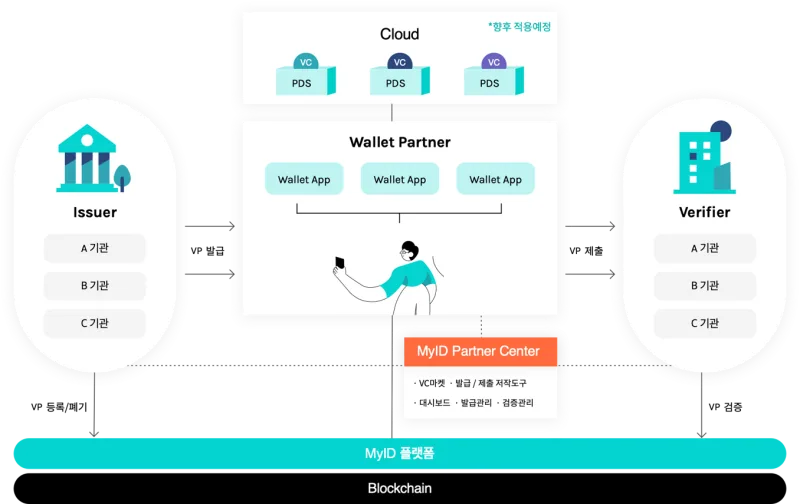
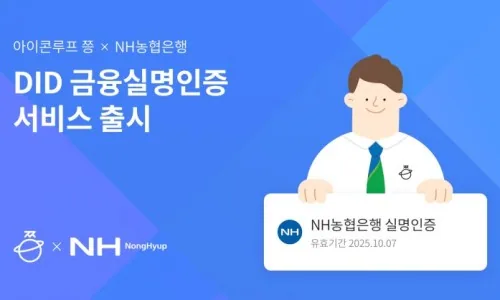
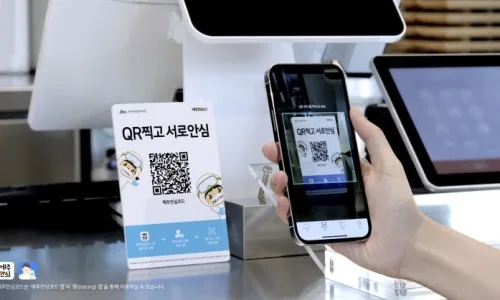
To make DID easier and more convenient to use, ICONLOOP offers a DID platform called the MyID Platform. Built on it are services that safely store and prove all kinds of personal data, including financial real-name verification and COVID-19 vaccination information. Also in service are Zzeung, a wallet application that holds multiple credentials for convenient use, and Jeju Safe Code, the Jeju-style electronic entry register.
See examples of ICONLOOP's DID services ▼


With the arrival of the Web 3.0 era, the concept of ownership — beyond reading and writing — is spreading rapidly from virtual assets into NFTs and beyond. As blockchain infrastructure and the user-facing wallet emerge as the most important elements of Web 3.0, ICONLOOP, which has led this field from the start, will keep working to deliver real, practical value through DID and to help build a world where individuals own their data outright.
Life Meets Blockchain, ICONLOOP