

Where DID stands today, seen through Shinhan Bank.
We came across an article that takes stock of where DID stands today, and it is worth sharing. As one of Korea's leading blockchain companies, ICONLOOP has kept researching, developing and commercializing DID from the early days, when hardly anyone knew what it was, right through to now.
That work has paid off. DID is now used not only in commercial areas such as the financial sector, local governments and enterprises, but also in places close to everyday life, like apartment building access and electronic entry logs, helping to build a more trustworthy and transparent world.
True to our slogan, Life Meets blockchain, ICONLOOP will do everything it can to build a society you can trust through blockchain.
■ 2018.11 Ⅰ Korea's first DID-related entry in the W3C Method Registry
■ 2019.06 Ⅰ MyID designated an Innovative Financial Service by the Financial Services Commission (FSC), granting it financial regulatory sandbox status ≫ Learn more
■ 2019.07 Ⅰ Launch of DPASS, a blockchain identity verification (DID) service ≫ Learn more
■ 2019.11 Ⅰ Lead organization of the MyID Alliance, Korea's largest DID consortium with roughly 86 partner companies ≫ Learn more
■ 2020.04 Ⅰ MyID passes the security review of the Financial Security Institute
■ 2020.04 Ⅰ Participation in drafting the Distributed ID Standard led by the Financial Security Institute ≫ Learn more
■ 2020.06 Ⅰ Participation in the Financial Authentication Task Force led by the FSC ≫ Learn more
■ 2020.06 Ⅰ Participation in the 2020 Blockchain Technology and Industry Policy Forum hosted by the Ministry of Science and ICT (MSIT) ≫ Learn more
■ 2020.07 Ⅰ Participation in the public-private joint DID council led by the Korea Internet & Security Agency (KISA) ≫ Learn more
■ 2020.08 Ⅰ Launch of Zzeung, a DID identity verification service built on MyID ≫ Learn more
■ 2020.08 Ⅰ Korea's first DID issuance in the financial sector, with Shinhan Bank ≫ Learn more
■ 2020.11 Ⅰ DID applied through Zzeung to Gangwon Province's blockchain-based integrated chronic disease management platform ≫ Learn more
■ 2020.11 Ⅰ Blockchain DID technology applied to SK Telecom's IoT smart home service, NUGU Smart Home ≫ Learn more
■ 2020.12 Ⅰ DID issuance for Jeju Safe Code, Jeju's tourism quarantine system ≫ Learn more
■ 2020.12 Ⅰ MyID's Innovative Financial Service designation extended by two years ≫ Learn more
■ 2020.12 Ⅰ Zzeung mobile driver's license service granted temporary approval under the ICT regulatory sandbox ≫ Learn more
■ 2021.01 Ⅰ Blockchain-based Seoul citizen reporter ID issued and linked to Zzeung ≫ Learn more
■ 2021.03 Ⅰ MyID platform-based access control system deployed at Orange Life headquarters ≫ Learn more
■ 2021.03 Ⅰ DID technology applied to Nayana, Gangwon Province's integrated digital service platform ≫ Learn more
Life Meets Blockchain, ICONLOOP
How Far Has DID Come? Shinhan Bank Calls It a Convenient Finance-Plus-Life Platform
Blockchain-based identity verification makes records impossible to forge and simplifies digital paperwork
Data is the core resource of this era. That was Tmall founder Jack Ma in 2015, and his prediction held up. The MyData era has arrived, and with the accredited certificate system abolished late last year, decentralized identity (DID) technology has come to the fore as well. Blockchain-based DID in particular is drawing attention as a way for individuals to secure sovereignty over their own data. So how far has DID come in Korea? Shinhan Bank's case offers an answer.
Leaving a record of yourself on the blockchain
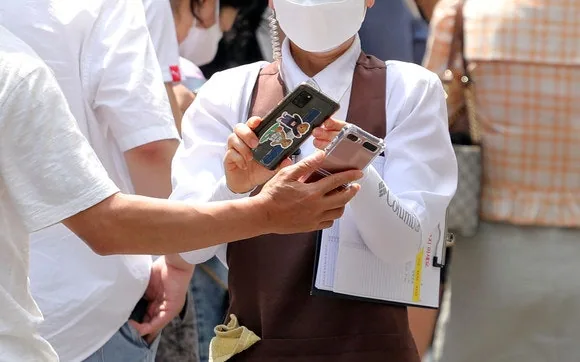
When A visited Jeju in early June, they were urged to install a particular app the moment they stepped off the plane. The app was called Zzeung. The unfamiliar name almost made them walk past, but the staff member's explanation made the point clear.
The staff member said Zzeung is the app required to run Jeju Safe Code, an electronic entry log used only in Jeju and secured by blockchain. Jeju, the staff member explained, has heavy floating population and a great many small restaurants, which made KI-Pass, the national electronic entry log, difficult to operate.
Using KI-Pass in a restaurant means buying a scanner and other equipment, which costs money. Small businesses therefore fell back on handwritten entry logs, and because some visitors did not fill them in, there was a real gap in the quarantine response. Jeju Safe Code, the staff member said, is a COVID-19 response system tailored to that reality.
Under the existing system, you generate a QR code on your phone and the business scans it. In Jeju, users do not have to create a QR code every time, because decentralized identity (DID) technology has been built into it.
So what exactly is DID?
Decentralized identity, or DID, is a technology rooted in blockchain. Your identity information is encrypted and stored on your smartphone, and when personal data needs to be submitted, you choose what to hand over yourself. Because it breaks away from conventional centralized identity verification, it is also called decentralized identification.
Here is how that verification works in Jeju Safe Code. First, Jeju residents and visitors complete identity verification in the Zzeung app installed on their phone. From then on, simply photographing the QR code posted at each business automatically authenticates their entry record.
The DID technology encrypts personal identity and visit records and stores them in distributed form, and the entry records are used only for epidemiological investigation of confirmed cases. Because the technology is blockchain-based, visitor data cannot be forged or altered.
Zzeung is a digital identity service developed by blockchain specialist ICONLOOP, and it uses decentralized identity technology built on MyID. MyID is both the DID consortium that ICONLOOP leads and the name of its DID platform. The platform was designated an Innovative Financial Service by the Financial Services Commission last year in recognition of its security and convenience.
Shinhan Bank simplifies identity checks with DID
Shinhan Bank has taken part in Zzeung since August of last year, the first commercialized DID service in the financial sector. The bank serves as an identity verification authority for Zzeung and has also brought MyID-based DID into its own app, SOL.
For Zzeung's real-name verification, Shinhan Bank verifies a user's identity through mobile phone authentication, account ownership checks and other steps required by the Real Name Financial Transactions Act, then issues the credential. When submitting it to another institution, the user does not repeat any of those steps; a fingerprint check is enough to submit it again and again. Whether the identity data has been tampered with is verified on the blockchain.
A bank official said that once Shinhan Bank provides identity information to Zzeung, users can pull that credential out of the blockchain whenever they need it and use it at other institutions, and that adopting the DID technology also helps relieve the friction in the bank's non-face-to-face operations.
The official added that while SOL already offers non-face-to-face services, the app alone had its limits, because a second identity check at the level of an in-branch visit was sometimes necessary. With Zzeung in place, cumbersome steps such as photographing an ID card can be cut out. Customers who complete identity verification in SOL can skip or simplify identity checks not only for transactions with securities firms, card companies and insurers, but on everyday convenience platforms as well.
If electronic signature technology is added to the identity service, it could also be used as a personal authentication method in place of a certificate, and the various documents required for financial transactions could be sent by mobile without confirmation from the issuing institution, making it more convenient still.
Hyunki Jang, head of Shinhan Bank's Digital R&D Center, said decentralized identity will become the entry point to the digital ID ecosystem that is set to spread, and that it can grow into a platform for managing and trading data, not just personal identity information.
DID commercialization will be quick, driven by public-private cooperation
DID, meanwhile, is expected to be commercialized quickly in the pursuit of data sovereignty.
As the MyData era approaches, in which individuals rather than financial companies control financial data such as bank account and credit card records, DID matters more by the day as the means to exercise full data sovereignty.
DID development in Korea is accordingly in full swing, and the pace picked up markedly starting last year. In April of last year the Financial Security Institute put together a financial security standard for DID, and in the second half of the year the government and private DID consortiums jointly launched a public-private DID council.
That council brought together what are considered the four major DID consortiums: the Initial DID Association (led by SK Telecom), the MyID Alliance (led by ICONLOOP), the DID Alliance (led by Raonsecure) and the MyKeepin Alliance (led by CoinPlug). Financial companies and enterprises belong to each of them.
Article source: http://weekly.cnbnews.com/news/article.html?no=139258