

A look at the government's commitment to the blockchain industry, from the Digital Economy Policy Conference on Innovating with Blockchain.
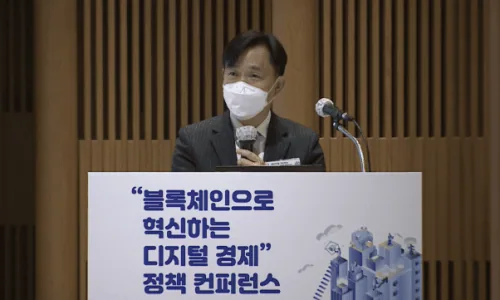
On the 8th, the Digital Economy Policy Conference on Innovating with Blockchain was held to survey the economic and social changes set in motion by COVID-19 and blockchain technology, and to examine policy issues around blockchain and decentralized innovative finance.
In his congratulatory address at the conference, Dohyun Kang, Director General for Information and Communications Policy at the Ministry of Science and ICT (MSIT), said the ministry would do its utmost to uncover success stories that let people feel blockchain technology in their everyday lives, to build a blockchain ecosystem with global competitiveness, and to realize a digital society of trust through blockchain. You can read the full article at the link at the bottom of this post.
MSIT: We Will Build a Globally Competitive Blockchain Ecosystem
We will do our utmost to uncover success stories that let people feel blockchain technology in their everyday lives, to build a blockchain ecosystem with global competitiveness, and to realize a digital society of trust through blockchain.
Dohyun Kang, Director General for Information and Communications Policy at the Ministry of Science and ICT, said this in a congratulatory address at the Digital Economy Policy Conference on Innovating with Blockchain, held both online and offline on the 8th at the Korea Advertising Culture Hall in Jamsil, emphasizing the government's commitment to supporting the blockchain industry.
The event was arranged to survey the economic and social changes set in motion by COVID-19 and blockchain technology, and to examine policy issues related to blockchain and decentralized innovative finance.
Blockchain is the technology by which anonymized participants in the digital world trust one another and assign value
Dohyun Kang, Director General for Information and Communications Policy, Ministry of Science and ICT
Kang also said he believes blockchain has now moved a step closer to a new phase of industrialization.
Blockchain technology has gone into government employee ID cards, so officials no longer need to wear a badge, Kang said, adding that with a variety of applications emerging lately — decentralized identifiers (DID), vaccination certificates, non-fungible tokens (NFT), central bank digital currency (CBDC) and more — expectations for the industry's growth are high.
Turning to the ministry's blockchain support policies, he said MSIT is carrying out the blockchain technology diffusion strategy announced last June. To overcome the limits of blockchain technology, the ministry is investing roughly KRW 120 billion over five years to develop core technologies for faster transactions and large-scale data management, and it is expanding its major pilot projects. It also intends to support demand creation that uncovers a wide range of blockchain services, and it has begun work on improving the laws and regulations that stand in the way of adoption.
- Source: ZDNet Korea
- Original: https://zdnet.co.kr/view/?no=20210408104543
Life Meets Blockchain, ICONLOOP