

Jeju Safe Code, built with blockchain, goes into full operation across the island
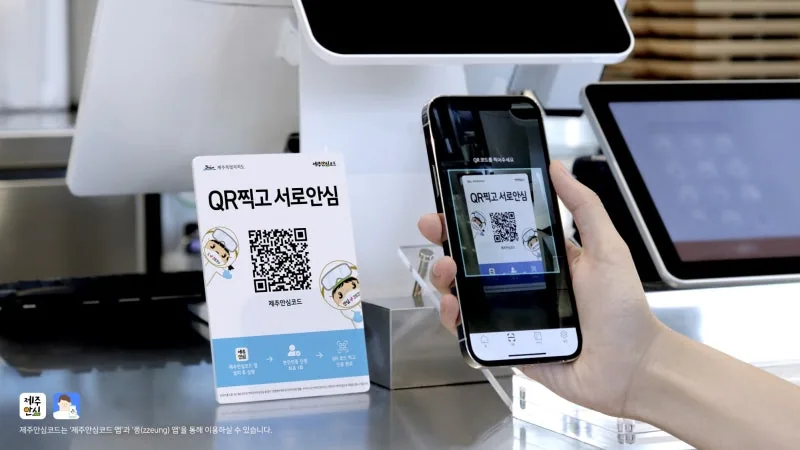
ICONLOOP and Jeju Self-Governing Province are putting Jeju Safe Code, a blockchain-based tourism epidemic response system, into full operation.
Jeju Safe Code was jointly developed by ICONLOOP and Jeju Province under a public-private partnership agreement. Since August it has been used to verify entry at public institutions, while a pilot ran in parallel at a number of businesses, including restaurants near the Jeju Provincial Government offices. On the strength of the positive response to that pilot and the project's clear potential, the system was also announced in October as part of the "safety net reinforcement" initiative within the Jeju New Deal comprehensive plan.
The move to full operation was also on the agenda at this morning's joint COVID-19 briefing, streamed live at 11 a.m. on Jeju Self-Governing Province's YouTube channel. Take a look at the video below for the details.
Replay the Jeju Safe Code segment of the Jeju Self-Governing Province joint COVID-19 briefing ▼
https://youtu.be/BizXQ-26P20?t=627
—
What is Jeju Safe Code?
Jeju Safe Code is a tourism-oriented epidemic response system for Jeju, designed to respond effectively to cluster infections by quickly identifying the places visited by people who test positive for COVID-19 and other infectious diseases, along with their contacts. As Korea's flagship tourist destination, Jeju sees a heavy inflow of outside visitors who, by the nature of tourism, travel widely and frequently visit crowded places such as popular restaurants and attractions. That raises the risk of gaps in the response effort and difficulty in tracing movements when a case emerges, so the goal is to expand entry verification to the places tourists visit most and to build a sustainable epidemic response system optimized for a tourist destination. The plan is also to use blockchain technology to make that system more convenient, faster and safer.

The biggest distinguishing feature of Jeju Safe Code is that, unlike the conventional approach of generating a QR code on the user's phone, visitors scan a QR code posted at the venue — making entry verification fast and simple. Put out several QR codes and a whole group can check in at once, with no waiting and no lines, which improves the visitor experience and reduces the risk of COVID-19 transmission. It is easy on business owners too: no separate terminal and no app installation, just a printed QR code on display.
Another strength of the system is that blockchain technology makes visitor records impossible to forge or alter. When you use Jeju Safe Code, your identity information and visit records are encrypted and stored in distributed form, and the entry verification data is used solely for epidemiological investigation of confirmed cases. You can also check your own entry verification history yourself.
The system consists of three parts: the Jeju Safe Code app, the Jeju Safe Code issued via DID through ICONLOOP's DID identity verification service Zzeung, and a dedicated epidemiological investigation system for Jeju Province. The Jeju Safe Code app, released by Jeju Province to operate and scale the system effectively, requires no separate sign-up — simply photograph the QR code posted at the venue with your phone and entry verification is done. Beyond entry verification, the app will add a variety of features and content designed to let tourists enjoy their trip in a safer environment, such as visitor surveys on how well venues are following health protocols, sharing of prevention information, and the selection and promotion of businesses with exemplary practices.
You can also use the system through Zzeung, ICONLOOP's DID identity verification app. Photograph the QR code posted at the venue with the camera inside the Zzeung app and a Jeju Safe Code is issued on a DID basis and stored on your phone, letting you verify entry at the venue without exposing any personal information. DID (Decentralized Identifier) is a self-sovereign approach to authentication in which individuals manage their own data directly — a blockchain-based identity verification technology that stores verified personal information on the user's phone so that, when verification is needed, only the necessary pieces can be selected and submitted with ease. Because Zzeung lets users submit their personal information directly to the health authorities with no third-party intermediary, it reduces the risk of data leakage and privacy infringement.
Go to the Zzeung service site ▼

Zzeung
Zzeung, ICONLOOP's DID identity verification service, covers everything from real-name verification to visit verification and credential verification. After becoming the first service in Korea to apply DID to real-name verification in the financial sector together with Shinhan Bank, it has continued to widen its reach with projects such as Jeju Safe Code and the blockchain-based integrated chronic disease management platform for Gangwon Province.
The dedicated epidemiological investigation system for Jeju Province, meanwhile, makes it possible to pull up a confirmed case's visit records together with a list of the contacts who were at the same place at the same time, all at once — enabling rapid identification and tracing of secondary and subsequent infections.
Some 800 businesses on the island have already completed their registration applications for Jeju Safe Code, a sign of how much owners are looking forward to the service. Businesses can apply for registration through the COVID-19 situation room on the Jeju Provincial Government website.
Go to the COVID-19 situation room on the Jeju Provincial Government website ▼

At a time when COVID-19 is changing so much of what we once took for granted in everyday life, ICONLOOP will keep working to make sure blockchain technology plays its part in building a safer and more trustworthy world.