

ICONLOOP and Gangwon Province begin the pilot of a blockchain-based chronic disease management platform.
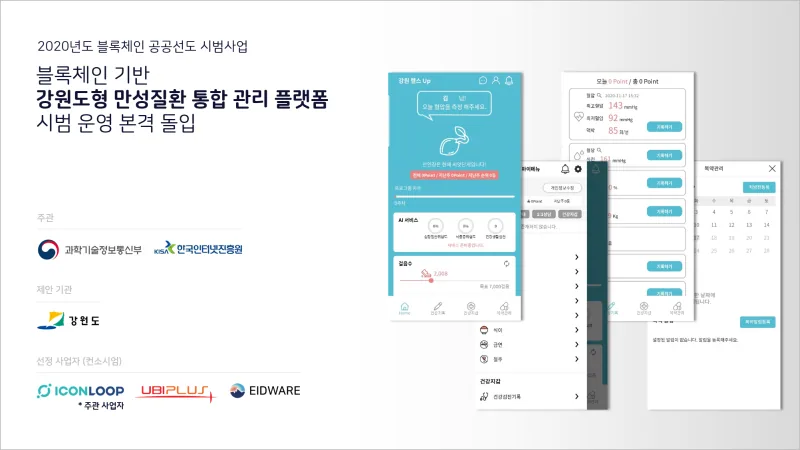
ICONLOOP has started the pilot run of the "Blockchain-Based Gangwon Chronic Disease Integrated Management Platform" together with Gangwon Province. The platform is the outcome of the healthcare project among the ten tasks in the 2020 Blockchain Public Sector Pilot Program hosted by the Ministry of Science and ICT (MSIT) and the Korea Internet & Security Agency (KISA) — a consortium led by ICONLOOP was selected for the project and has been developing it ever since.
The pilot runs for about four weeks, from November 9 to December 4, and covers 100 chronic disease patients registered with the Gaesu and Geomun primary health care posts in Pyeongchang. Participants have each been given four kinds of IoMT (medical IoT) devices — a blood pressure monitor, a blood glucose meter, a scale, and a smart band (activity tracker) — and are using them to try the platform.
The biometric readings taken with those devices are analyzed by AI, and on the basis of that analysis and prediction each participant receives a personalized self-care service specialized for cardio-cerebrovascular disease: health information, lifestyle information, feedback from the institutions, coaching, and more. The record of what has been provided to each user is managed on the blockchain, more transparently and more securely.
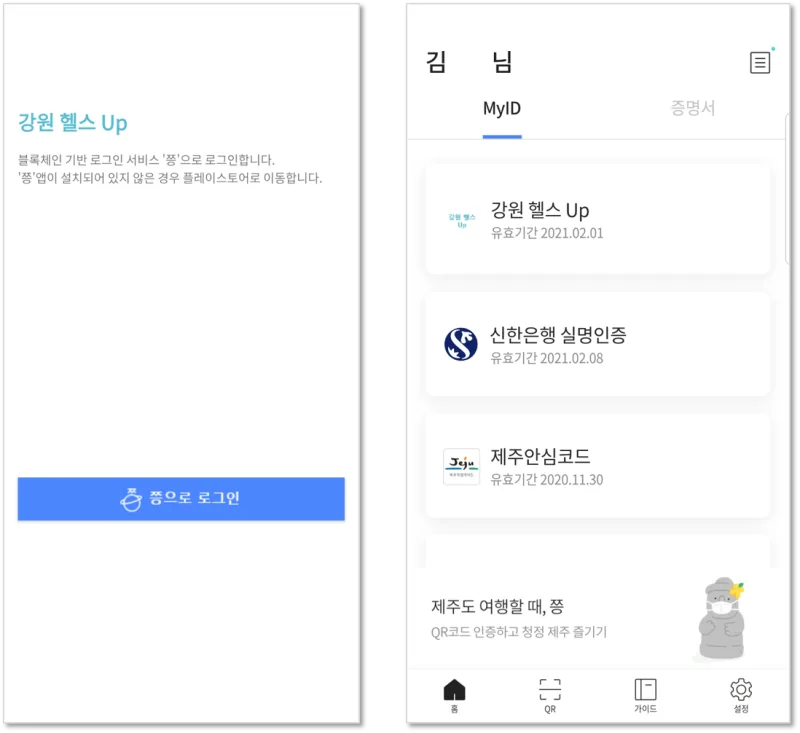
The most noteworthy thing about the "Gangwon Chronic Disease Integrated Management Platform" is that DID (Decentralized ID) has been applied to it. Users log in and verify their identity through Zzeung, ICONLOOP's DID-based identity verification service, and a credential (VC) certifying that the holder is a registered chronic disease patient is issued as a DID. That credential is what verifies eligibility when the management service is used, so only the patient in question can receive the service meant for them. With the DID they have been issued, users can also directly manage and control their previously stored personal health data whenever it has to be submitted to a third-party institution.
—
What DID does here
- A means of authentication for logging into the app
- Issuing the credential that certifies a registered chronic disease patient
- A means of authentication when personal data is passed to a third-party institution
In other words, DID technology gives patients the "right to self-determination over personal data" — the ability to manage and control ownership of their own data directly — along with the "right to data portability," which lets them permit third parties to receive and manage their information. That is exactly the groundwork for MyData, a topic drawing steady attention lately.
—
What is MyData?
- It refers to the process by which individuals actively manage and control their own information,
- and go on to put that information to active use in areas such as credit or asset management.
- It lets you check, all at once, the information about you that is scattered across various institutions and companies,
- and lets you provide your information to businesses so they can recommend tailored products or services.
- Source: excerpted from the Naver Current Affairs Dictionary
Once this pilot puts DID infrastructure in place, we can look forward to it expanding into many other areas beyond healthcare. ICONLOOP will keep working with institutions and partners to build a world where sovereignty over data returns to the individual.