

Ship owners can now show the ship inspection certificate stored on their phone as a QR code, and agency officers can verify on the spot whether it is authentic and valid.
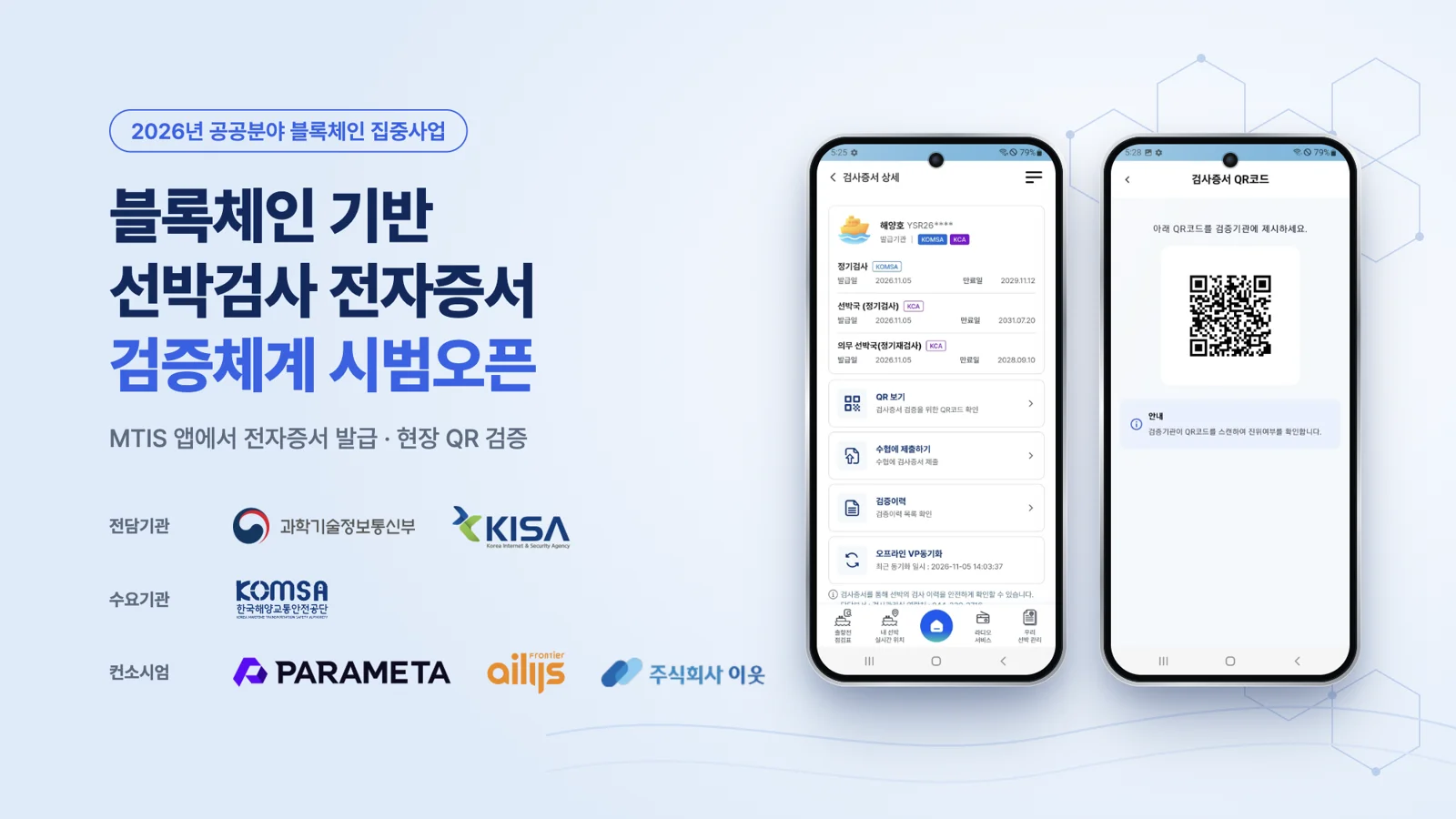
PARAMETA has opened a trial of the Blockchain-based Ship Inspection Certificate Verification System, which it is building with the Korea Maritime Transportation Safety Authority (KOMSA), on the Maritime Transportation Safety Information System (MTIS) app. The project is part of the 2026 Public Sector Blockchain Program led by the Ministry of Science and ICT and the Korea Internet & Security Agency (KISA).
KOMSA is a quasi-governmental agency under Korea’s Ministry of Oceans and Fisheries, dedicated to safety at sea. It was launched in July 2019, when the Korea Maritime Transportation Safety Authority Act took effect, by expanding the Korea Ship Safety Technology Authority, which had carried out ship inspections. Acting on authority delegated by the Minister of Oceans and Fisheries, KOMSA conducts ship inspections and issues inspection certificates. It also manages the safe operation of passenger ships, provides maritime safety education, and operates MTIS. In other words, KOMSA is the agency that issues the very certificates this system verifies.
A certificate checked more than 560,000 times a year
A ship inspection certificate is an official document proving that a vessel has passed its safety inspection, and every vessel must carry one. Vessels subject to inspection include 5,700 general vessels and 63,800 fishing vessels.
The certificate is needed whenever a vessel is registered, operated, insured, or sold. The Korea Coast Guard, the National Federation of Fisheries Cooperatives (Suhyup), the Korea Communications Agency (KCA), local governments and others check it more than about 560,000 times a year.
KOMSA has issued ship inspection certificates on paper and as PDF documents. But for an agency receiving a certificate to know whether it is still valid, it often had to ask the issuing agency’s inspectors again. Many places check the certificate, yet the basis for judging its authenticity existed only at the issuing agency.
Changing verification, not issuance
The new system does not change how certificates are issued. It changes how they are verified once received.
1. Ship owners keep their ship inspection certificates in the certificate wallet of the MTIS app.
2. When a certificate is needed, they show a QR code in the app.
3. When an authorized agency officer scans the QR code, the certificate’s authenticity and validity are confirmed on the spot using information recorded on the blockchain.
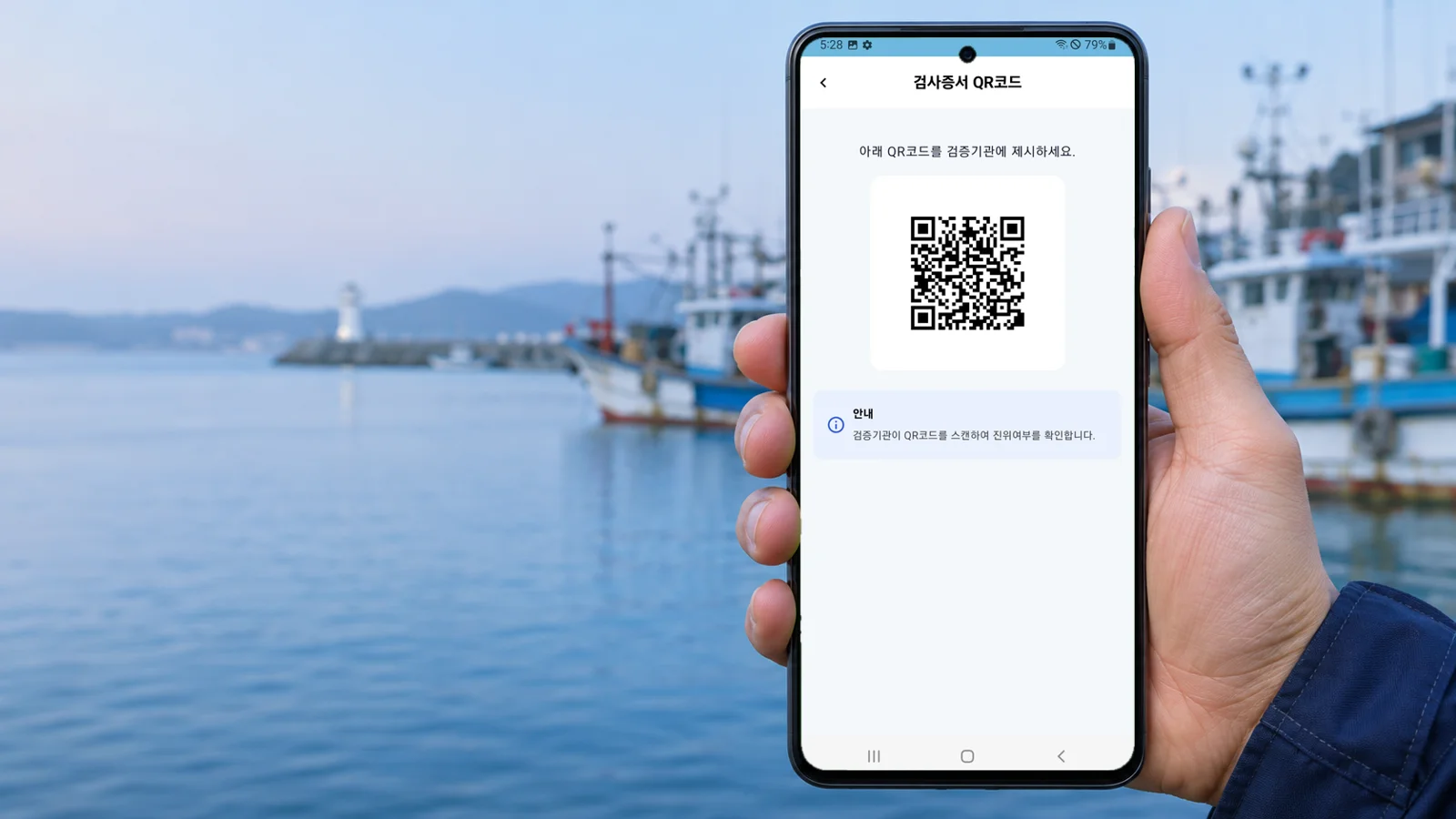
Several agencies can rely on the same information without asking the issuing agency again. Ship owners can also see in the app who checked their certificate and when. Paper certificates stay in use, and owners keep a copy on their phones as well.
You can see how the system works in the introduction video below.
Even at sea, out of network range
Network connections often drop on board. So the system lets users open and verify certificates even at sea where the connection is poor. Verifications made offline are reflected once the connection returns.
When verifying with a QR code, both the ship owner and the agency officer need Bluetooth turned on.
Built on MyID 2.0
The system runs on PARAMETA’s MyID 2.0. MyID 2.0 is a shared public blockchain infrastructure that lets agencies adopt decentralized identity (DID) and blockchain-based services by subscription, without building their own infrastructure. Decentralized identity means the holder keeps their own certificates and shows only what is needed, only where it is needed. MyID 2.0 was the first blockchain service to receive the Cloud Security Assurance Program (CSAP) certification.
PARAMETA leads the project, with AI company Ailys Frontier handling AI-based anomaly detection and Q&A, and MTIS app operator Iut handling app integration.
Following the 2021 Blockchain-based Ship Inspection Management Platform project with KCA and Suhyup, PARAMETA is now working with KOMSA, the agency that issues ship inspection certificates, to expand certificate verification in the maritime sector. The goal is a structure where ship owners manage their own inspection information and multiple agencies can trust and use it together.
How to start and trial events
On the MTIS app home screen, tap “Certificate Status,” agree to the notice, and create a certificate wallet (the “Create Wallet” button in the app). Set a PIN and you are ready. Follow the steps in the video below.
A guide for agency officers is in the video for verifying agencies, and the full app flow is in the demo video. The videos are in Korean.
To celebrate the trial opening, two events start on November 24, 2026. In the “Mobile Ship Document Folder” event, the first 500 ship owners who create a certificate wallet will receive a gift. In the “e-Certificate CHECK 100” event, running until December 11, agency officers are entered automatically once they verify at least one e-certificate QR code in the MTIS app. Details are in the MTIS app notice.
For inquiries, contact the KOMSA Inspection Management Office (+82-44-330-2716).
Are you reviewing how to issue and verify certificates?
PARAMETA’s MyID 2.0 helps public agencies adopt blockchain-based certificate issuance and verification without building their own infrastructure. If you are considering it, please contact PARAMETA.